

'TI IRHIJLEKT ATMOSPtIEKI(' DIFFUSION
15
and of the evolution of the temperature of the ground:
T O I ) = g ( r )
supposing that ; . : . ( z. t ) had a constant value 7:. Taking as a numerical
exam p le
f ( ~ )
= -8; + To, g ( t ) = Bt + To
for 7: = 200 cm2 sec- I , the computations gave the basis of the inversion at
11 = 1 m for i = 38 min 20 sec after sunrise. The general dflusion equation
(5.3) has been considered under much less restrictive conditions than (a)-(c),
leading to Eq. (5.6). In particular, let us suppose
-
u = const,
ii = 3i; = 0
and let us introduce the three turbulent diffusion coefficients defined by
(S.8a)
(7ijiT.y = - u's'
I
(5.8b)
~
ds/ay = - v ~ s ~
4 &/(-z = --Is'
(5%)
IS. I
__ -
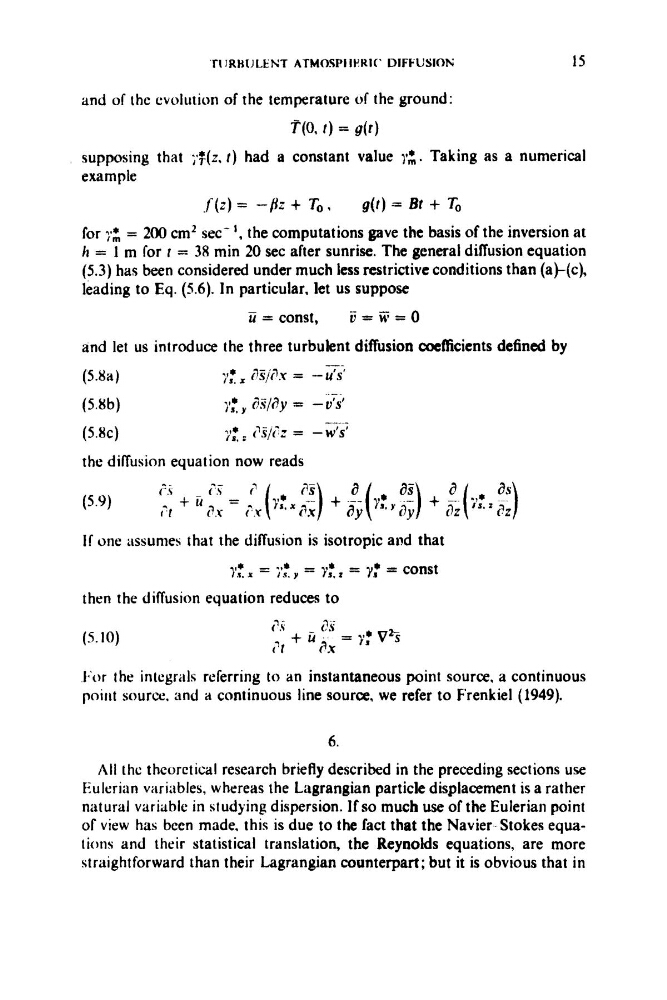
the diffusion equation now reads
If m e assumes that the diffusion is isotropic ai?d that
7,: I = 7. : = 7: I = y
: = const
then the diffusion equation reduces to
(5.10)
I;or the integrals referring to an instantaneous point source, a continuous
point source, and a continuous line source, we refer to Frenkiel (1949).
6.
A11 thc thcorctical research briefly described in the preceding sections use
Eulerinn variables, whereas the Lagrangian particle displacement is a rather
natural variable in studying dispersion. lfso much use of the Eulerian point
of view has been made. this is due to the fact that the Navier-Stokes equalions and their statistical translation, the Reynolds equations, are more
straightforward than their Lagrangian counterpart; but it is obvious that in
15
and of the evolution of the temperature of the ground:
T O I ) = g ( r )
supposing that ; . : . ( z. t ) had a constant value 7:. Taking as a numerical
exam p le
f ( ~ )
= -8; + To, g ( t ) = Bt + To
for 7: = 200 cm2 sec- I , the computations gave the basis of the inversion at
11 = 1 m for i = 38 min 20 sec after sunrise. The general dflusion equation
(5.3) has been considered under much less restrictive conditions than (a)-(c),
leading to Eq. (5.6). In particular, let us suppose
-
u = const,
ii = 3i; = 0
and let us introduce the three turbulent diffusion coefficients defined by
(S.8a)
(7ijiT.y = - u's'
I
(5.8b)
~
ds/ay = - v ~ s ~
4 &/(-z = --Is'
(5%)
IS. I
__ -
the diffusion equation now reads
If m e assumes that the diffusion is isotropic ai?d that
7,: I = 7. : = 7: I = y
: = const
then the diffusion equation reduces to
(5.10)
I;or the integrals referring to an instantaneous point source, a continuous
point source, and a continuous line source, we refer to Frenkiel (1949).
6.
A11 thc thcorctical research briefly described in the preceding sections use
Eulerinn variables, whereas the Lagrangian particle displacement is a rather
natural variable in studying dispersion. lfso much use of the Eulerian point
of view has been made. this is due to the fact that the Navier-Stokes equalions and their statistical translation, the Reynolds equations, are more
straightforward than their Lagrangian counterpart; but it is obvious that in