

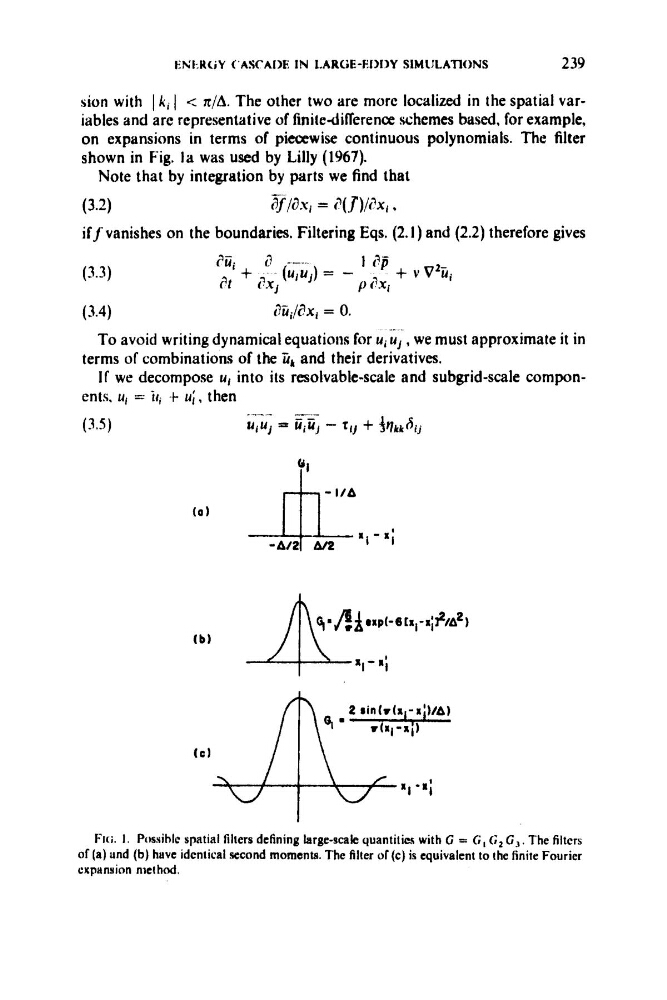
sion with I k , I < n/A. The other two arc more localized in the spatial variables and arc representative of finitedifl'erence schemes based, for example,
on expansions in terms of piecewise continuous polynomials. The filter
shown in Fig. la was used by Lilly (1967).
Note that by integration by parts we find that
(3.2)
q @ X i = ? ( . f ) / C X i .
iff vanishes on the boundaries. Filtering Eqs. (2.1) and (2.2) therefore gives
(3.3)
&ji
(7
1 cjj5
?t
iix,
p ?.Xi
+ (U&) = - + v VZU,
(3.4)
1?Ei/i?Xi = 0.
To avoid writing dynamical equations for uiu,, we must approximate it in
I f we decompose ui into its resolvable-scale and subgrid-scale componterms of combinations of the Dk and their derivatives.
ents. ui = iri -t u;, then
(3.5)
( 0 )
t '
FIG. I . Possihlc spatial filters defining hrge-scale quantities with G = G, G2 G,. The filters
of (a) und (b) have identical second moments. The filter or (c) is equivalent to the finite Fourier
expansion method.
on expansions in terms of piecewise continuous polynomials. The filter
shown in Fig. la was used by Lilly (1967).
Note that by integration by parts we find that
(3.2)
q @ X i = ? ( . f ) / C X i .
iff vanishes on the boundaries. Filtering Eqs. (2.1) and (2.2) therefore gives
(3.3)
&ji
(7
1 cjj5
?t
iix,
p ?.Xi
+ (U&) = - + v VZU,
(3.4)
1?Ei/i?Xi = 0.
To avoid writing dynamical equations for uiu,, we must approximate it in
I f we decompose ui into its resolvable-scale and subgrid-scale componterms of combinations of the Dk and their derivatives.
ents. ui = iri -t u;, then
(3.5)
( 0 )
t '
FIG. I . Possihlc spatial filters defining hrge-scale quantities with G = G, G2 G,. The filters
of (a) und (b) have identical second moments. The filter or (c) is equivalent to the finite Fourier
expansion method.