

238
A. I.I:ONARO
2. PROBLEM OF N( IMFRIC'AI. SIMULATION
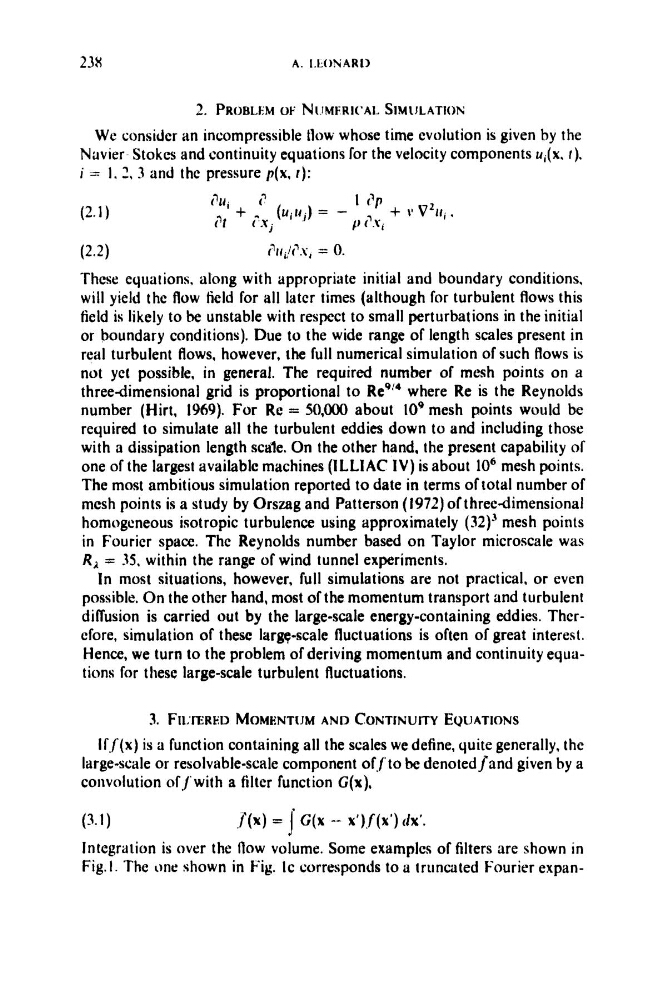
We consider an incompressible How whose time evolution is given by the
Nuvier- Stokes and continuity equations for the velocity components ui(x. 1).
i = 1. 2, 3 and the pressure p(x, I ) :
(2.1 )
(2.2)
f'rricls, = 0.
These equations. along with appropriate initial and boundary conditions,
will yield the flow field for all later times (although for turbulent Hows this
field is likely to be unstable with respect to small perturbations in the initial
or boundary conditions). Due to the wide range of length scales present in
real turbulent flows, however, the full numerical simulation of such flows is
not yet possible, in general. The required number of mesh points on a
threedimensional grid is proportional to ReP'* where Re is the Reynolds
number (Hirt, 1969). For Re = 50,000 about lo9 mesh points would be
required to simulate all the turbulent eddies down to and including those
with a dissipation length scale. On the other hand, the present capability of
one of the largest available machines (ILLIAC IV) is about lo6 mesh points.
The most ambitious simulation reported to date in terms of total number of
mesh points is a study by Orszag and Patterson (1972) of threedimensional
homogcneous isotropic turbulence using approximately ( 32)3 mesh points
in Fourier space. The Reynolds number based on Taylor microscale was
R A = 35. within the range of wind tunnel experiments.
In most situations, however, full simulations are not practical, or even
possible. On the other hand, most of the momentum transport and turbulent
diffusion is carried out by the large-scale energy-containing eddies. Thcrefore, simulation of these largpscale fluctuations is often of great interest.
Hence, we turn to the problem of deriving momentum and continuity equations for these large-scale turbulent fluctuations.
3. FII;IFRED MOMENT~JM A N D CONTINUITY EQUATIONS
If.f(x) is a function containing all the scales we define, quite generally, the
large-scale or resolvable-scale component ofj'to be denotedfand given by a
convolution offwith a filter function G(x),
(3.1)
,f(x) = G(x - x ' ) ~ ( x ' )
tlx'.
Integration is over the flow volume. Some examples of filters are shown in
Fig.1. The one shown in Fig. Ic corresponds to truncated Fourier expan-
A. I.I:ONARO
2. PROBLEM OF N( IMFRIC'AI. SIMULATION
We consider an incompressible How whose time evolution is given by the
Nuvier- Stokes and continuity equations for the velocity components ui(x. 1).
i = 1. 2, 3 and the pressure p(x, I ) :
(2.1 )
(2.2)
f'rricls, = 0.
These equations. along with appropriate initial and boundary conditions,
will yield the flow field for all later times (although for turbulent Hows this
field is likely to be unstable with respect to small perturbations in the initial
or boundary conditions). Due to the wide range of length scales present in
real turbulent flows, however, the full numerical simulation of such flows is
not yet possible, in general. The required number of mesh points on a
threedimensional grid is proportional to ReP'* where Re is the Reynolds
number (Hirt, 1969). For Re = 50,000 about lo9 mesh points would be
required to simulate all the turbulent eddies down to and including those
with a dissipation length scale. On the other hand, the present capability of
one of the largest available machines (ILLIAC IV) is about lo6 mesh points.
The most ambitious simulation reported to date in terms of total number of
mesh points is a study by Orszag and Patterson (1972) of threedimensional
homogcneous isotropic turbulence using approximately ( 32)3 mesh points
in Fourier space. The Reynolds number based on Taylor microscale was
R A = 35. within the range of wind tunnel experiments.
In most situations, however, full simulations are not practical, or even
possible. On the other hand, most of the momentum transport and turbulent
diffusion is carried out by the large-scale energy-containing eddies. Thcrefore, simulation of these largpscale fluctuations is often of great interest.
Hence, we turn to the problem of deriving momentum and continuity equations for these large-scale turbulent fluctuations.
3. FII;IFRED MOMENT~JM A N D CONTINUITY EQUATIONS
If.f(x) is a function containing all the scales we define, quite generally, the
large-scale or resolvable-scale component ofj'to be denotedfand given by a
convolution offwith a filter function G(x),
(3.1)
,f(x) = G(x - x ' ) ~ ( x ' )
tlx'.
Integration is over the flow volume. Some examples of filters are shown in
Fig.1. The one shown in Fig. Ic corresponds to truncated Fourier expan-