

2 34
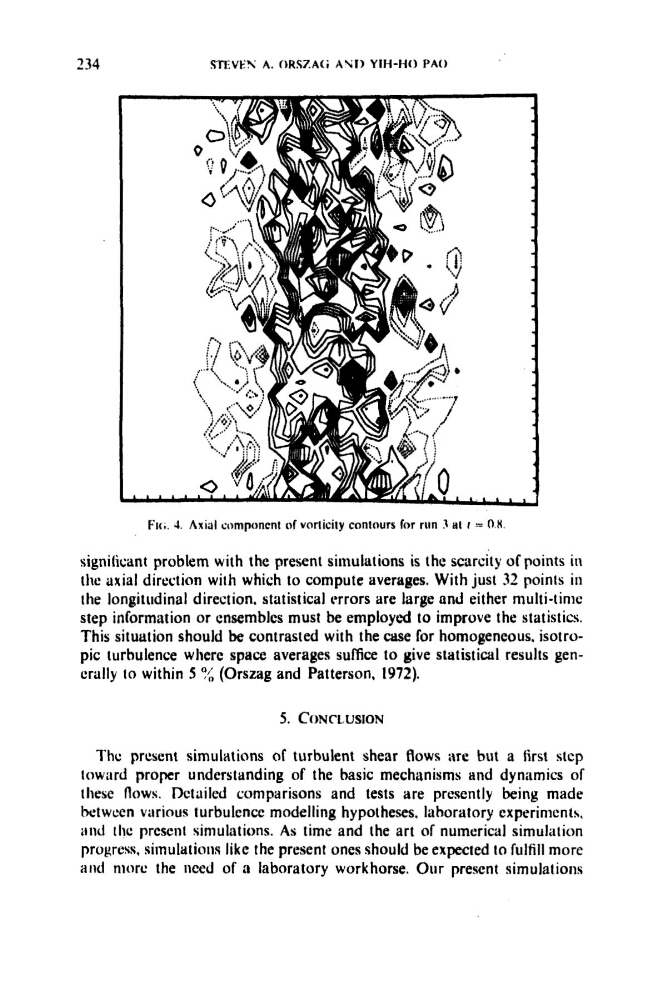
STEVEN A. ORSI.A Fic;. 4. Axial componcnt of vorlicity contours for run 3 81 I = 0.8.
signilkant problem with the present siinulutions is the scarcity of points in
the axial direction with which to compute averages. With just 32 points in
the longitudinal direction. statistical errors are large and either multi-time
step information or ensembles must be employtd to improve the statistics.
This situation should be contrasted with the w e for homogeneous. isotropic turbulence wlierc space averages suffice to give statistical results generally to within 5 n(, (Orszag and Patterson, 1972).
5. CONCLUSION
The present simulations of turbulent shear flows itre but a first step
tOwiJrd proper understanding of the basic mechanisms and dynamics of
lhese flows. Dctailcd comparisons and tests are presently being made
betwcen ViJriOUS turbulence modelling hypotheses, laboratory cxperimcnts,
and lhc present simulations. As time and the art of numerical sirnulalion
progress, simulations like the present ones should be expected to fultill more
atid niorc the ricecl of ;I laboratory workhorse. Our present simulations
STEVEN A. ORSI.A Fic;. 4. Axial componcnt of vorlicity contours for run 3 81 I = 0.8.
signilkant problem with the present siinulutions is the scarcity of points in
the axial direction with which to compute averages. With just 32 points in
the longitudinal direction. statistical errors are large and either multi-time
step information or ensembles must be employtd to improve the statistics.
This situation should be contrasted with the w e for homogeneous. isotropic turbulence wlierc space averages suffice to give statistical results generally to within 5 n(, (Orszag and Patterson, 1972).
5. CONCLUSION
The present simulations of turbulent shear flows itre but a first step
tOwiJrd proper understanding of the basic mechanisms and dynamics of
lhese flows. Dctailcd comparisons and tests are presently being made
betwcen ViJriOUS turbulence modelling hypotheses, laboratory cxperimcnts,
and lhc present simulations. As time and the art of numerical sirnulalion
progress, simulations like the present ones should be expected to fultill more
atid niorc the ricecl of ;I laboratory workhorse. Our present simulations