

NUMERICAL. COMPCITATION OF TURBULENT SHEAR FLOWS
235
0 3
0.2
0. I
0
1
1
I
1
1
I
1
2
3
4
5
8
7
8
9
1 0
D
D
3 ~ y ( t - g )
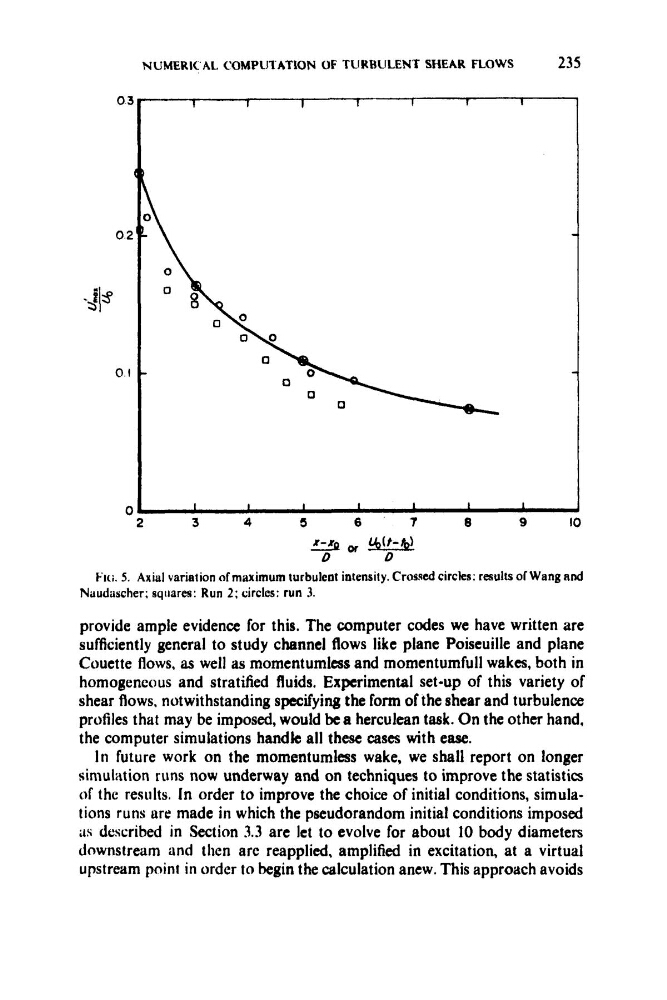
FIG. 5. Axiul variation of maximum turbulent intensity. Crossed circles: results of Wang and
Naudascher; squares: Run 2: circles: run 3.
provide ample evidence for this. The computer codes we have written are
sufficiently general to study channel flows like plane Poiseuille and plane
Couette flows, as well as momentumless and momentumfull wakes, both in
homogeneous and stratified fluids. Experimental set-up of this variety of
shear flows. notwithstanding specifying the form of the shear and turbulence
profiles that may be imposed, would be a herculean task. On the other hand,
the computer simulations handle all these cases with ease.
In future work on the momentumless wake, we shall report on longer
simulation runs now underway and on techniques to improve the statistics
of the results. In order to improve the choice of initial conditions, simulations runs are made in which the pseudorandom initial conditions imposed
ils described in Section 3.3 are let to evolve for about 10 body diameters
downstream and then arc reapplied, amplified in excitation, at a virtual
upstream point in order to begin the calculation anew. This approach avoids
235
0 3
0.2
0. I
0
1
1
I
1
1
I
1
2
3
4
5
8
7
8
9
1 0
D
D
3 ~ y ( t - g )
FIG. 5. Axiul variation of maximum turbulent intensity. Crossed circles: results of Wang and
Naudascher; squares: Run 2: circles: run 3.
provide ample evidence for this. The computer codes we have written are
sufficiently general to study channel flows like plane Poiseuille and plane
Couette flows, as well as momentumless and momentumfull wakes, both in
homogeneous and stratified fluids. Experimental set-up of this variety of
shear flows. notwithstanding specifying the form of the shear and turbulence
profiles that may be imposed, would be a herculean task. On the other hand,
the computer simulations handle all these cases with ease.
In future work on the momentumless wake, we shall report on longer
simulation runs now underway and on techniques to improve the statistics
of the results. In order to improve the choice of initial conditions, simulations runs are made in which the pseudorandom initial conditions imposed
ils described in Section 3.3 are let to evolve for about 10 body diameters
downstream and then arc reapplied, amplified in excitation, at a virtual
upstream point in order to begin the calculation anew. This approach avoids