

Thib choice of boundary conditions in the .yj direction is necessitated by the
fact thilt our computer codes are written to solve also the Boussinesq equations of motion ofa stratified fluid for which the x 3 direction is singled as the
direction of gravity and the equations of shear flows in a channel with rigid
top and bottom boundaries.
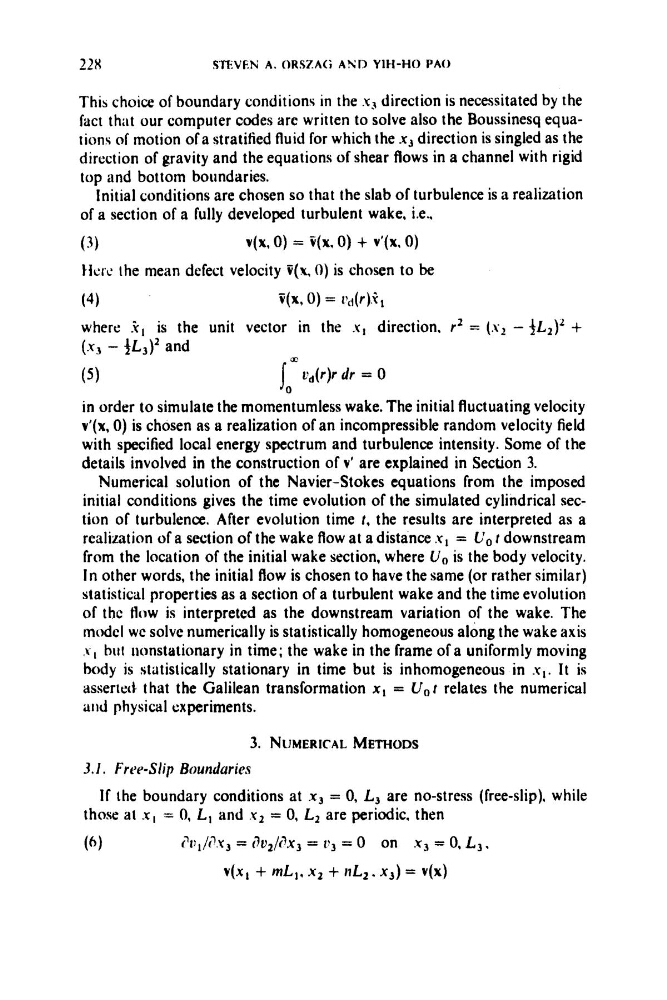
Initial conditions are chosen so that the slab of turbulence is a realization
of a section of a fully developed turbulent wake, i.e..
(3)
v(x, 0) = q x , 0) + v'(x. 0)
Hcrc the mean dcfect velocity V(u, 0) is chosen to be
(4)
B(x, 0) = i>d(r)t,
where .iC, is the unit vector in the .vI direction, r 2 = (s2 - +L2)' +
(.x3 - fL3)2 and
( 5 )
lom u,,(r)r dr = o
in order to simulate the momentumless wake. The initial fluctuating velocity
v'(x, 0) is chosen as a realization of an incompressible random velocity field
with specified local energy spectrum and turbulence intensity. Some of the
details involved in the construction of v' are explained in Section 3.
Numerical solution of the Navier-Stokes equations from the imposed
initial conditions gives the time evolution of the simulated cylindrical section of turbulence. After evolution time t, the results are interpreted as a
realization of a section of the wake flow at a distance .Y I = U0 t downstream
from the location of the initial wake section, where U 0 is the body velocity.
In other words, the initial flow is chosen to have the same (or rather similar)
statistical properties as a section of a turbulent wake and the time evolution
of thc flow is interpreted as the downstream variation of the wake. The
model wc solve numerically is statistically homogeneous along the wake axis
t I but iicinstationary in time; the wake in the frame ofa uniformly moving
body is statislically stationary in time but is inhomogeneous in .xl. It is
asserted that the Galilean transformation xI = U, r relates the numerical
arid physical experiments.
3. NCJMERICAL METHODS
3.1. Free-Slip Bounduries
those at x I = 0, L , and .x2 = 0, L2 are periodic. then
( 6 )
( ' I I ~ / ~ ! Y ~ = h2/(7x3 = 1'3 = 0 on x3 = 0, L 3 .
If the boundary conditions at x3 = 0, L3 are no-stress (free-slip). while
v(xI + mL,, x2 + nL2. x3) = v(x)
fact thilt our computer codes are written to solve also the Boussinesq equations of motion ofa stratified fluid for which the x 3 direction is singled as the
direction of gravity and the equations of shear flows in a channel with rigid
top and bottom boundaries.
Initial conditions are chosen so that the slab of turbulence is a realization
of a section of a fully developed turbulent wake, i.e..
(3)
v(x, 0) = q x , 0) + v'(x. 0)
Hcrc the mean dcfect velocity V(u, 0) is chosen to be
(4)
B(x, 0) = i>d(r)t,
where .iC, is the unit vector in the .vI direction, r 2 = (s2 - +L2)' +
(.x3 - fL3)2 and
( 5 )
lom u,,(r)r dr = o
in order to simulate the momentumless wake. The initial fluctuating velocity
v'(x, 0) is chosen as a realization of an incompressible random velocity field
with specified local energy spectrum and turbulence intensity. Some of the
details involved in the construction of v' are explained in Section 3.
Numerical solution of the Navier-Stokes equations from the imposed
initial conditions gives the time evolution of the simulated cylindrical section of turbulence. After evolution time t, the results are interpreted as a
realization of a section of the wake flow at a distance .Y I = U0 t downstream
from the location of the initial wake section, where U 0 is the body velocity.
In other words, the initial flow is chosen to have the same (or rather similar)
statistical properties as a section of a turbulent wake and the time evolution
of thc flow is interpreted as the downstream variation of the wake. The
model wc solve numerically is statistically homogeneous along the wake axis
t I but iicinstationary in time; the wake in the frame ofa uniformly moving
body is statislically stationary in time but is inhomogeneous in .xl. It is
asserted that the Galilean transformation xI = U, r relates the numerical
arid physical experiments.
3. NCJMERICAL METHODS
3.1. Free-Slip Bounduries
those at x I = 0, L , and .x2 = 0, L2 are periodic. then
( 6 )
( ' I I ~ / ~ ! Y ~ = h2/(7x3 = 1'3 = 0 on x3 = 0, L 3 .
If the boundary conditions at x3 = 0, L3 are no-stress (free-slip). while
v(xI + mL,, x2 + nL2. x3) = v(x)