

I
.I--;
4
1
r
- _
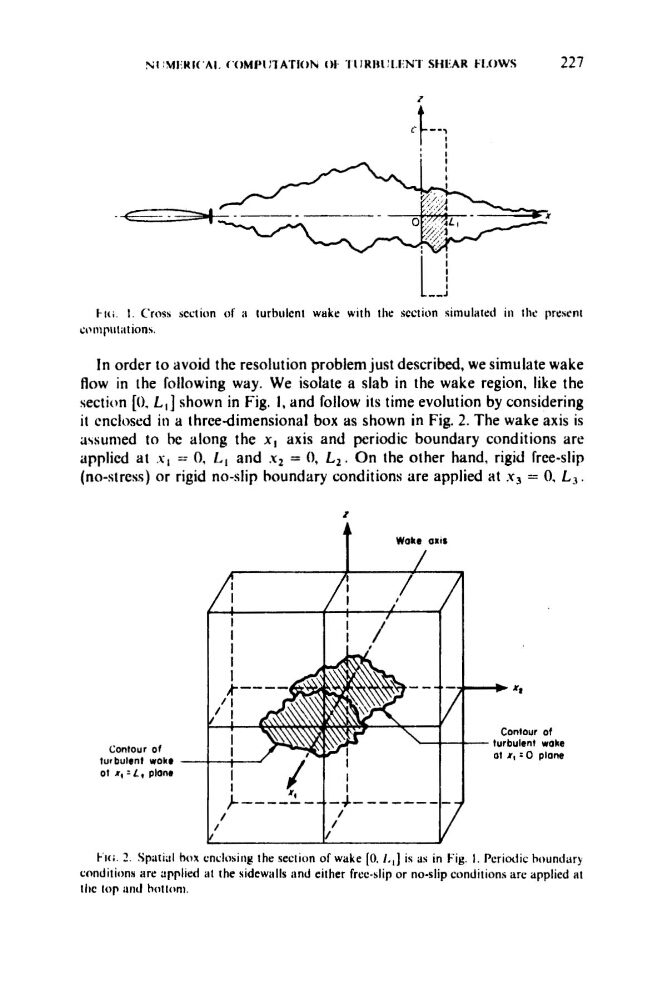
f.t(i. I . Cross section of ;I turbulent wake with the section simulated iri tlis present
scmptit;ition~.
In order to avoid the resolution problem just described, we simulate wake
flow in the following way. We isolate a slab in the wake region, like the
section [O, L,] shown in Fig. 1, and follow its time evolution by considering
it cnclosed in a three-dimensional box as shown in Fig. 2. The wake axis is
awmied to be along the x t axis and periodic boundary conditions are
applied at .st = 0, L , and .x2 = 0, L 2 . On the other hand, rigid free-slip
(no-stress) or rigid no-slip boundary conditions are applied
Contour of
turbulent woke
01 I , = L , plane
I
.)
Wake axis
turbulent woke
Piti. 2. Spatial hox cnclosinp the section of wake (0. /,,I is as in Fig. 1. Periodic houndarp
conditions are applied at the sidewalls and either free-slip or no-slip conditions arc applied at
tltc lop i~nd hottom.
.I--;
4
1
r
- _
f.t(i. I . Cross section of ;I turbulent wake with the section simulated iri tlis present
scmptit;ition~.
In order to avoid the resolution problem just described, we simulate wake
flow in the following way. We isolate a slab in the wake region, like the
section [O, L,] shown in Fig. 1, and follow its time evolution by considering
it cnclosed in a three-dimensional box as shown in Fig. 2. The wake axis is
awmied to be along the x t axis and periodic boundary conditions are
applied at .st = 0, L , and .x2 = 0, L 2 . On the other hand, rigid free-slip
(no-stress) or rigid no-slip boundary conditions are applied
Contour of
turbulent woke
01 I , = L , plane
I
.)
Wake axis
turbulent woke
Piti. 2. Spatial hox cnclosinp the section of wake (0. /,,I is as in Fig. 1. Periodic houndarp
conditions are applied at the sidewalls and either free-slip or no-slip conditions arc applied at
tltc lop i~nd hottom.