

flows hiniulatcd at moderatc Reynolds numbers i\rC not very different froin
thosc iit huge Reynolds numbers. I t is also reasonable to assume Regnoldsnumber-independene of large scilles in shear flows proi-itlrtl initial and
botrndary conditions are Reynolds number independent. It seems that Reynolds number dependencies observed in laboratory flows may be ascribed to
variations in initial or boundary conditions; for example, Reynolds number
variations in turbulent jets seem to be mainly due to variations in inlet
conditions (like boundary layer thickness) with Reynolds number.
As a first application of our shear flow turbulence codes. we have simulnted the momentumless wake of ii self-propelled body. As pointed out by
Natldiischer ( 1965), the inomentumless wake bears close relationship to grid
(Iiomogeneous) turbulence, since both are characterized by a very limited
region in which there is significant energy transformation from mean (shear)
How .to turbulence (Reynolds stresses).
In Section 2. we summarize the dynilnlical equations and boundary conditions employed with particular emphasis on the momentumless wake model.
I n Section 3, some novel aspects of the numerical approximation are discussed, while in Section 4, some results are presented for wake turbulence.
Finally, in Section 5. we summarize our results and the future outlook.
2. EQUATIONS OF MOTION
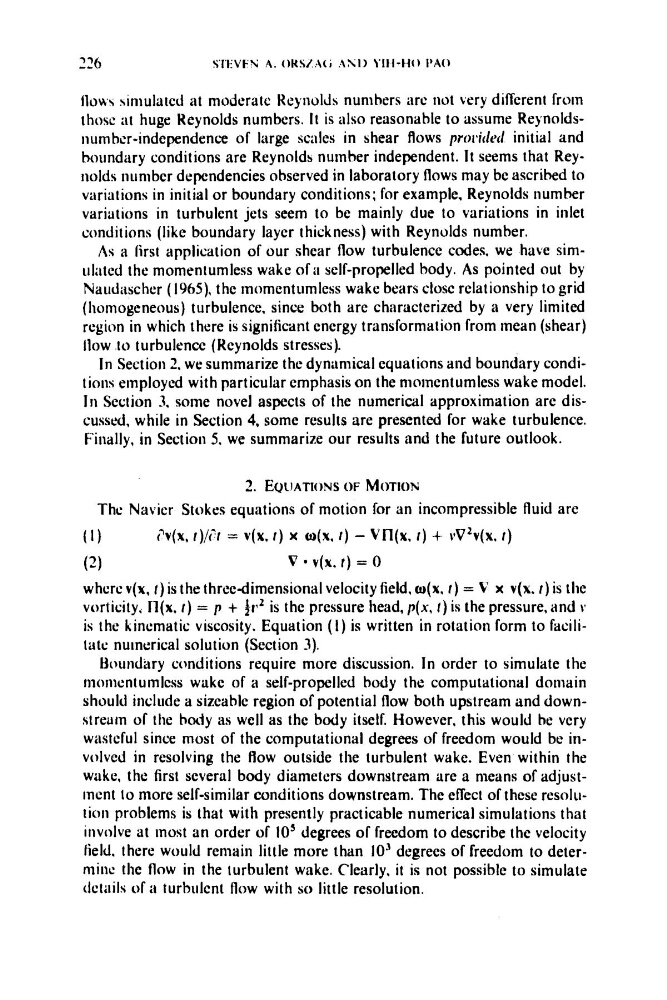
Thc Navier Stokes equations of motion for an incompressible fluid are
( 1 )
(2)
clv(x, [)/A = v(x. x o(x. t ) - vn(x. f ) + \w2v(x. f )
v v(x. 1 ) = 0
where v(x, f ) is the three-dimensional velocity field. o(x. I ) = V x v(x. f ) is the
vorticity. n(x, I ) = p + )I$* is the pressure head, p ( x , I ) is the pressure, and I’
is the hinematic viscosity. Equation ( I ) is written in rotation form to facilitalc nuinerical solution (Section 3).
Boundary conditions require more discussion. In order to simulate the
momcntumlcss wake of a self-propelled body the computational domain
should include a sizeable region of potential flow both upstream and downstream of the body as well as the body itself. However, this would be very
wiistcful since most of the computational degrees of freedom would be involved in resolving the How outside the turbulent wake. Even within the
wake, the first several body diameters downstream are a means of adjustincnt to more self-similar conditions downstream. The effect of these resolut i o n problems is that with presently practicable numerical simulations that
involve at most an order of lo5 degrees of freedom to describe the velocity
field. there would remain little more than lo3 degrees of freedom to deterniinc thc flow in the turbulent wake. Clearly. it is not possible to simulate
tlctilils of a turbulent flow with s o little resolution.
thosc iit huge Reynolds numbers. I t is also reasonable to assume Regnoldsnumber-independene of large scilles in shear flows proi-itlrtl initial and
botrndary conditions are Reynolds number independent. It seems that Reynolds number dependencies observed in laboratory flows may be ascribed to
variations in initial or boundary conditions; for example, Reynolds number
variations in turbulent jets seem to be mainly due to variations in inlet
conditions (like boundary layer thickness) with Reynolds number.
As a first application of our shear flow turbulence codes. we have simulnted the momentumless wake of ii self-propelled body. As pointed out by
Natldiischer ( 1965), the inomentumless wake bears close relationship to grid
(Iiomogeneous) turbulence, since both are characterized by a very limited
region in which there is significant energy transformation from mean (shear)
How .to turbulence (Reynolds stresses).
In Section 2. we summarize the dynilnlical equations and boundary conditions employed with particular emphasis on the momentumless wake model.
I n Section 3, some novel aspects of the numerical approximation are discussed, while in Section 4, some results are presented for wake turbulence.
Finally, in Section 5. we summarize our results and the future outlook.
2. EQUATIONS OF MOTION
Thc Navier Stokes equations of motion for an incompressible fluid are
( 1 )
(2)
clv(x, [)/A = v(x. x o(x. t ) - vn(x. f ) + \w2v(x. f )
v v(x. 1 ) = 0
where v(x, f ) is the three-dimensional velocity field. o(x. I ) = V x v(x. f ) is the
vorticity. n(x, I ) = p + )I$* is the pressure head, p ( x , I ) is the pressure, and I’
is the hinematic viscosity. Equation ( I ) is written in rotation form to facilitalc nuinerical solution (Section 3).
Boundary conditions require more discussion. In order to simulate the
momcntumlcss wake of a self-propelled body the computational domain
should include a sizeable region of potential flow both upstream and downstream of the body as well as the body itself. However, this would be very
wiistcful since most of the computational degrees of freedom would be involved in resolving the How outside the turbulent wake. Even within the
wake, the first several body diameters downstream are a means of adjustincnt to more self-similar conditions downstream. The effect of these resolut i o n problems is that with presently practicable numerical simulations that
involve at most an order of lo5 degrees of freedom to describe the velocity
field. there would remain little more than lo3 degrees of freedom to deterniinc thc flow in the turbulent wake. Clearly. it is not possible to simulate
tlctilils of a turbulent flow with s o little resolution.