

196
J. C. WYNGAAHD ET AL.
tensor falls to zcro. it is
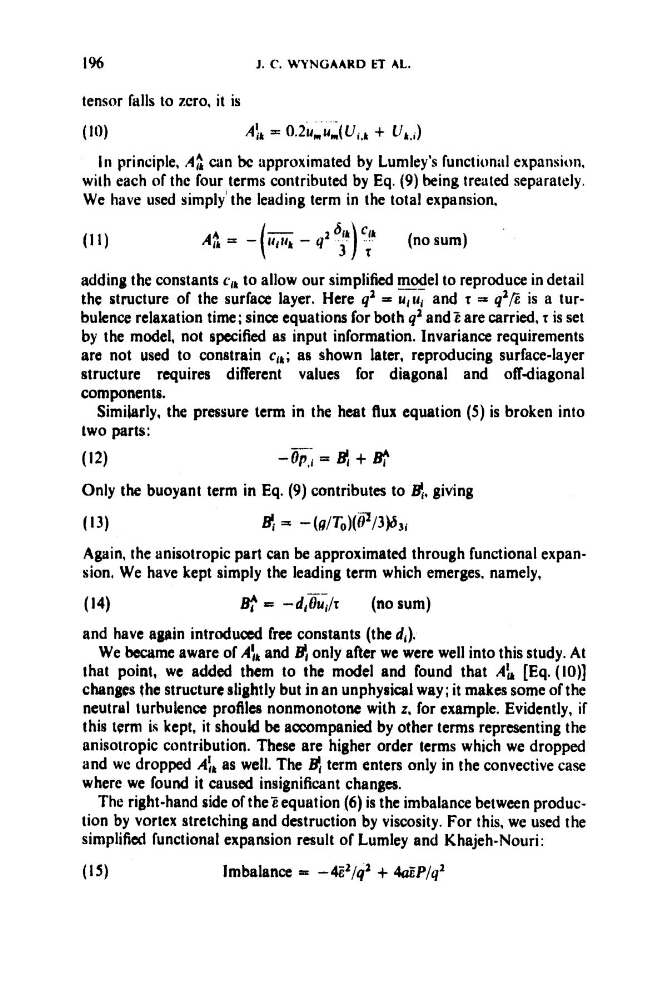
( W
111 principle, A; can bc approximated by Lumley's functionid expansion,
with each of thc four terms contributed by Eq. (9) being treated separately.
We have used simply' the leading term in the total expansion,
(no sum)
adding the constants cIk to allow our simplified model to reproduce in detail
the structure of the surface layer. Here q2 = 6 4 ; and t = q2/Z is a turbulence relaxation time; since equations for both q2 andl are carried, T is set
by the model, not specified as input information. Invariance requirements
are not used to constrain ctr; as shown later, reproducing surface-layer
structure rquires different values for diagonal and offdiagonal
components.
Similarly, the pressure term in the heat flux equation ( 5 ) is broken into
two parts:
(12)
(13)
B: = - ( d 7 # ~ / 3 P 3 ,
-
-8p,, = 8' 1 + B:
Only the buoyant term in Eq. (9) contributes to 8'1, giving
Again, the anisotropic part can be approximated through functional expansion, We have kept simply the leading term which emerges, namely,
(14)
B;' = -d,&i/T
(no sum)
and have again introdud free constants (the d,).
We became aware of A!k and # only after we were well into this study. At
that point, we added them to the model and found that A: [Eq. (lo)]
changes the structure slightly but in an unphysical way; it makes some of the
neutrul turbulence profiles nonmonotone with z. for example. Evidently, if
this term is kept, it should be aocompanied by other terms representing the
anisotropic contribution. These are higher order terms which we dropped
and we dropped Air as well. The 4 term enters only in the convective case
where we found it caused insignificant changes.
The right-hand side of the3 equation (6) is the imbalance between production by vortex stretching and destruction by viscosity. For this, we used the
simplified functional expansion result of Lumley and Khajeh-Nouri:
(15)
Imbalance = -4Z2/q2 + 4aEP/q2
J. C. WYNGAAHD ET AL.
tensor falls to zcro. it is
( W
111 principle, A; can bc approximated by Lumley's functionid expansion,
with each of thc four terms contributed by Eq. (9) being treated separately.
We have used simply' the leading term in the total expansion,
(no sum)
adding the constants cIk to allow our simplified model to reproduce in detail
the structure of the surface layer. Here q2 = 6 4 ; and t = q2/Z is a turbulence relaxation time; since equations for both q2 andl are carried, T is set
by the model, not specified as input information. Invariance requirements
are not used to constrain ctr; as shown later, reproducing surface-layer
structure rquires different values for diagonal and offdiagonal
components.
Similarly, the pressure term in the heat flux equation ( 5 ) is broken into
two parts:
(12)
(13)
B: = - ( d 7 # ~ / 3 P 3 ,
-
-8p,, = 8' 1 + B:
Only the buoyant term in Eq. (9) contributes to 8'1, giving
Again, the anisotropic part can be approximated through functional expansion, We have kept simply the leading term which emerges, namely,
(14)
B;' = -d,&i/T
(no sum)
and have again introdud free constants (the d,).
We became aware of A!k and # only after we were well into this study. At
that point, we added them to the model and found that A: [Eq. (lo)]
changes the structure slightly but in an unphysical way; it makes some of the
neutrul turbulence profiles nonmonotone with z. for example. Evidently, if
this term is kept, it should be aocompanied by other terms representing the
anisotropic contribution. These are higher order terms which we dropped
and we dropped Air as well. The 4 term enters only in the convective case
where we found it caused insignificant changes.
The right-hand side of the3 equation (6) is the imbalance between production by vortex stretching and destruction by viscosity. For this, we used the
simplified functional expansion result of Lumley and Khajeh-Nouri:
(15)
Imbalance = -4Z2/q2 + 4aEP/q2