

MOI)F:I.INti THE ATMOSPHERIC’ ROIJNDARY LAYER
197
Here u is a free constant and P is the production rate of turbulent kinetic
energy. Wc used u = $, but found the results generally indistinguishable
from those for u = 0.
One can also carry a dynamical equation for T;, , the molecular destruction
rate of U i ; its structure and modeling are analogous to the 7: equation, as
discussed by Lumley and Khajeh-Nouri. We have simply used instead
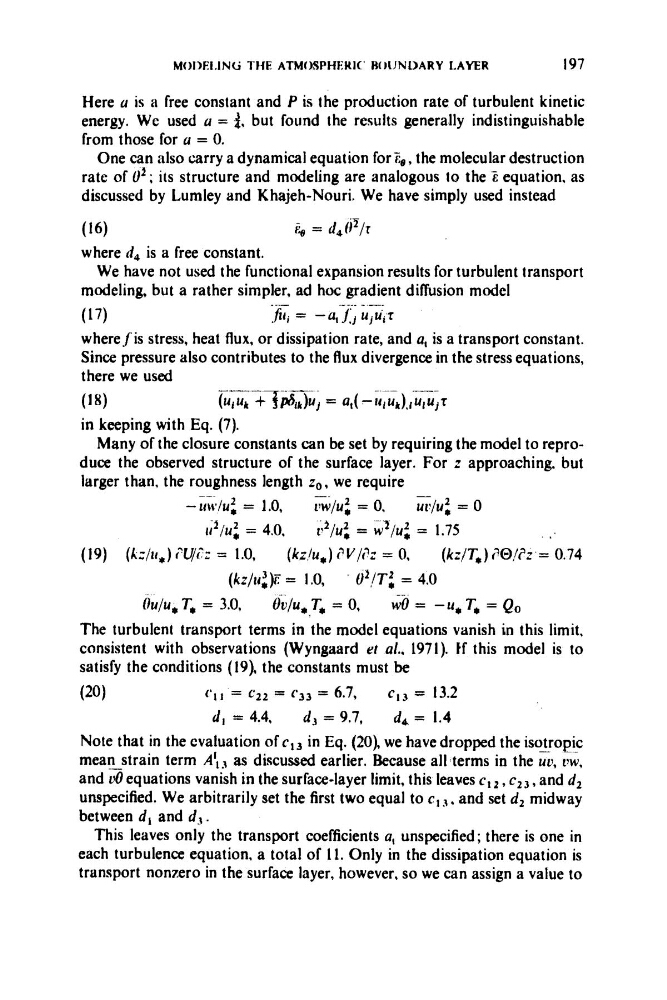
(16)
t9 = d402/r
where d4 is a free constant.
modeling, but a rather simpler, ad hoc gradient diffusion model
wherefis stress, heat flux, or dissipation rate, and a, is a transport constant.
Since pressure also contributes to the flux divergence in the stress equations,
there we used
in keeping with Eq. (7).
duce the observed structure of the surface layer. For z ar
-
We have not used the functional expansion results for turbulent transport
.. -
_ _ .
- __
(17)
.firi = -u,j;, u p , 7
_-(18)
( U A +3i 6&3 = Q , ( - - I ~ I U & ) . I ~ P j 7
Many of the closure constants can be set by requiring the model to reprolarger than, the roughness length zo, we require
14’iU: = 4.0.
-_
__
- uu./u: = 1.0, L’w/u; = 0. GIU: = 0
tY2/uf = w’I/u: = 1.75
(19) (LZ/U*) ?V/;Z = 1.0,
(krh,) C‘V/c% = 0.
( W T ,
(kZ/U:)t; = 1.0,
t)’/T: = 4.0
broaching. but
__
OU/U, T, = 3.0,
O’VJU, T, = 0, WO = -11, T, = Q o
The turbulent transport terms in the model equations vanish in this limit,
consistent with observations (Wyngaard er al.. 1971). if this model is to
satisfy the conditions (19). the constants must be
(20)
(‘11 = ~ 2 2
= (‘33 = 6.7,
~ 1 3
= 13.2
dl = 4.4,
d 3 = 9.7,
d , = 1.4
Note that in the evaluation of c l j in Eq. (20), we have dropped the isotropic _. _ _
mean strain term A’l3 as discussed earlier. Because all’terms in the UL’, ow,
and L a equations vanish in the surface-layer limit, this leaves c , ~ , ~ 2 3 ,
and d ,
unspecified. We arbitrarily set the first two equal to cl J , and set d, midway
between dl and d 3 .
This leaves only the transport coefficients a, unspecified; there is one in
each turbulence equation, a total of 11. Only in the dissipation equation is
transport nonzero in the surface layer, however, so we can assign a value to
197
Here u is a free constant and P is the production rate of turbulent kinetic
energy. Wc used u = $, but found the results generally indistinguishable
from those for u = 0.
One can also carry a dynamical equation for T;, , the molecular destruction
rate of U i ; its structure and modeling are analogous to the 7: equation, as
discussed by Lumley and Khajeh-Nouri. We have simply used instead
(16)
t9 = d402/r
where d4 is a free constant.
modeling, but a rather simpler, ad hoc gradient diffusion model
wherefis stress, heat flux, or dissipation rate, and a, is a transport constant.
Since pressure also contributes to the flux divergence in the stress equations,
there we used
in keeping with Eq. (7).
duce the observed structure of the surface layer. For z ar
-
We have not used the functional expansion results for turbulent transport
.. -
_ _ .
- __
(17)
.firi = -u,j;, u p , 7
_-(18)
( U A +3i 6&3 = Q , ( - - I ~ I U & ) . I ~ P j 7
Many of the closure constants can be set by requiring the model to reprolarger than, the roughness length zo, we require
14’iU: = 4.0.
-_
__
- uu./u: = 1.0, L’w/u; = 0. GIU: = 0
tY2/uf = w’I/u: = 1.75
(19) (LZ/U*) ?V/;Z = 1.0,
(krh,) C‘V/c% = 0.
( W T ,
(kZ/U:)t; = 1.0,
t)’/T: = 4.0
broaching. but
__
OU/U, T, = 3.0,
O’VJU, T, = 0, WO = -11, T, = Q o
The turbulent transport terms in the model equations vanish in this limit,
consistent with observations (Wyngaard er al.. 1971). if this model is to
satisfy the conditions (19). the constants must be
(20)
(‘11 = ~ 2 2
= (‘33 = 6.7,
~ 1 3
= 13.2
dl = 4.4,
d 3 = 9.7,
d , = 1.4
Note that in the evaluation of c l j in Eq. (20), we have dropped the isotropic _. _ _
mean strain term A’l3 as discussed earlier. Because all’terms in the UL’, ow,
and L a equations vanish in the surface-layer limit, this leaves c , ~ , ~ 2 3 ,
and d ,
unspecified. We arbitrarily set the first two equal to cl J , and set d, midway
between dl and d 3 .
This leaves only the transport coefficients a, unspecified; there is one in
each turbulence equation, a total of 11. Only in the dissipation equation is
transport nonzero in the surface layer, however, so we can assign a value to