

MODELING THE ATMOSPHERIC BOUNDARY LAYER
195
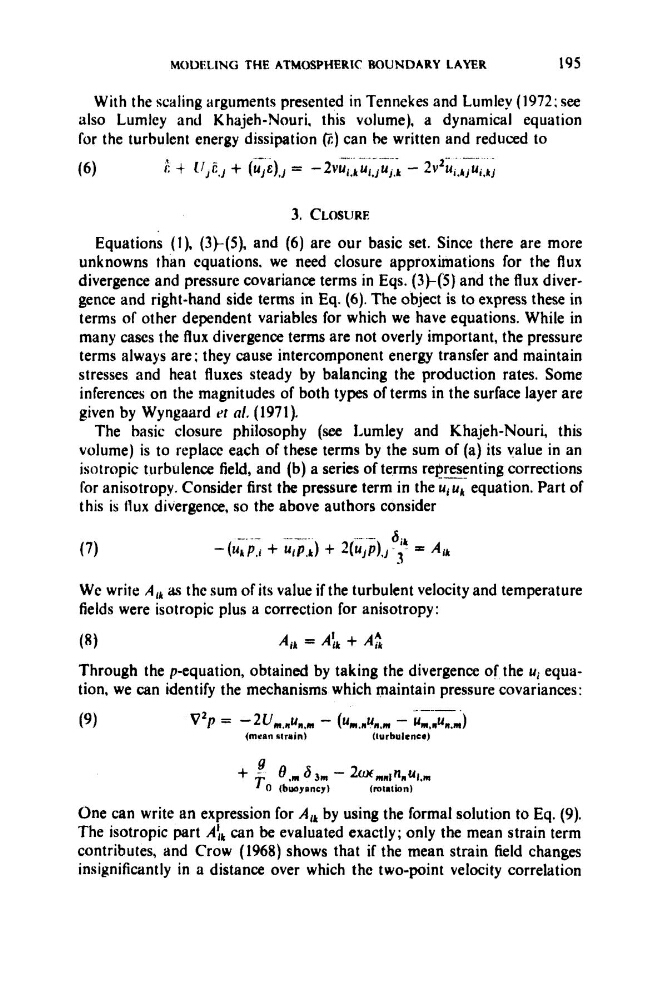
With the scaling arguments presented in Tennekes and Lumley (1972: see
also Lumley and Khajeh-Nouri. this volume), a dynamical equation
for the turbulent energy dissipation @) can he written and reduced to
3. CLOSURE
Equations (l), (3)-(5), and (6) are our basic set. Since there are more
unknowns than equations. we need closure approximations for the flux
divergence and pressure covariance terms in Eqs. (3)-(5) and the flux divergence and right-hand side terms in Eq. (6). The object is to express these in
terms of other dependent variables for which we have equations. While in
many cases the flux divergence terms are not overly important, the pressure
terms always are; they cause intercomponent energy transfer and maintain
stresses and heat fluxes steady by balancing the production rates. Some
inferences on the magnitudes of both types of terms in the surface layer are
given by Wyngaard rt d, (1971).
The basic closure philosophy (see Lumley and Khajeh-Nouri, this
volume) is to replace each of these terms by the sum of (a) its value in an
isotropic turbulence field, and (b) a series of terms representing corrections
for anisotropy. Consider first the pressure term in the uiuk equation. Part of
this is flux divergence, so the above authors consider
We write A,, as the sum of its value if the turbulent velocity and temperature
fields were isotropic plus a correction for anisotropy :
(8)
Ail: = A:, + A$
Through the p-equation, obtained by taking the divergence of the ui equation, we can identify the mechanisms which maintain pressure covariances:
-
V’P = -2Vm.nun,m - (um.nun.m - ~ m , m ~ n . m )
(maan struin)
(turbulence)
(9)
9
+ em 6 3m - 2 ~ m n l n n ~ l . n
T O (buoyancy)
(rotation)
One can write an expression for A& by using the formal solution to Eq. (9).
The isotropic part A:, can be evaluated exactly; only the mean strain term
contributes, and Crow (1968) shows that if the mean strain field changes
insignificantly in a distance over which the two-point velocity correlation
195
With the scaling arguments presented in Tennekes and Lumley (1972: see
also Lumley and Khajeh-Nouri. this volume), a dynamical equation
for the turbulent energy dissipation @) can he written and reduced to
3. CLOSURE
Equations (l), (3)-(5), and (6) are our basic set. Since there are more
unknowns than equations. we need closure approximations for the flux
divergence and pressure covariance terms in Eqs. (3)-(5) and the flux divergence and right-hand side terms in Eq. (6). The object is to express these in
terms of other dependent variables for which we have equations. While in
many cases the flux divergence terms are not overly important, the pressure
terms always are; they cause intercomponent energy transfer and maintain
stresses and heat fluxes steady by balancing the production rates. Some
inferences on the magnitudes of both types of terms in the surface layer are
given by Wyngaard rt d, (1971).
The basic closure philosophy (see Lumley and Khajeh-Nouri, this
volume) is to replace each of these terms by the sum of (a) its value in an
isotropic turbulence field, and (b) a series of terms representing corrections
for anisotropy. Consider first the pressure term in the uiuk equation. Part of
this is flux divergence, so the above authors consider
We write A,, as the sum of its value if the turbulent velocity and temperature
fields were isotropic plus a correction for anisotropy :
(8)
Ail: = A:, + A$
Through the p-equation, obtained by taking the divergence of the ui equation, we can identify the mechanisms which maintain pressure covariances:
-
V’P = -2Vm.nun,m - (um.nun.m - ~ m , m ~ n . m )
(maan struin)
(turbulence)
(9)
9
+ em 6 3m - 2 ~ m n l n n ~ l . n
T O (buoyancy)
(rotation)
One can write an expression for A& by using the formal solution to Eq. (9).
The isotropic part A:, can be evaluated exactly; only the mean strain term
contributes, and Crow (1968) shows that if the mean strain field changes
insignificantly in a distance over which the two-point velocity correlation