

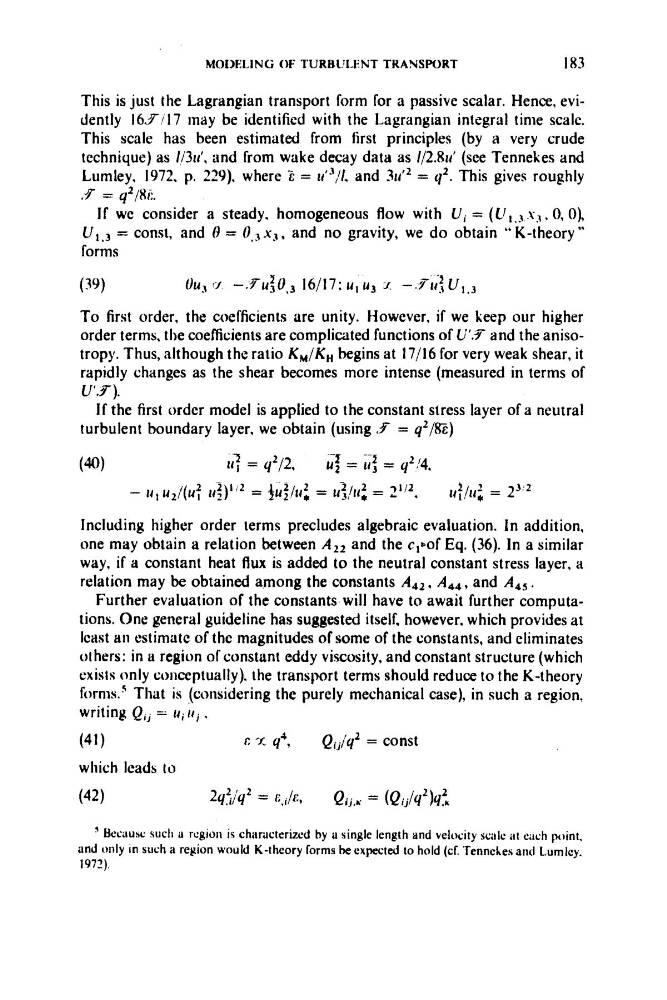
This is just the Lagrangian transport form for a passive scalar. Hence, evidently 16.7117 inay be identified with the Lagrangiaii integral time scale.
This scale has been estimated from first principles (by a very crude
technique) as //31i’, and from wake decay data as 1/2.81t’ (see Tennekes and
Lumley, 1972. p. 229). where 7: = it‘-’,’/, and 3 d 2 = q2. This gives roughly
If we consider a steady. homogeneous flow with U i = ( L/t.3 . Y . ~ , 0. O),
Ut,3 = const, and 0 = O~,x,, and no gravity, we do obtain “K-theory”
forms
Y = y2/8C.
(39)
O U ~
r/
-.Tu:U.J 16/17: U I ~3 J - 914: U1.3
To first order. the coefficients are unity. However, if we keep our higher
order terms, the coefficients are complicated functions of U‘.F and the anisotropy. Thus, although the ratio KM/KH begins at 17/16 for very weak shear, it
rapidly changes as the shear becomes more intense (measured in terms of
If the first order model is applied to the constant stress layer of a neutral
U‘.F).
turbulent boundary layer, we obtain (using .P = q2/&)
(4)
1;: = 4212,
= Ti: = q2/4.
- 141 u,/(u: I l i ) t r 2 = fu$/tl: = 11{/11: = 2”’.
l t l / U ;
2 ’ = 2’
Including higher order terms precludes algebraic evaluation. In addition,
one may obtain a relation between A Z 2 and the ctmof Eq. (36). In a similar
way, if a constant heat flux is added to the neutral constant stress layer, a
relation may be obtained among the constants A 4 2 , A44, and A,, .
Further evaluation of the constants will have to await further computations. One general guideline has suggested itself, however. which provides at
least an cstimatc of the magnitudes of some of the constants, and eliminates
others: in H region of constant eddy viscosity, and constant structure (which
cxists only conceptually). the transport terms should reduce to the K-theory
That is (considering the purely mechanical case), in such a region,
writing Q,, = u , u , .
(41)
r: x y4,
QI,iY2 = const
which kads to
’ Becausc such il rcgion is characterizcd by a single length and velocity sciile at each point.
and only in such a repion would K-theory forms be expcied to hold (cf. ‘Tennches and Lumley.
197’).
This scale has been estimated from first principles (by a very crude
technique) as //31i’, and from wake decay data as 1/2.81t’ (see Tennekes and
Lumley, 1972. p. 229). where 7: = it‘-’,’/, and 3 d 2 = q2. This gives roughly
If we consider a steady. homogeneous flow with U i = ( L/t.3 . Y . ~ , 0. O),
Ut,3 = const, and 0 = O~,x,, and no gravity, we do obtain “K-theory”
forms
Y = y2/8C.
(39)
O U ~
r/
-.Tu:U.J 16/17: U I ~3 J - 914: U1.3
To first order. the coefficients are unity. However, if we keep our higher
order terms, the coefficients are complicated functions of U‘.F and the anisotropy. Thus, although the ratio KM/KH begins at 17/16 for very weak shear, it
rapidly changes as the shear becomes more intense (measured in terms of
If the first order model is applied to the constant stress layer of a neutral
U‘.F).
turbulent boundary layer, we obtain (using .P = q2/&)
(4)
1;: = 4212,
= Ti: = q2/4.
- 141 u,/(u: I l i ) t r 2 = fu$/tl: = 11{/11: = 2”’.
l t l / U ;
2 ’ = 2’
Including higher order terms precludes algebraic evaluation. In addition,
one may obtain a relation between A Z 2 and the ctmof Eq. (36). In a similar
way, if a constant heat flux is added to the neutral constant stress layer, a
relation may be obtained among the constants A 4 2 , A44, and A,, .
Further evaluation of the constants will have to await further computations. One general guideline has suggested itself, however. which provides at
least an cstimatc of the magnitudes of some of the constants, and eliminates
others: in H region of constant eddy viscosity, and constant structure (which
cxists only conceptually). the transport terms should reduce to the K-theory
That is (considering the purely mechanical case), in such a region,
writing Q,, = u , u , .
(41)
r: x y4,
QI,iY2 = const
which kads to
’ Becausc such il rcgion is characterizcd by a single length and velocity sciile at each point.
and only in such a repion would K-theory forms be expcied to hold (cf. ‘Tennches and Lumley.
197’).