

Reynolds (1970) and others d o not appear: our formalism excludes explicit
dependence on the mean velocity profile, and forces implicit dependence
through second order quantities."
Now, we may apply the same rcasoiiing to the term in (14). Examining the
equations. we find that
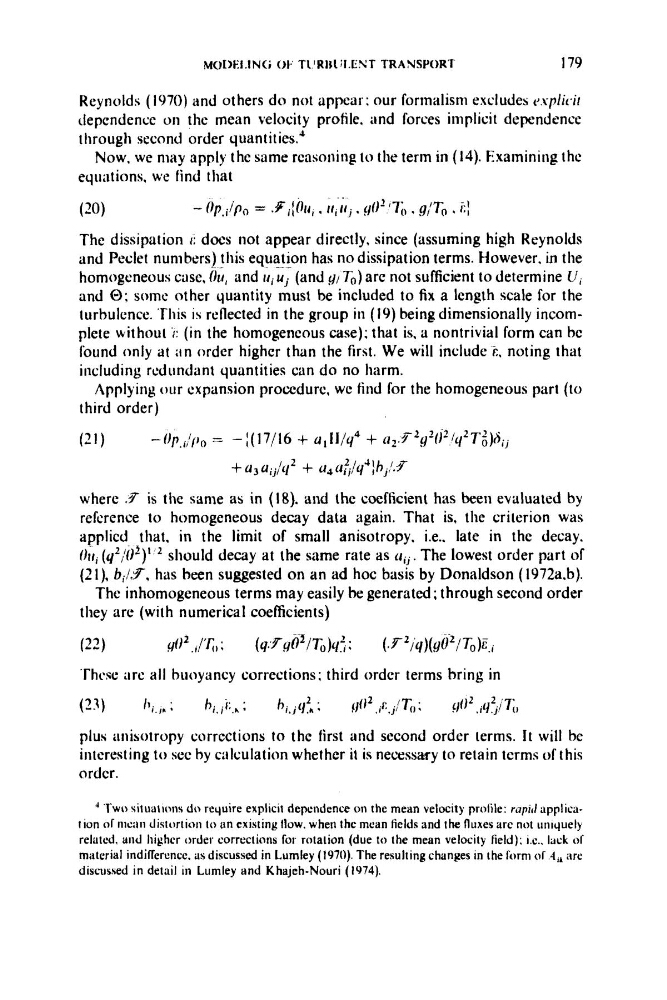
(20)
- op,iipo = . ~ ~ ( i ) t t ;
. ,ri.Iti . {lo2 '7;, , g:~, , i:;
The dissipation ti does not appear directly, since (assuming high Reynolds
and Peclet numbers) this equation has no dissipation terms. However. in the
homogeneous case. &, and I4;u; (and g/ 7 ' ' ) are not sufficient to determine Li;
and 0: some other quantity must be included to fix a length scale for the
turbulencc. This is reflected in the group in (19) being dimensionally incomplete without j : (in the homogencous case); that is, a nontrivial form can he
found o n l y at ;tn order highcr than the first. We will include '2. noting that
including rcdiindant quantities can d o no harm.
Applying our cxpansion prowdurc. we find for the homogeneous part (to
third order)
(21)
-op~i/l)o = - ((17/16 + u , ~ ~ / q 4
+ N 2 . ~ ~ y 2 0 2 , / y 2 7 ~ ) i j i , i
-tu3uij/y2 + ~ , c i ~ ~ / y ~ ~ h , , ' . J /
where .P is the same as in (18). and the coefficient has been evaluated by
refcrence to homogeneous decay data again. That is, the criterion was
applicd that, in the limit of small anisotropy. i.e.. late in the decay.
Orri (qz,'#)'!2 should decay at the same rate as ( J ~ ~ .
The lowest order part of
Q l ) , b i / Y , has been suggested on an ad hoc basis by Donaldson (1972a.b).
The inhomogeneous terms may easily he generated ; through second order
they are (with numerical coefficients)
(22)
( ~ : P u @
i r, )4:, :
('13)
hi.," ;
h i j ; , h ; hi,iqzh; q02,if:,j,'T): g0 2 ,i4,j/ 2 7 - (,
uo2 . J'J) ;
(. P 2i4 )( gU-5/ r0 ) E . ~
Thcse are all buoynncy corrections; third order terms bring in
plus iiilisotropy corrections to the first and second order terms. It will be
inleresting to sec by calculation whether it is necessary to retain terms ofthis
order.
' 'Two situations do require explicit dependence on the mean velocity prolile: rapid application or niciIn distortion to an existing (low. when the mean fields and the fluxes arc not uniquely
related. slid highcr order corrections for rotation (due to the mean velocity lield): i.e.. lack o l
material indifference. as discussed in Lumley (1970). The resulting changes in the forni or .4,, are
discussed in detail in Lumley and Khajeh-Nouri (1974).
dependence on the mean velocity profile, and forces implicit dependence
through second order quantities."
Now, we may apply the same rcasoiiing to the term in (14). Examining the
equations. we find that
(20)
- op,iipo = . ~ ~ ( i ) t t ;
. ,ri.Iti . {lo2 '7;, , g:~, , i:;
The dissipation ti does not appear directly, since (assuming high Reynolds
and Peclet numbers) this equation has no dissipation terms. However. in the
homogeneous case. &, and I4;u; (and g/ 7 ' ' ) are not sufficient to determine Li;
and 0: some other quantity must be included to fix a length scale for the
turbulencc. This is reflected in the group in (19) being dimensionally incomplete without j : (in the homogencous case); that is, a nontrivial form can he
found o n l y at ;tn order highcr than the first. We will include '2. noting that
including rcdiindant quantities can d o no harm.
Applying our cxpansion prowdurc. we find for the homogeneous part (to
third order)
(21)
-op~i/l)o = - ((17/16 + u , ~ ~ / q 4
+ N 2 . ~ ~ y 2 0 2 , / y 2 7 ~ ) i j i , i
-tu3uij/y2 + ~ , c i ~ ~ / y ~ ~ h , , ' . J /
where .P is the same as in (18). and the coefficient has been evaluated by
refcrence to homogeneous decay data again. That is, the criterion was
applicd that, in the limit of small anisotropy. i.e.. late in the decay.
Orri (qz,'#)'!2 should decay at the same rate as ( J ~ ~ .
The lowest order part of
Q l ) , b i / Y , has been suggested on an ad hoc basis by Donaldson (1972a.b).
The inhomogeneous terms may easily he generated ; through second order
they are (with numerical coefficients)
(22)
( ~ : P u @
i r, )4:, :
('13)
hi.," ;
h i j ; , h ; hi,iqzh; q02,if:,j,'T): g0 2 ,i4,j/ 2 7 - (,
uo2 . J'J) ;
(. P 2i4 )( gU-5/ r0 ) E . ~
Thcse are all buoynncy corrections; third order terms bring in
plus iiilisotropy corrections to the first and second order terms. It will be
inleresting to sec by calculation whether it is necessary to retain terms ofthis
order.
' 'Two situations do require explicit dependence on the mean velocity prolile: rapid application or niciIn distortion to an existing (low. when the mean fields and the fluxes arc not uniquely
related. slid highcr order corrections for rotation (due to the mean velocity lield): i.e.. lack o l
material indifference. as discussed in Lumley (1970). The resulting changes in the forni or .4,, are
discussed in detail in Lumley and Khajeh-Nouri (1974).