

17X
J. I.. I.I:MI.I(Y A N I ) H. KtIAJlill-NOlIRI
I J ~ ~ .
a vcctor hi, and thrcescalars. I;, y2. arid g/T,. In the isotropic limit u i j , h , .
and g/'f;, all vanish, as do ill1 gradicnts. Thus uii., would be a sccond order
tcriii. nnd (1; a lirst order tcrm. First. lorm the functional Taylor series in the
gradients of the arguments. Second. the tcnsor coefficients are now functions
o f the locill values of u i j , h i , ctc.; cxprcss them in invariant form, arranging
them according to order (note that thc invariants of uil are of second and
third .order. etc.). Expand in powers of BIT,; finally. apply dimensional
analysis to thc coefficients.
Thc net result consists of terms of two types: those that would be present
i n :I homogeneous flow, and corrections for inhomogeneity. Through third
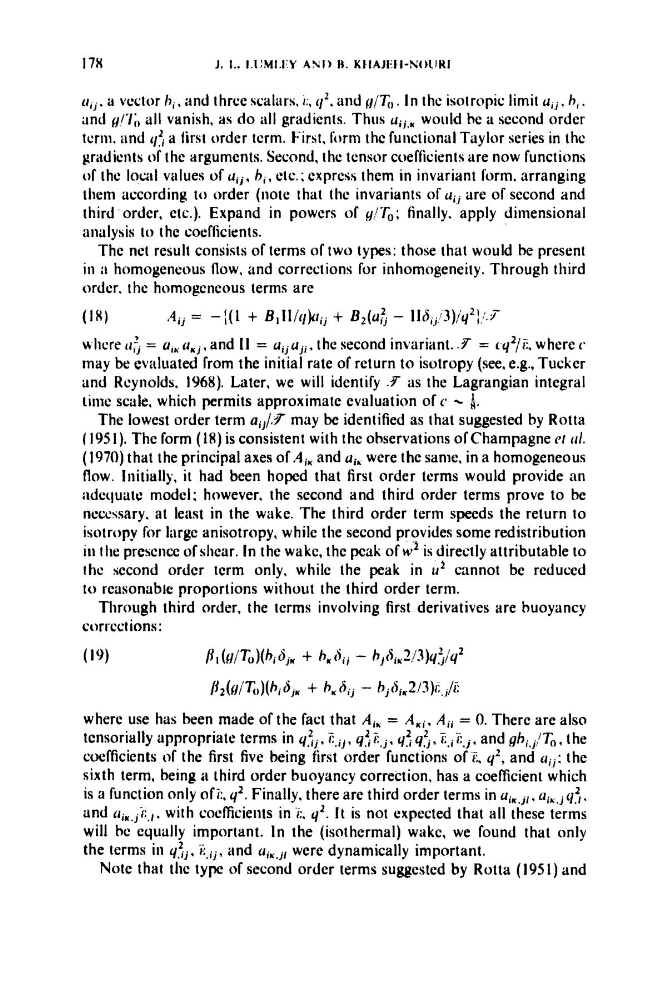
order. t he homogeneous terms are
wlicre ti; = u,, t i K j . and 11 = uijuJi. the second invariant. .T = q 2 / k where c
rnay be evaluated from the initial rate of return to isotropy (see, e.g., Tucker
and Reynolds. 1968). Later, we will identify .T as the Lagrangian integral
time scale, which permits approximate evaluation of c - Q.
The lowest order term aij/.T may be identified as that suggested by Rotta
( 1951). The form (18) is consistent with the observations ofchampagne cjt ti/.
( 1970) that the principal axes of Ai, and uir were the same, in a homogeneous
flow. Initially, it had been hoped that first order terms would provide an
adequatc model; however, the sccond and third order terms prove to be
ncccssary. at kitst in the wake. The third order term speeds the return to
isotropy for li~rge anisotropy, while the second provides some redistribution
in IIie presence of shear. In the wake, the pcak of w2 is directly attributable to
thc second order tcrm only, while the peak in I,* cannot be reduced
to reasonable proportions without the third order term.
Through third order, the terms involving first derivatives are buoyancy
cortcct ions :
/~,(Q/T,,)(hi(SiK + h,dij - hjSi,2/3)L. j/i
where use has been made of the fact that Ai, = A K i , Aii = 0. There are also
tcnsorially appropriate terms in 4:j, Z,i,, q: 2.j, 4: q f j , Xai E , j , and ghi.j/To, the
coefficicnts of the first five being first order functions of E. q', and q i : the
sixth term, being a third order buoyancy correction, has a coefficient which
is a function only ofi:, 4'. Finally. there are third order terms in uiK.j,, aiK.jq:.
and t i i K . j k . i , with coeficieiits in C. 4'. I t is not expected that all these terms
will bc equally important. In the (isothermal) witkc, we found that only
the terms in
E , i j , and air.jr were dynamically important.
Note that the typc of second order terms suggested by Rotta (1951) and
J. I.. I.I:MI.I(Y A N I ) H. KtIAJlill-NOlIRI
I J ~ ~ .
a vcctor hi, and thrcescalars. I;, y2. arid g/T,. In the isotropic limit u i j , h , .
and g/'f;, all vanish, as do ill1 gradicnts. Thus uii., would be a sccond order
tcriii. nnd (1; a lirst order tcrm. First. lorm the functional Taylor series in the
gradients of the arguments. Second. the tcnsor coefficients are now functions
o f the locill values of u i j , h i , ctc.; cxprcss them in invariant form, arranging
them according to order (note that thc invariants of uil are of second and
third .order. etc.). Expand in powers of BIT,; finally. apply dimensional
analysis to thc coefficients.
Thc net result consists of terms of two types: those that would be present
i n :I homogeneous flow, and corrections for inhomogeneity. Through third
order. t he homogeneous terms are
wlicre ti; = u,, t i K j . and 11 = uijuJi. the second invariant. .T = q 2 / k where c
rnay be evaluated from the initial rate of return to isotropy (see, e.g., Tucker
and Reynolds. 1968). Later, we will identify .T as the Lagrangian integral
time scale, which permits approximate evaluation of c - Q.
The lowest order term aij/.T may be identified as that suggested by Rotta
( 1951). The form (18) is consistent with the observations ofchampagne cjt ti/.
( 1970) that the principal axes of Ai, and uir were the same, in a homogeneous
flow. Initially, it had been hoped that first order terms would provide an
adequatc model; however, the sccond and third order terms prove to be
ncccssary. at kitst in the wake. The third order term speeds the return to
isotropy for li~rge anisotropy, while the second provides some redistribution
in IIie presence of shear. In the wake, the pcak of w2 is directly attributable to
thc second order tcrm only, while the peak in I,* cannot be reduced
to reasonable proportions without the third order term.
Through third order, the terms involving first derivatives are buoyancy
cortcct ions :
/~,(Q/T,,)(hi(SiK + h,dij - hjSi,2/3)L. j/i
where use has been made of the fact that Ai, = A K i , Aii = 0. There are also
tcnsorially appropriate terms in 4:j, Z,i,, q: 2.j, 4: q f j , Xai E , j , and ghi.j/To, the
coefficicnts of the first five being first order functions of E. q', and q i : the
sixth term, being a third order buoyancy correction, has a coefficient which
is a function only ofi:, 4'. Finally. there are third order terms in uiK.j,, aiK.jq:.
and t i i K . j k . i , with coeficieiits in C. 4'. I t is not expected that all these terms
will bc equally important. In the (isothermal) witkc, we found that only
the terms in
E , i j , and air.jr were dynamically important.
Note that the typc of second order terms suggested by Rotta (1951) and