

I 80
J. I.. LUMLEY A N D B. KHAJEH-NOURI
4. THE TRANSPORT TERMS .
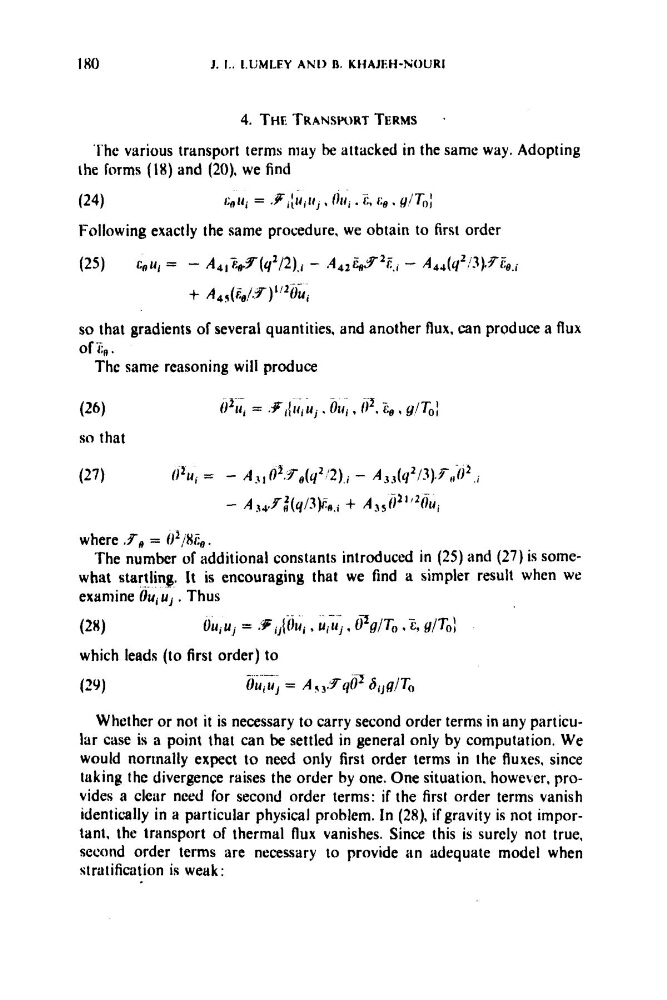
The various transport terms niay be attacked in the same way. Adopting
the forms (18) and (20). we find
(24)
EoUj = - ~ l ~ 1 4 1 U , ,
0 1 4 , . 2, C b , y/T,I
Following exactly the same procedure, we obtain to first order
(25)
c,,u, = - A41ZpF(y2/2).i - .442&Y2E,, - A44(4’/3).Pifi.i
+ A 4 5 (&/.S ) ’ ’ 2 i l i 1
so that gradients of several quantities, and another flux, can produce a flux
or x ~ .
The same reasoning will produce
(27)
( P U i = - 0 ~ . 3 - , ( ~ ~ : 2 ) , ~
- A 3 3 ( q 2 / 3 ) . q i j 2 , j
- A3Ji(y/3)ke.i + A35fi21’2fiui
where .Tfi = (li/HEo.
The number of additional constants introductd in (25) and (27) is somewhat startling. .~... I t is encouraging that we find a simpler result when we
examine Ou,uj . Thus
(2H)
which leads (to first order) to
(29)
t?ui14j = A,,.Tqir)? d,,g/T,
Vuiwj = :Fi,(nui, Uii{, @@/To, Z, y/To)
.
Whether or not it is necessary to carry second order terms in any particular case is a point that can be settled in general only by computation. We
would nortnally expect to need only first order terms in the fluxes. since
taking the divergence raises the order by one. One situation. however, provides a clew need for second order terms: if the first order terms vanish
identically in a particular physical problem. In (28), if gravity is not important. the transport of thermal flux vanishes. Since this is surely not true,
second order terms are necessary to provide iin adequate model when
stratification is weak:
J. I.. LUMLEY A N D B. KHAJEH-NOURI
4. THE TRANSPORT TERMS .
The various transport terms niay be attacked in the same way. Adopting
the forms (18) and (20). we find
(24)
EoUj = - ~ l ~ 1 4 1 U , ,
0 1 4 , . 2, C b , y/T,I
Following exactly the same procedure, we obtain to first order
(25)
c,,u, = - A41ZpF(y2/2).i - .442&Y2E,, - A44(4’/3).Pifi.i
+ A 4 5 (&/.S ) ’ ’ 2 i l i 1
so that gradients of several quantities, and another flux, can produce a flux
or x ~ .
The same reasoning will produce
(27)
( P U i = - 0 ~ . 3 - , ( ~ ~ : 2 ) , ~
- A 3 3 ( q 2 / 3 ) . q i j 2 , j
- A3Ji(y/3)ke.i + A35fi21’2fiui
where .Tfi = (li/HEo.
The number of additional constants introductd in (25) and (27) is somewhat startling. .~... I t is encouraging that we find a simpler result when we
examine Ou,uj . Thus
(2H)
which leads (to first order) to
(29)
t?ui14j = A,,.Tqir)? d,,g/T,
Vuiwj = :Fi,(nui, Uii{, @@/To, Z, y/To)
.
Whether or not it is necessary to carry second order terms in any particular case is a point that can be settled in general only by computation. We
would nortnally expect to need only first order terms in the fluxes. since
taking the divergence raises the order by one. One situation. however, provides a clew need for second order terms: if the first order terms vanish
identically in a particular physical problem. In (28), if gravity is not important. the transport of thermal flux vanishes. Since this is surely not true,
second order terms are necessary to provide iin adequate model when
stratification is weak: