

154
RK'HARD 1.. PESKIK
(3.6)
These equations were obtained by employing an averaging technique over
the grid volume and collecting the subgrid scale fluctuation terms into a
separate stress expression. This expression is represented by a subgrid scale
stress model and the model employed here is similar to that first introduced
by Smagorinsky (1963):
(3.7)
(3.8)
0 = (Ax Ay Az)lr3
c is an empirical constant.
Discussion of the choice of the empirical constant in the subgrid scale
model is found in the thesis by Kau (1972). These differential equations
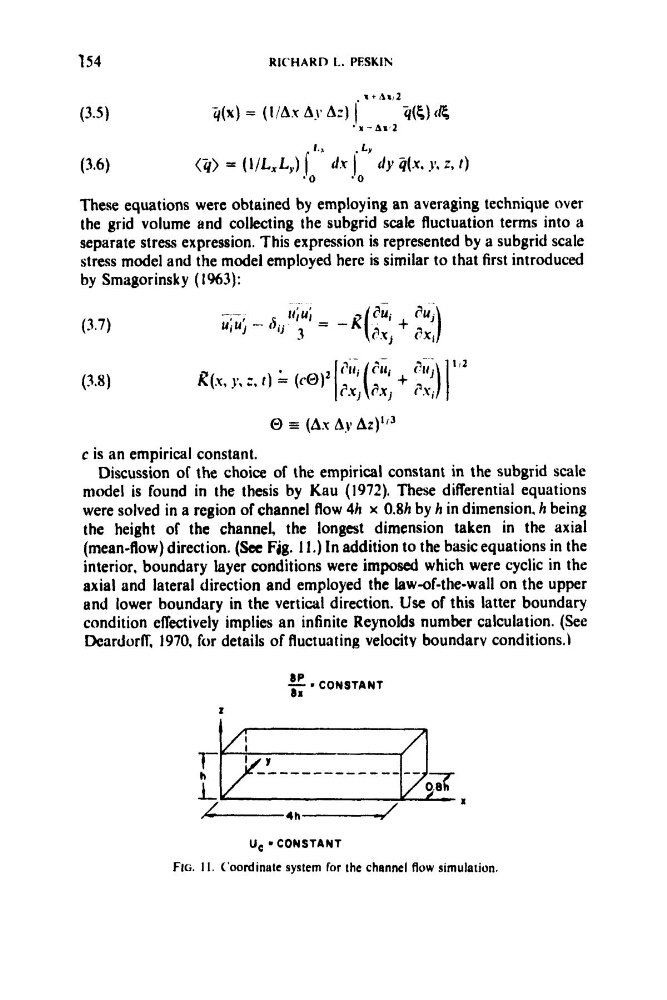
were solved in a region of channel flow 4h x 0.8h by h in dimension, h being
the height of the channel, the longest dimension taken in the axial
(mean-flow) direction. (Sac Fig. 11.) In addition to the basic equations in the
interior, boundary layer conditions were imposed which were cyclic in the
axial and lateral direction and employed the lawsf-the-wall on the upper
and lower boundary in the vertical direction, Use of this latter boundary
condition effectively implies an infinite Reynolds number calculation. (See
Deardorff, 1970, for details of fluctuating velocity boundarv conditions.)
8P
- 9 CONSTANT
I X
I
Uc 9 CONSTANT
FIG. I I . C'oordinate system for the channel flow simulation.
RK'HARD 1.. PESKIK
(3.6)
These equations were obtained by employing an averaging technique over
the grid volume and collecting the subgrid scale fluctuation terms into a
separate stress expression. This expression is represented by a subgrid scale
stress model and the model employed here is similar to that first introduced
by Smagorinsky (1963):
(3.7)
(3.8)
0 = (Ax Ay Az)lr3
c is an empirical constant.
Discussion of the choice of the empirical constant in the subgrid scale
model is found in the thesis by Kau (1972). These differential equations
were solved in a region of channel flow 4h x 0.8h by h in dimension, h being
the height of the channel, the longest dimension taken in the axial
(mean-flow) direction. (Sac Fig. 11.) In addition to the basic equations in the
interior, boundary layer conditions were imposed which were cyclic in the
axial and lateral direction and employed the lawsf-the-wall on the upper
and lower boundary in the vertical direction, Use of this latter boundary
condition effectively implies an infinite Reynolds number calculation. (See
Deardorff, 1970, for details of fluctuating velocity boundarv conditions.)
8P
- 9 CONSTANT
I X
I
Uc 9 CONSTANT
FIG. I I . C'oordinate system for the channel flow simulation.