

diinensional study was in order. ’10 this ciiii !lireeIlin~ensioiiaI siniulation of
turbulent cliannel l10w was used to slud) 111e Lagrangian problem. The
channel flow problein is relevant b e ~ i t l i ~ c
it is ;t first step toward the important planetary boundary layer simulation problem and it contains regions of
shear flow as well as approximate isotropy in the center of the channel.
Consequently the channel flow problem contains many features of practical
value when one is concerned with turbulent diffusion. Obviously, to deal
with such a complicated flow situation, one must give up many of the
simplifying features found in the two-dimensional simulation. In particular
computation limitations indicate that simulation at reasonable values of the
Reynolds number cannot be accomplished with today’s computing machinery, without employing some closure model, that is. some model that analytically simulates large wave number or small length scale features of the flow.
In effect, the computation reported here employs a subgrid scale model. that
is, a model to account for turbulent dissipation on length scales smaller than
that represented by the numerical sirnulation grid. The technique employed
is similar to that reported by Deardorff and Peskin (1970), but in the present
study, the main emphasis is placed on the Eulerian-Lagrangian problem. In
addition the computations were generalized to include the effects of heavy
particle (as distinct from fluid point) diffusion in the shear flow field.
3.1. Techniques .fur the Guiirrutiun qj’tlte Euleriun Field
The Euleriun field was generated in the simulated three-dimensional channel flow by a technique similar to that employed by Deardorff (1970). Essentially the computation involved satisfying the Navier-Stokes equations at
each point in the internal grid together with application of boundary conditions and a subgrid scale formulation of turbulence to account for motions
on a length scale smaller than the grid dimension. More details on this can
be found on the aforementioned paper by Deardorfl(197O). or the thesis by
Kau (1972).
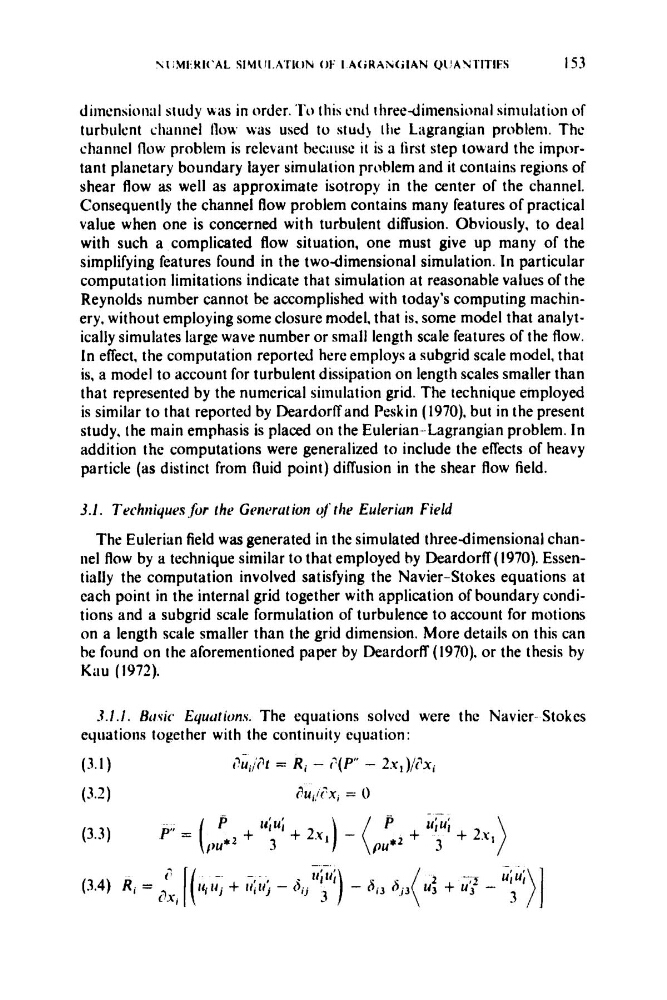
3.1.1. Hovic Equu1ion.s. The equations solved were the Navier- Stokes
eyiiat ions toget her with the continuity equa tion :
(3.1)
-
i7ui/’8t = Ri - ?(P” - 2x,)/?xi
(3.1)
?Ui,/?X, = 0
turbulent cliannel l10w was used to slud) 111e Lagrangian problem. The
channel flow problein is relevant b e ~ i t l i ~ c
it is ;t first step toward the important planetary boundary layer simulation problem and it contains regions of
shear flow as well as approximate isotropy in the center of the channel.
Consequently the channel flow problem contains many features of practical
value when one is concerned with turbulent diffusion. Obviously, to deal
with such a complicated flow situation, one must give up many of the
simplifying features found in the two-dimensional simulation. In particular
computation limitations indicate that simulation at reasonable values of the
Reynolds number cannot be accomplished with today’s computing machinery, without employing some closure model, that is. some model that analytically simulates large wave number or small length scale features of the flow.
In effect, the computation reported here employs a subgrid scale model. that
is, a model to account for turbulent dissipation on length scales smaller than
that represented by the numerical sirnulation grid. The technique employed
is similar to that reported by Deardorff and Peskin (1970), but in the present
study, the main emphasis is placed on the Eulerian-Lagrangian problem. In
addition the computations were generalized to include the effects of heavy
particle (as distinct from fluid point) diffusion in the shear flow field.
3.1. Techniques .fur the Guiirrutiun qj’tlte Euleriun Field
The Euleriun field was generated in the simulated three-dimensional channel flow by a technique similar to that employed by Deardorff (1970). Essentially the computation involved satisfying the Navier-Stokes equations at
each point in the internal grid together with application of boundary conditions and a subgrid scale formulation of turbulence to account for motions
on a length scale smaller than the grid dimension. More details on this can
be found on the aforementioned paper by Deardorfl(197O). or the thesis by
Kau (1972).
3.1.1. Hovic Equu1ion.s. The equations solved were the Navier- Stokes
eyiiat ions toget her with the continuity equa tion :
(3.1)
-
i7ui/’8t = Ri - ?(P” - 2x,)/?xi
(3.1)
?Ui,/?X, = 0