

NCJMERICAI. SIMULATION OF LAGRASCilAN QUAYTITIES
I49
In general the results verify the correctness of Taylor's formula for application in this situation and illustrate the appropriateness of this type of
technique for Lagrangian statistical studies. Both the Lagrangian autocorrelation and the Lagrangian integral scale exhibit some noise fluctuation at
large times. which is indicative of statistical fluctuation caused by use of a
finite number of particles which for long times after release result in a
reduced number density and consequent increase in statistical noise. This
problem was further complicated by a slowly evolving coherent rotation of
the whole field. The "Lagrangian Reynolds stress" was also computed to
test isotropy. In general this stress was small.
2.2.2. Tcst oj /he " Corrsiii Hppothcsis *'
Corrsin (1959) introduced a hypothesis relating Eulerian space-- time correlation to Lagrangian autocorrelation. The implications of this hypothesis
were examined by Saffman (1963) for long times from release and Peskin
(1965) for short time after release. For isotropic stationary fields, Corrsin's
relation is
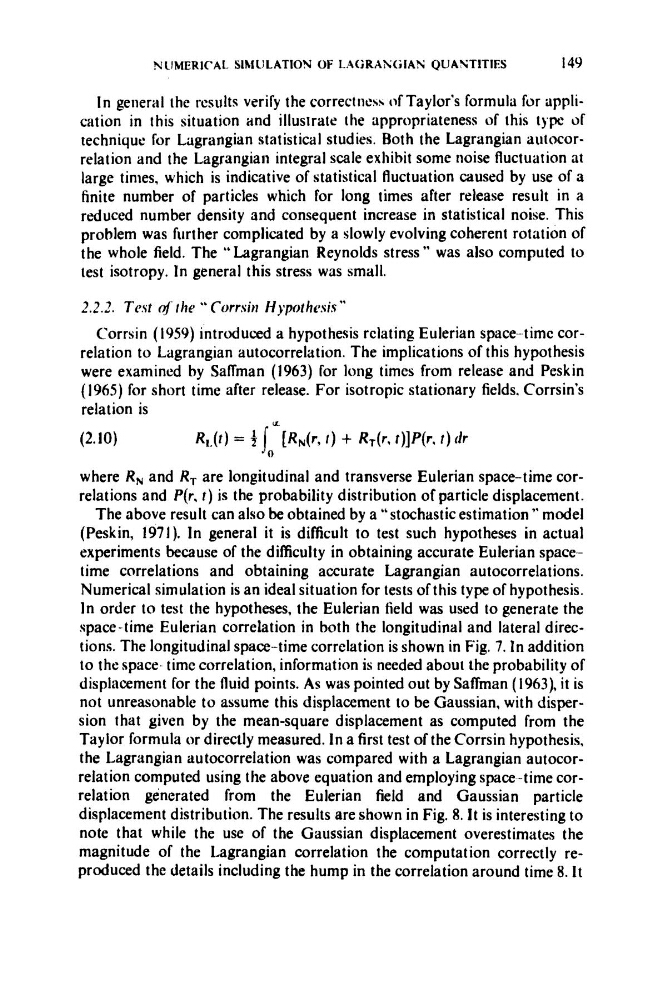
(2.10)
where R N and R,. are longitudinal and transverse Eulerian space-time correlations and P(r. t ) is the probability distribution of particle displacement.
The above result can also be obtained by a "stochastic estimation" model
(Peskin, 1971). In general it is difficult to test such hypotheses in actual
experiments because of the difficulty in obtaining accurate Eulerian spacetime correlations and obtaining accurate Lagrangian autocorrelations.
Numerical simulation is an ideal situation for tests of this type of hypothesis.
In order to test the hypotheses, the Eulerian field was used to generate the
space-time Eulerian correlation in both the longitudinal and lateral directions. The longitudinal space-time correlation is shown in Fig. 7. In addition
to the space- time correlation, information is needed about the probability of
displacement for the fluid points. As was pointed out by Saffman (1963). it is
not unreasonable to assume this displacement to be Gaussian, with dispersion that given by the mean-square displacement as computed from the
Taylor formula or directly measured. In a first test of the Corrsin hypothesis,
the Lagrangian autocorrelation was compared with a Lagrangian autocorrelation computed using the above equation and employing space-time correlation generated from the Eulerian field and Gaussian particle
displacement distribution. The results are shown in Fig. 8. It is interesting to
note that while the use of the Gaussian displacement overestimates the
magnitude of the Lagrangian correlation the computation correctly reproduced the details including the hump in the correlation around time 8. It
I49
In general the results verify the correctness of Taylor's formula for application in this situation and illustrate the appropriateness of this type of
technique for Lagrangian statistical studies. Both the Lagrangian autocorrelation and the Lagrangian integral scale exhibit some noise fluctuation at
large times. which is indicative of statistical fluctuation caused by use of a
finite number of particles which for long times after release result in a
reduced number density and consequent increase in statistical noise. This
problem was further complicated by a slowly evolving coherent rotation of
the whole field. The "Lagrangian Reynolds stress" was also computed to
test isotropy. In general this stress was small.
2.2.2. Tcst oj /he " Corrsiii Hppothcsis *'
Corrsin (1959) introduced a hypothesis relating Eulerian space-- time correlation to Lagrangian autocorrelation. The implications of this hypothesis
were examined by Saffman (1963) for long times from release and Peskin
(1965) for short time after release. For isotropic stationary fields, Corrsin's
relation is
(2.10)
where R N and R,. are longitudinal and transverse Eulerian space-time correlations and P(r. t ) is the probability distribution of particle displacement.
The above result can also be obtained by a "stochastic estimation" model
(Peskin, 1971). In general it is difficult to test such hypotheses in actual
experiments because of the difficulty in obtaining accurate Eulerian spacetime correlations and obtaining accurate Lagrangian autocorrelations.
Numerical simulation is an ideal situation for tests of this type of hypothesis.
In order to test the hypotheses, the Eulerian field was used to generate the
space-time Eulerian correlation in both the longitudinal and lateral directions. The longitudinal space-time correlation is shown in Fig. 7. In addition
to the space- time correlation, information is needed about the probability of
displacement for the fluid points. As was pointed out by Saffman (1963). it is
not unreasonable to assume this displacement to be Gaussian, with dispersion that given by the mean-square displacement as computed from the
Taylor formula or directly measured. In a first test of the Corrsin hypothesis,
the Lagrangian autocorrelation was compared with a Lagrangian autocorrelation computed using the above equation and employing space-time correlation generated from the Eulerian field and Gaussian particle
displacement distribution. The results are shown in Fig. 8. It is interesting to
note that while the use of the Gaussian displacement overestimates the
magnitude of the Lagrangian correlation the computation correctly reproduced the details including the hump in the correlation around time 8. It