

I 46
RICIiARD I-. PESKIN
*
0
W
2
W
a
I X l O ' *
I 1 10-3
1x10''
I
10
100
W A V E NUMBER
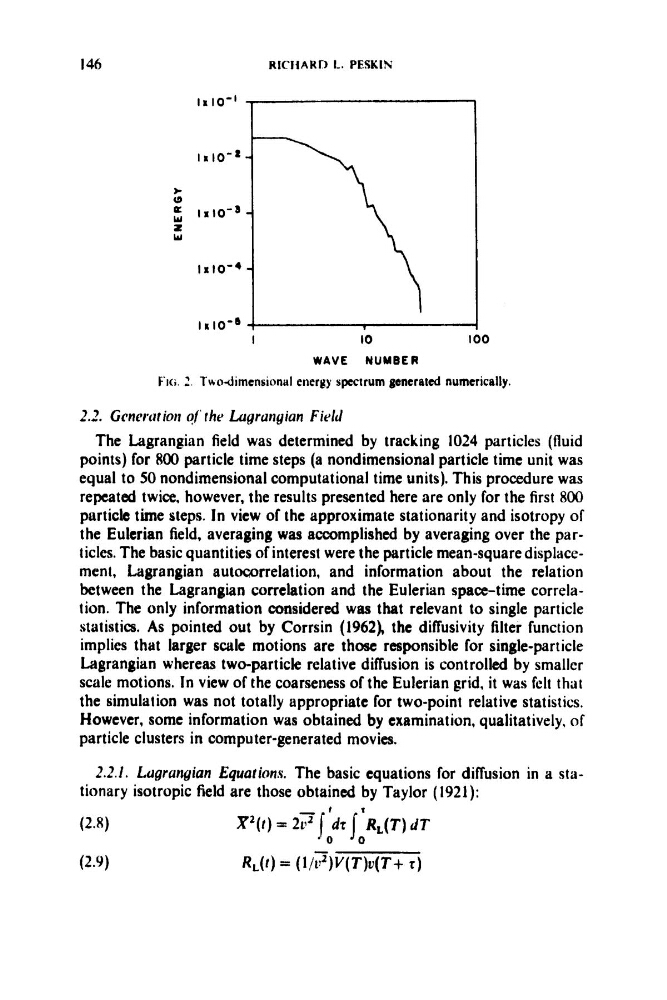
FIG. 2. Twoilirnensional energy spectrum generated numerically.
2.2. Gcnerctrion of' rhe Lcrgrangian Field
The Lagrangian field was determined by tracking 1024 particles (fluid
points) for 800 particle time steps (a nondimensional particle time unit was
equal to 50 nondimensional computational time units). This procedure was
repeated twice, however, the results presented here are only for the first 800
purticb time steps. in view of the approximate stationarity and isotropy of
the Eulerian field, averaging was accomplished by averaging over the particles. The basic quantities of interest were the particle mean-square displacement, Lagrangian autwrrelation, and information about the relation
between the Lagrangian correlation and the Eulerian space-time correlation. The only information considered was that relevant to single particle
statistics. As pointed out by Corrsin (1962), the diffusivity filter function
implics that larger scale motions are those responsible for single-particle
Lagrangian whereas two-particle relative diffusion is controlled by smaller
scale motions. In view of the coarseness of the Eulerian grid, it was felt that
the simulation was not totally appropriate for two-point relative statistics.
However, some information was obtained by examination, qualitatively, of
particle clusters in computer-generated movies.
2.2.1. Lugrungian Equafions. The basic equations for diffusion in a stationary isotropic field are those obtained by Taylor (1921):
- '
'
' 0
0
X2(0 = 2tl2 1 dr R,(T) dT
& ( I ) = (l/;;T)V(T)"(T+ t)
RICIiARD I-. PESKIN
*
0
W
2
W
a
I X l O ' *
I 1 10-3
1x10''
I
10
100
W A V E NUMBER
FIG. 2. Twoilirnensional energy spectrum generated numerically.
2.2. Gcnerctrion of' rhe Lcrgrangian Field
The Lagrangian field was determined by tracking 1024 particles (fluid
points) for 800 particle time steps (a nondimensional particle time unit was
equal to 50 nondimensional computational time units). This procedure was
repeated twice, however, the results presented here are only for the first 800
purticb time steps. in view of the approximate stationarity and isotropy of
the Eulerian field, averaging was accomplished by averaging over the particles. The basic quantities of interest were the particle mean-square displacement, Lagrangian autwrrelation, and information about the relation
between the Lagrangian correlation and the Eulerian space-time correlation. The only information considered was that relevant to single particle
statistics. As pointed out by Corrsin (1962), the diffusivity filter function
implics that larger scale motions are those responsible for single-particle
Lagrangian whereas two-particle relative diffusion is controlled by smaller
scale motions. In view of the coarseness of the Eulerian grid, it was felt that
the simulation was not totally appropriate for two-point relative statistics.
However, some information was obtained by examination, qualitatively, of
particle clusters in computer-generated movies.
2.2.1. Lugrungian Equafions. The basic equations for diffusion in a stationary isotropic field are those obtained by Taylor (1921):
- '
'
' 0
0
X2(0 = 2tl2 1 dr R,(T) dT
& ( I ) = (l/;;T)V(T)"(T+ t)