

3 3. 'T/imwl Comirlcrul iorrs
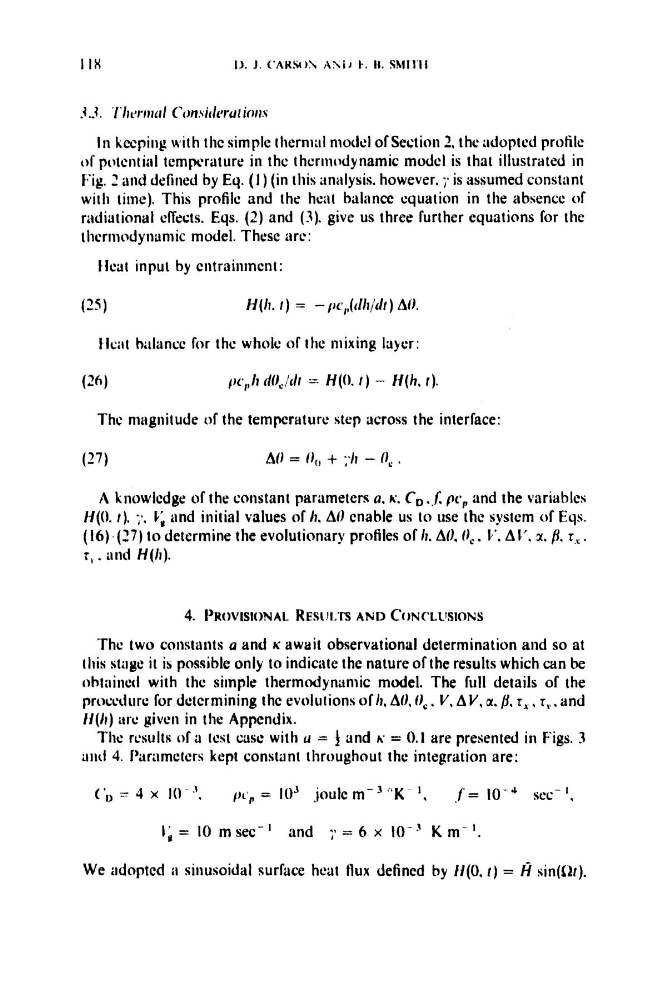
In kccping with thc simple therniul model of Section 2. thc adopted profilc
of potential tcmprature in thc therinodynamic model is that illustrated in
Fig. 2 and defined by Eq. ( I ) (in this analysis. however. ;' is assumed constant
with time). This profile and the heat bali1na equation in the absence of
riidiational effects. Eqs. (2) and (3). give us three further equations for the
thcrniodynaniic model. These arc:
llcat input by entrainment:
I k i t hihncc for the whole of the mixing laycr
Thc magnitude of the temperature step across the interface:
A knowlcdge of the constant parameters u. Y. CD ..I: pc,, and the variables
/I((). I). ;', C. ; and initial values of It. A[] enable us to use the system of Eys.
(16) (27) to detormine the evolutionary profiles of / I . AO, Oc. I/', Al', z. p. y r .
1, . iilld H(h).
4. PROVISIONAL HES111.TS AND CONCLUSIONS
The two constants a and K await observational determination and so at
this stiiec it is possible only to indicotc the nature ofthe results which can be
(htilinetl with the simple thermodynaniic model. The full details of the
priwdurc for dctcrmining thc cvolutions ofh. AO, 0,. I/. AV, a. /I. r, , T,, and
/ ] ( / I ) ure given in the Appendix.
The rcsults ofa test case with u = f and K = 0.1 are presented in Figs. 3
uiid 4. I'arumeters kept constant throughout the integration are:
I ; = 10 msec-I and ;1=6 x
Km".
We iidoptcd i t siiiusoidal surface heat flux defined by 1f(O. I ) = f i sin(fL).
In kccping with thc simple therniul model of Section 2. thc adopted profilc
of potential tcmprature in thc therinodynamic model is that illustrated in
Fig. 2 and defined by Eq. ( I ) (in this analysis. however. ;' is assumed constant
with time). This profile and the heat bali1na equation in the absence of
riidiational effects. Eqs. (2) and (3). give us three further equations for the
thcrniodynaniic model. These arc:
llcat input by entrainment:
I k i t hihncc for the whole of the mixing laycr
Thc magnitude of the temperature step across the interface:
A knowlcdge of the constant parameters u. Y. CD ..I: pc,, and the variables
/I((). I). ;', C. ; and initial values of It. A[] enable us to use the system of Eys.
(16) (27) to detormine the evolutionary profiles of / I . AO, Oc. I/', Al', z. p. y r .
1, . iilld H(h).
4. PROVISIONAL HES111.TS AND CONCLUSIONS
The two constants a and K await observational determination and so at
this stiiec it is possible only to indicotc the nature ofthe results which can be
(htilinetl with the simple thermodynaniic model. The full details of the
priwdurc for dctcrmining thc cvolutions ofh. AO, 0,. I/. AV, a. /I. r, , T,, and
/ ] ( / I ) ure given in the Appendix.
The rcsults ofa test case with u = f and K = 0.1 are presented in Figs. 3
uiid 4. I'arumeters kept constant throughout the integration are:
I ; = 10 msec-I and ;1=6 x
Km".
We iidoptcd i t siiiusoidal surface heat flux defined by 1f(O. I ) = f i sin(fL).