

I (a'
L
0
2
4
6
8
10
timo Ihr)
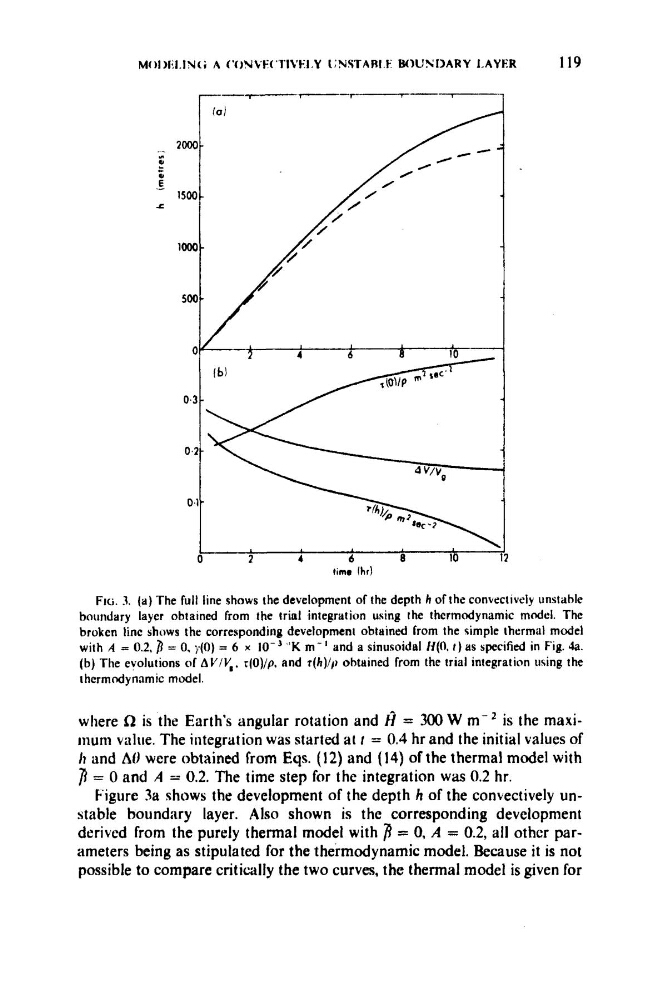
FIG. (a) The full line shows the development of the depth h of the convectively tin able
boundary layer obtained from the trinl integration using the thermodynamic model. The
broken line shows the corresponding development obtained from the simple thermal model
with 4 = 0.2, = 0, ~ ( 0 )
= 6 x lo-' 'K m - ' and a sinusoidal II(0. t ) as specified in Fig. .la.
(b) The evolutions of AV/<. r(O)/p, and T ( h ) / p obtained from the trial integration wing the
thcrmndynamic model.
where f2 is the Earth's angular rotation and H = 300 W m-' is the maximum value. The integration was started at I = 0.4 hr and the initial values of
It and A0 were obtained from Eqs. (12) and (14) of the thermal model with
7, = 0 and A = 0.2. The time step for the integration was 0.2 hr.
Figure 3a shows the development of the depth h of the convectively unstable boundary layer. Also shown is the corresponding development
derived from the purely thermaJ model with p = 0, A = 0.2, all other parameters being as stipulated for the thermodynamic model. Because it is not
possible to compare critically the two curves, the thermal model is given for
L
0
2
4
6
8
10
timo Ihr)
FIG. (a) The full line shows the development of the depth h of the convectively tin able
boundary layer obtained from the trinl integration using the thermodynamic model. The
broken line shows the corresponding development obtained from the simple thermal model
with 4 = 0.2, = 0, ~ ( 0 )
= 6 x lo-' 'K m - ' and a sinusoidal II(0. t ) as specified in Fig. .la.
(b) The evolutions of AV/<. r(O)/p, and T ( h ) / p obtained from the trial integration wing the
thcrmndynamic model.
where f2 is the Earth's angular rotation and H = 300 W m-' is the maximum value. The integration was started at I = 0.4 hr and the initial values of
It and A0 were obtained from Eqs. (12) and (14) of the thermal model with
7, = 0 and A = 0.2. The time step for the integration was 0.2 hr.
Figure 3a shows the development of the depth h of the convectively unstable boundary layer. Also shown is the corresponding development
derived from the purely thermaJ model with p = 0, A = 0.2, all other parameters being as stipulated for the thermodynamic model. Because it is not
possible to compare critically the two curves, the thermal model is given for