

MODEL.ING A C'ONVECI1VEl.Y 1JNSTABI.t BOUNDARY LAYER
117
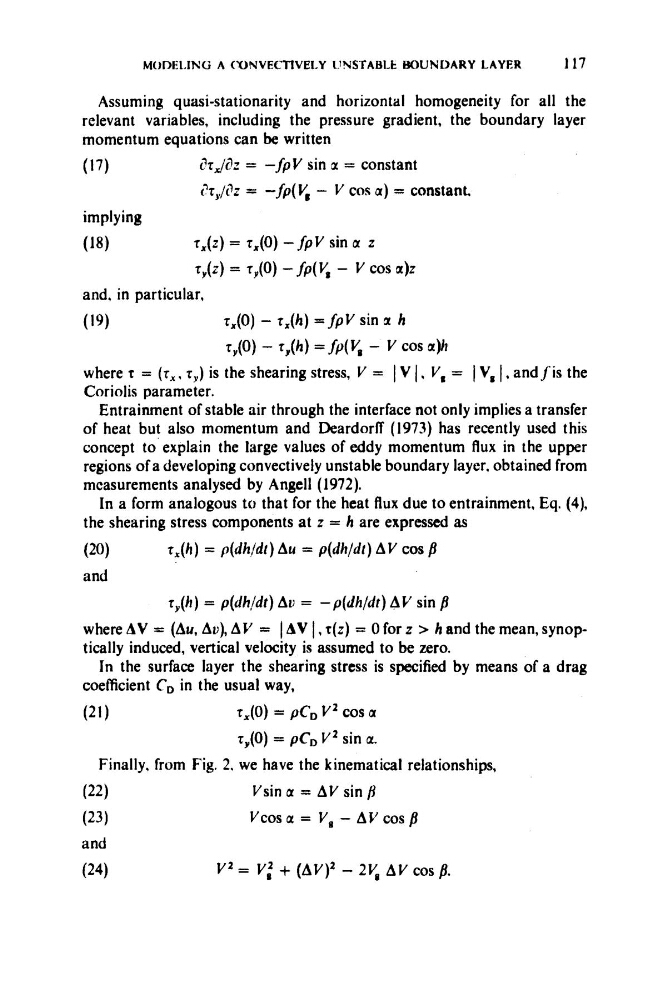
Assuming quasi-stationarity and horizontal homogeneity for all the
relevant variables, including the pressure gradient, the boundary layer
momentum equations can be written
(17)
2tJ& = -fpV sin o! = constant
?T,./& = -fp( V, - V cos a ) = constant.
implying
(18)
and, in particular,
(19)
~ ~ ( 0 )
- r,(h) =fpV sin a h
~ ~ ( 0 )
- t,(h) = fp( V, - V cos a)h
where r = ( T ~ ,
T J is the shearing stress, V = I V 1, V, = 1 Vs 1, andj'is the
Coriolis parameter.
Entrainment of stable air through the interface not only implies a transfer
of heat but also momentum and Deardorff (1973) has recently used this
concept to explain the large values of eddy momentum flux in the upper
regions of a developing convectively unstable boundary layer. obtained from
measurements analysed by Angel1 (1972).
In a form analogous to that for the heat flux due to entrainment, Eq. (4),
the shearing stress components at z = h are expressed as
(20)
T,(z) = TJO) - fp V sin a z
fy(z) = ~ ~ ( 0 )
-fp(V, - I/ cos a)z
z,(h) = p(dh/dt) AU = p(dk/dt) AV cos
and
tY(h) = p(dh,/dt) Au = -p(dh/dr) A Y sin / I
where hV = (Au, Ao), A V = I AV 1, K(Z) = 0 for z > hand the mean, synoptically induced, vertical velocity is assumed to be zero.
In the surface layer the shearing stress is specified by means of a drag
coefficient CD in the usual way,
(21)
t,(O) = pCD V z cos a
t,(O) = pC, v2 sin a.
Finally, from Fig. 2. we have the kinematical relationships,
(22)
(23)
and
Vsin a = A V sin p
Vcos a = Y , - A Y cos fl
(24)
V 2 = Y i + (AV)' - 2V, A V cos 8.
117
Assuming quasi-stationarity and horizontal homogeneity for all the
relevant variables, including the pressure gradient, the boundary layer
momentum equations can be written
(17)
2tJ& = -fpV sin o! = constant
?T,./& = -fp( V, - V cos a ) = constant.
implying
(18)
and, in particular,
(19)
~ ~ ( 0 )
- r,(h) =fpV sin a h
~ ~ ( 0 )
- t,(h) = fp( V, - V cos a)h
where r = ( T ~ ,
T J is the shearing stress, V = I V 1, V, = 1 Vs 1, andj'is the
Coriolis parameter.
Entrainment of stable air through the interface not only implies a transfer
of heat but also momentum and Deardorff (1973) has recently used this
concept to explain the large values of eddy momentum flux in the upper
regions of a developing convectively unstable boundary layer. obtained from
measurements analysed by Angel1 (1972).
In a form analogous to that for the heat flux due to entrainment, Eq. (4),
the shearing stress components at z = h are expressed as
(20)
T,(z) = TJO) - fp V sin a z
fy(z) = ~ ~ ( 0 )
-fp(V, - I/ cos a)z
z,(h) = p(dh/dt) AU = p(dk/dt) AV cos
and
tY(h) = p(dh,/dt) Au = -p(dh/dr) A Y sin / I
where hV = (Au, Ao), A V = I AV 1, K(Z) = 0 for z > hand the mean, synoptically induced, vertical velocity is assumed to be zero.
In the surface layer the shearing stress is specified by means of a drag
coefficient CD in the usual way,
(21)
t,(O) = pCD V z cos a
t,(O) = pC, v2 sin a.
Finally, from Fig. 2. we have the kinematical relationships,
(22)
(23)
and
Vsin a = A V sin p
Vcos a = Y , - A Y cos fl
(24)
V 2 = Y i + (AV)' - 2V, A V cos 8.