

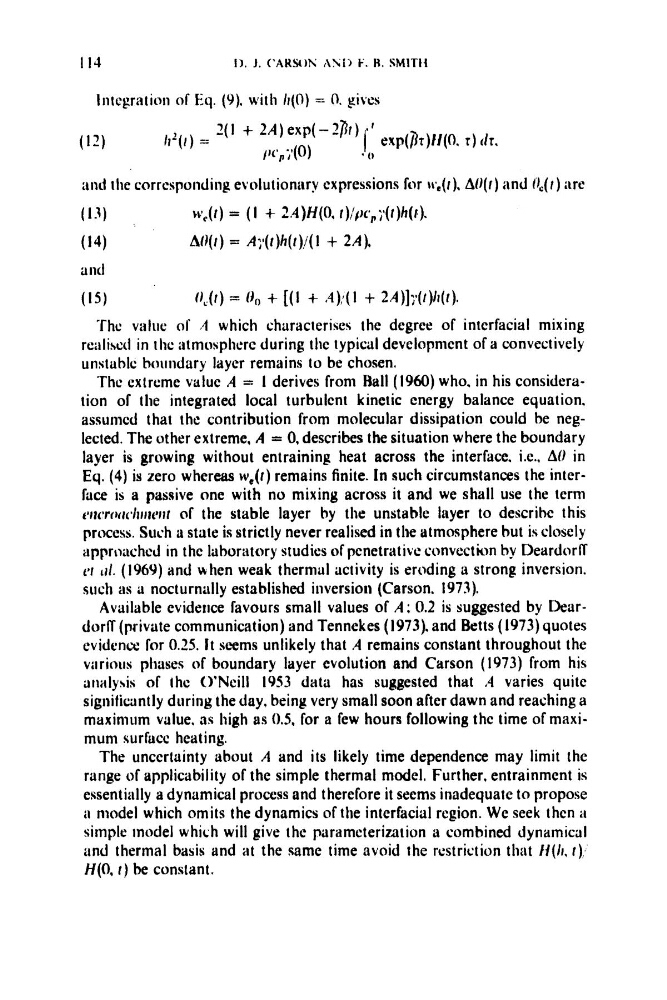
liitegration of Eq. (9). with I#)) = 0. sivcs
and the corresponding evolutionary expressions for we(/). All(/) and (I,(!) itre
(13)
(14)
and
(15)
The vialue or A which characterises the degree of interfacial mixing
rciilid in the iitmospherc during the typical development of a convectively
unstable houndary layer remains to be chosen.
'The extreme value A = I derives from Hall (1960) who. in his consideration of the integrated local turbulent kinetic energy balance equation.
assuincd that the contribution from molecular dissipation could be neglected. The other extreme, A = 0. describes the situation where the boundary
layer is growing without entraining heat across the interface. i.e., A0 in
Eq. (4) is zero whereas w&) remains finite. In such circumstances the interface is a passive one with no mixing across it and we shall use the term
t~ttcrc~trt~/ir~terit of the stable layer by the unstable layer to describe this
process. Such a state is strictly never realised in the atmosphere but is closely
approached in the laboratory studies of penetrative convection hy Deardorff
1'1 d. (1969) and when weak thermal activity is eroding a strong inversion.
such as a nocturnally established inversion (Carson. 1973).
Available evidence favours small values of A ; 0.2 is suggested by Deardorfl (private communication) and Tennekes (1973). and Bctts (1973) quotes
evidence for 0.25. It seems unlikely that A remains constant throughout the
vilrioils phases of boundary layer evolution and Carson (1973) from his
imiilysis of thc O'Neill 1953 data has suggested that ,4 varies quite
signiticanrly during the day, being very small soon after dawn and reaching a
maximum value. as high as 0.5, for a few hours following the time of maximum su r fucc heating.
The uncertainty about A and its likely time dependence may limit the
range of applicability of the simple thermal modcl. Further, entrainment is
essentially a dynamical process and therefore it seems inadequate to propose
il niodel which omits the dynamics ofthe interfacial region. We seek then il
simple model which will give the parameterization a combined dynamical
and thermal basis and at the same time avoid the restriction that If(/], t),,'
H(0. t ) be constant.
w&) = ( I + 2.4)H(O, t)/pcpj'(t)h(l.).
All(/) = A;(t)h(t)/(l + 2A),
O,(/) = tl0 + [(I + .4);( 1 + ~A)]?(/)/I(/).
and the corresponding evolutionary expressions for we(/). All(/) and (I,(!) itre
(13)
(14)
and
(15)
The vialue or A which characterises the degree of interfacial mixing
rciilid in the iitmospherc during the typical development of a convectively
unstable houndary layer remains to be chosen.
'The extreme value A = I derives from Hall (1960) who. in his consideration of the integrated local turbulent kinetic energy balance equation.
assuincd that the contribution from molecular dissipation could be neglected. The other extreme, A = 0. describes the situation where the boundary
layer is growing without entraining heat across the interface. i.e., A0 in
Eq. (4) is zero whereas w&) remains finite. In such circumstances the interface is a passive one with no mixing across it and we shall use the term
t~ttcrc~trt~/ir~terit of the stable layer by the unstable layer to describe this
process. Such a state is strictly never realised in the atmosphere but is closely
approached in the laboratory studies of penetrative convection hy Deardorff
1'1 d. (1969) and when weak thermal activity is eroding a strong inversion.
such as a nocturnally established inversion (Carson. 1973).
Available evidence favours small values of A ; 0.2 is suggested by Deardorfl (private communication) and Tennekes (1973). and Bctts (1973) quotes
evidence for 0.25. It seems unlikely that A remains constant throughout the
vilrioils phases of boundary layer evolution and Carson (1973) from his
imiilysis of thc O'Neill 1953 data has suggested that ,4 varies quite
signiticanrly during the day, being very small soon after dawn and reaching a
maximum value. as high as 0.5, for a few hours following the time of maximum su r fucc heating.
The uncertainty about A and its likely time dependence may limit the
range of applicability of the simple thermal modcl. Further, entrainment is
essentially a dynamical process and therefore it seems inadequate to propose
il niodel which omits the dynamics ofthe interfacial region. We seek then il
simple model which will give the parameterization a combined dynamical
and thermal basis and at the same time avoid the restriction that If(/], t),,'
H(0. t ) be constant.
w&) = ( I + 2.4)H(O, t)/pcpj'(t)h(l.).
All(/) = A;(t)h(t)/(l + 2A),
O,(/) = tl0 + [(I + .4);( 1 + ~A)]?(/)/I(/).