

MOI )lil,lNC; A (‘0NVECTIVEI.Y IlNSTAB1.E ROUNDARY LAYER
I IS
3. A SIMPLE THERMODYNAMIC MODEL
3.1. The Eatruinrncwt Process
Observations such as those of Readings ct a/. (1973) and Browning c’r ul.
(1973) show that in general there is not only a temperature change across the
convoluted interface between the deepening convectively unstable boundary
layer and the capping stable layer but also a finite shear in the wind velocity.
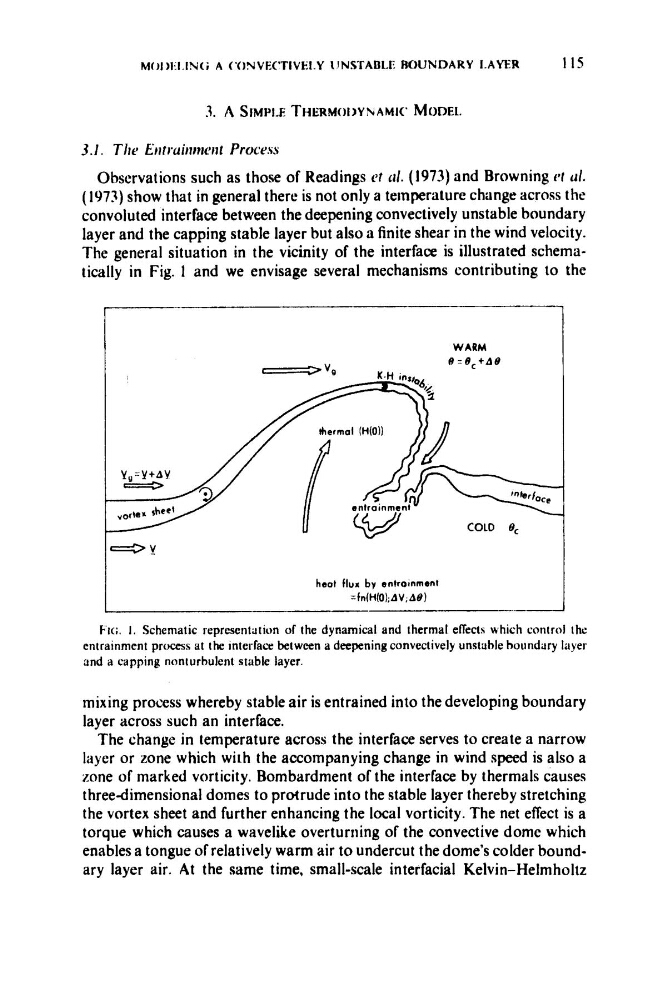
The general situation in the vicinity of the interface is illustrated schematically in Fig. 1 and we envisage several mechanisms contributing to
WARM
the
heat flUK by enlrainment
=fn(H(Ol,AV,A8)
______
FIG, 1. Schematic representation of the dynamical and thermal erects hhich control the
entrainment pr(JCeSS at the rnterfacv betwcen a deepening convectively unstahle hounddry layer
and a capping nonturbulent stable layer.
mixing process whereby stable air is entrained into the developing boundary
layer across such an interface.
The change in temperature across the interface serves to create a narrow
layer or zone which with the accompanying change in wind speed is also a
zone of marked vorticity. Bombardment of the interface by thermals causes
threedimensional domes to protrude into the stable layer thereby stretching
the vortex sheet and further enhancing the local vorticity. The net effect is a
torque which causes a wavelike overturning of the convective dome which
enables a tongue of relatively warm air to undercut the dome’s colder boundary layer air. At the same time, small-scale interfacial Kelvin-Helmholtz
I IS
3. A SIMPLE THERMODYNAMIC MODEL
3.1. The Eatruinrncwt Process
Observations such as those of Readings ct a/. (1973) and Browning c’r ul.
(1973) show that in general there is not only a temperature change across the
convoluted interface between the deepening convectively unstable boundary
layer and the capping stable layer but also a finite shear in the wind velocity.
The general situation in the vicinity of the interface is illustrated schematically in Fig. 1 and we envisage several mechanisms contributing to
WARM
the
heat flUK by enlrainment
=fn(H(Ol,AV,A8)
______
FIG, 1. Schematic representation of the dynamical and thermal erects hhich control the
entrainment pr(JCeSS at the rnterfacv betwcen a deepening convectively unstahle hounddry layer
and a capping nonturbulent stable layer.
mixing process whereby stable air is entrained into the developing boundary
layer across such an interface.
The change in temperature across the interface serves to create a narrow
layer or zone which with the accompanying change in wind speed is also a
zone of marked vorticity. Bombardment of the interface by thermals causes
threedimensional domes to protrude into the stable layer thereby stretching
the vortex sheet and further enhancing the local vorticity. The net effect is a
torque which causes a wavelike overturning of the convective dome which
enables a tongue of relatively warm air to undercut the dome’s colder boundary layer air. At the same time, small-scale interfacial Kelvin-Helmholtz