

MODELING A CONVECTIVELY IINSTABLE BOL'NDARY LAYER
113
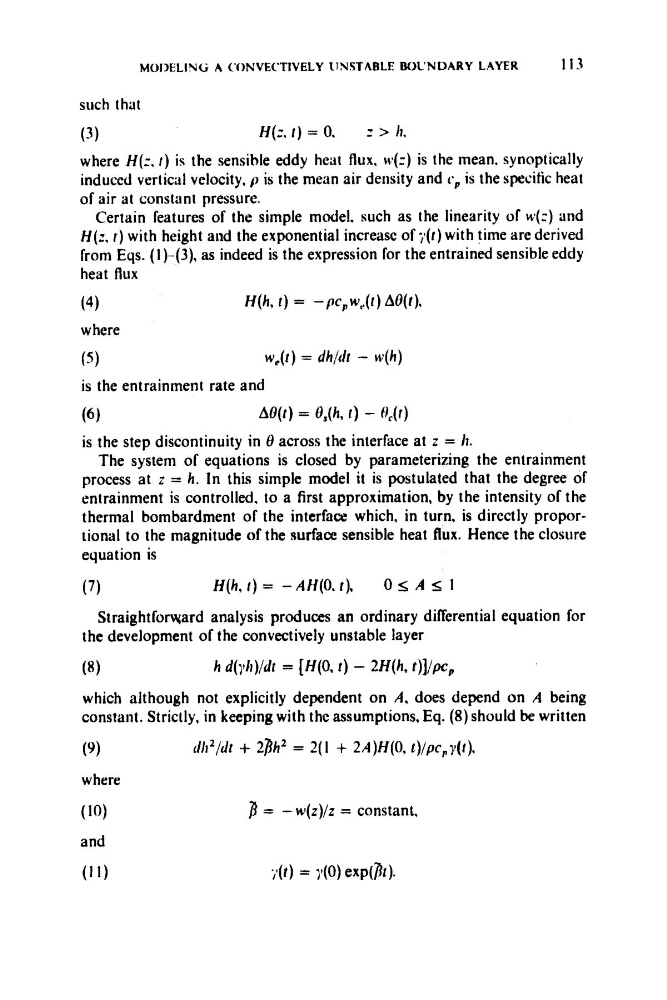
such that
(3)
H(z.1) = 0.
: > It,
where H(z. I ) is the sensible eddy heat flux. w(:) is the mean. synoptically
induced vertical velocity, p is the mean air density and cP i s the specific heat
of air at constant pressure.
Certain features of the simple model. such as the linearity of w(:) and
H ( z . I ) with height and the exponential increase of ~ ( t )
with time are derived
from Eqs. (l)-(3), as indeed is the expression for the entrained sensible eddy
heat flux
(4)
lf(h, t ) = -pc,w,,(t) AW),
where
( 5 )
is the entrainment rate and
( 6 )
AO(C) = e,p, t ) - e,(r)
is the step discontinuity in 0 across the interface at z = 11.
The system of equations is closed by parameteriiing the entrainment
process at z = h. In this simple model it is postulated that the degree of
entrainment is controlled. to a first approximation, by the intensity of the
thermal bombardment of the interface which, in turn, is directly proportional to the magnitude o f the surface sensible heat flux. Hence the closure
equation is
(7)
H(h, I ) = - AH(0. t ) ,
0 I ; A I I
Straightforyard analysis produces an ordinary differential equation for
the development of the convectively unstable layer
(8)
h d()!l~)/dt = [H(O. t ) - 2H(h, t)]/wp
which although not explicitly dependent on A, does depend on A being
constant. Strictly, in keeping with the assumptions, Eq. (8) should be written
( 9 )
rlI12/clf + 272h2 = 2( I + 2A)H(O, t)/pc,y(r).
where
(10)
and
( 1 1 )
At) = Y(0) exp(j?d.
8 = - w(z)/z = constant,
113
such that
(3)
H(z.1) = 0.
: > It,
where H(z. I ) is the sensible eddy heat flux. w(:) is the mean. synoptically
induced vertical velocity, p is the mean air density and cP i s the specific heat
of air at constant pressure.
Certain features of the simple model. such as the linearity of w(:) and
H ( z . I ) with height and the exponential increase of ~ ( t )
with time are derived
from Eqs. (l)-(3), as indeed is the expression for the entrained sensible eddy
heat flux
(4)
lf(h, t ) = -pc,w,,(t) AW),
where
( 5 )
is the entrainment rate and
( 6 )
AO(C) = e,p, t ) - e,(r)
is the step discontinuity in 0 across the interface at z = 11.
The system of equations is closed by parameteriiing the entrainment
process at z = h. In this simple model it is postulated that the degree of
entrainment is controlled. to a first approximation, by the intensity of the
thermal bombardment of the interface which, in turn, is directly proportional to the magnitude o f the surface sensible heat flux. Hence the closure
equation is
(7)
H(h, I ) = - AH(0. t ) ,
0 I ; A I I
Straightforyard analysis produces an ordinary differential equation for
the development of the convectively unstable layer
(8)
h d()!l~)/dt = [H(O. t ) - 2H(h, t)]/wp
which although not explicitly dependent on A, does depend on A being
constant. Strictly, in keeping with the assumptions, Eq. (8) should be written
( 9 )
rlI12/clf + 272h2 = 2( I + 2A)H(O, t)/pc,y(r).
where
(10)
and
( 1 1 )
At) = Y(0) exp(j?d.
8 = - w(z)/z = constant,