

112
D. J. CARSON AND F. B. SMITH
rapidly evolving daytime convectively unstable layer which is generally
capped by a nonturbulent stable layer. Two of the main factors controlling
the development of the convective layer are the flux of sensible eddy heat
entering the boundary layer at the ground and also a turbulent mixing
process which occurs at the interface between the well-mixed boundary layer
air and the nonturbulent air in the capping stable layer. The process whereby stable air from above is mixed into the developing convectively unstable
boundary layer is called entrainment.
The part played by the dynamics in the entrainment process has received
little attention and the simplest parameterizations treat it from purely thermal considerations. However, recent observations (Readings er a/.. 1973)
indicate that wind shear at the interface may be of fundamental importance
not only to the entrainment of eddy momentum but also of eddy sensible
(and latent) heat.
This contribution sets out (i) to draw attention to the general results and
limitations of the simple thermal approach, and (ii) to provide a combined. if
grossly simplified, dynamical and thermal approach to the parameterization
of the entrainment process and the development of the convectively unstable
boundary layer.
2. SIMPLE THERMAL MODELS
The history of simple thermal models for parameterizing the development
of the convectively unstable boundary layer capped by a stable layer can be
traced through the papers of Ball (1960), Lilly (1968). Deardormer a/. (1969).
Tennekes (1973) and Carson (1973). We summarize here the method and
results of the model discussed in depth by Carson (1973) and independently
proposed by Betts (1973).
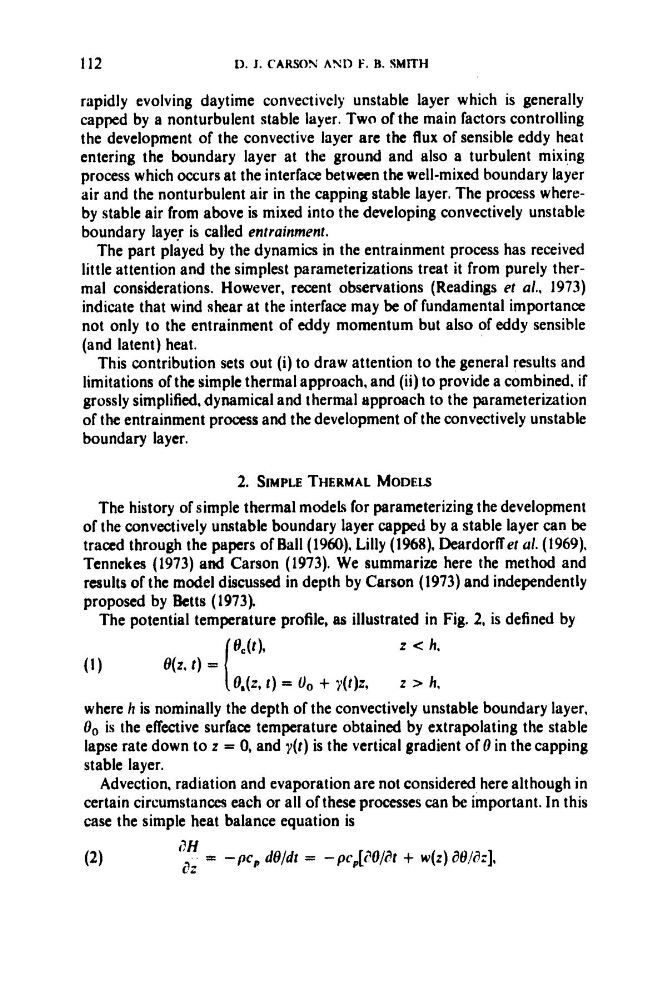
The potential temperature profile, as illustrated in Fig. 2, is defined by
@At)(
L < h.
(1)
o(z. r ) = [
O,(t, I ) = Uo + r(r)z, z > h,
where h is nominally the depth of the convectively unstable boundary layer,
O0 is the effective surface temperature obtained by extrapolating the stable
lapse rate down to z = 0, and y ( t ) is the vertical gradient of 0 in the capping
stable layer.
Advection. radiation and evaporation are not considered here although in
certain circumstances each or all of these processes can be important. In this
case the simple heat balance equation is
D. J. CARSON AND F. B. SMITH
rapidly evolving daytime convectively unstable layer which is generally
capped by a nonturbulent stable layer. Two of the main factors controlling
the development of the convective layer are the flux of sensible eddy heat
entering the boundary layer at the ground and also a turbulent mixing
process which occurs at the interface between the well-mixed boundary layer
air and the nonturbulent air in the capping stable layer. The process whereby stable air from above is mixed into the developing convectively unstable
boundary layer is called entrainment.
The part played by the dynamics in the entrainment process has received
little attention and the simplest parameterizations treat it from purely thermal considerations. However, recent observations (Readings er a/.. 1973)
indicate that wind shear at the interface may be of fundamental importance
not only to the entrainment of eddy momentum but also of eddy sensible
(and latent) heat.
This contribution sets out (i) to draw attention to the general results and
limitations of the simple thermal approach, and (ii) to provide a combined. if
grossly simplified, dynamical and thermal approach to the parameterization
of the entrainment process and the development of the convectively unstable
boundary layer.
2. SIMPLE THERMAL MODELS
The history of simple thermal models for parameterizing the development
of the convectively unstable boundary layer capped by a stable layer can be
traced through the papers of Ball (1960), Lilly (1968). Deardormer a/. (1969).
Tennekes (1973) and Carson (1973). We summarize here the method and
results of the model discussed in depth by Carson (1973) and independently
proposed by Betts (1973).
The potential temperature profile, as illustrated in Fig. 2, is defined by
@At)(
L < h.
(1)
o(z. r ) = [
O,(t, I ) = Uo + r(r)z, z > h,
where h is nominally the depth of the convectively unstable boundary layer,
O0 is the effective surface temperature obtained by extrapolating the stable
lapse rate down to z = 0, and y ( t ) is the vertical gradient of 0 in the capping
stable layer.
Advection. radiation and evaporation are not considered here although in
certain circumstances each or all of these processes can be important. In this
case the simple heat balance equation is