

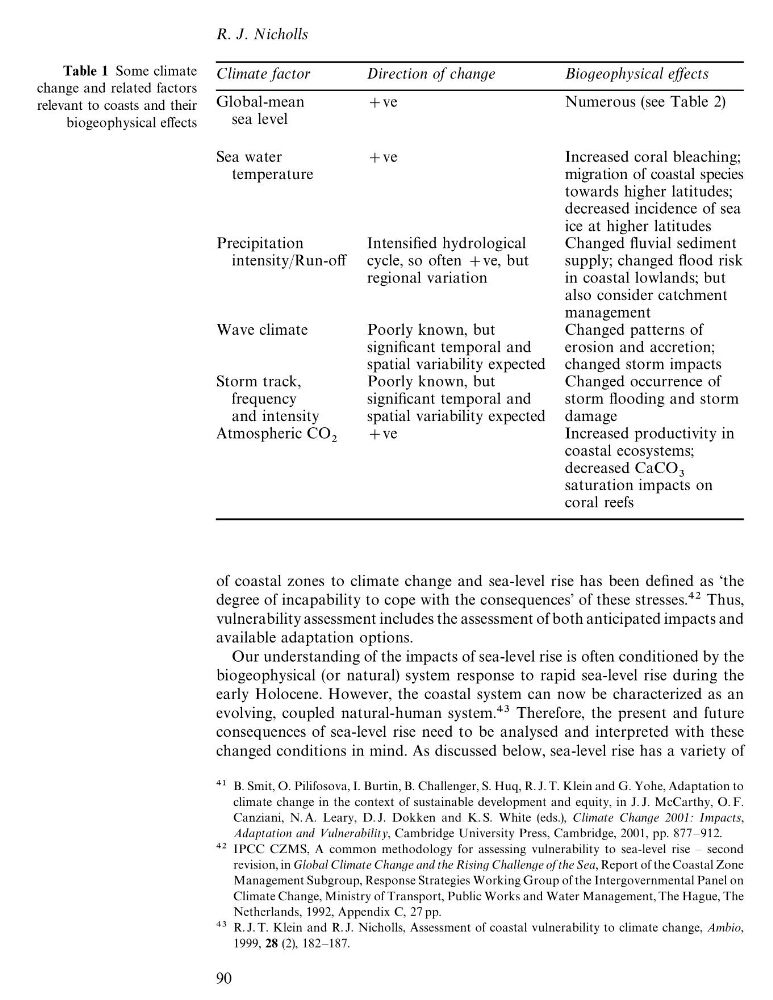
Table 1 Some climate
change and related factors
relevant to coasts and their
biogeophysical effects
Climate factor
Direction of change
Biogeophysical effects
Global-mean
sea level
;ve
Numerous (see Table 2)
Sea water
temperature
;ve
Increased coral bleaching;
migration of coastal species
towards higher latitudes;
decreased incidence of sea
ice at higher latitudes
Precipitation
intensity/Run-off
Intensified hydrological
cycle, so often ;ve, but
regional variation
Changed fluvial sediment
supply; changed flood risk
in coastal lowlands; but
also consider catchment
management
Wave climate
Poorly known, but
significant temporal and
spatial variability expected
Changed patterns of
erosion and accretion;
changed storm impacts
Storm track,
frequency
and intensity
Poorly known, but
significant temporal and
spatial variability expected
Changed occurrence of
storm flooding and storm
damage
Atmospheric CO
;ve
Increased productivity in
coastal ecosystems;
decreased CaCO
saturation impacts on
coral reefs
of coastal zones to climate change and sea-level rise has been defined as ‘the
degree of incapability to cope with the consequences’ of these stresses. Thus,
vulnerability assessment includes the assessment of both anticipated impacts and
available adaptation options.
Our understanding of the impacts of sea-level rise is often conditioned by the
biogeophysical (or natural) system response to rapid sea-level rise during the
early Holocene. However, the coastal system can now be characterized as an
evolving, coupled natural-human system. Therefore, the present and future
consequences of sea-level rise need to be analysed and interpreted with these
changed conditions in mind. As discussed below, sea-level rise has a variety of
B. Smit, O. Pilifosova, I. Burtin, B. Challenger, S. Huq, R. J. T. Klein and G. Yohe, Adaptation to
climate change in the context of sustainable development and equity, in J. J. McCarthy, O. F.
Canziani, N. A. Leary, D. J. Dokken and K. S. White (eds.), Climate Change 2001: Impacts,
Adaptation and Vulnerability, Cambridge University Press, Cambridge, 2001, pp. 877—912.
IPCC CZMS, A common methodology for assessing vulnerability to sea-level rise — second
revision, in Global Climate Change and the Rising Challenge of the Sea, Report of the Coastal Zone
Management Subgroup, Response Strategies Working Group of the Intergovernmental Panel on
Climate Change, Ministry of Transport, Public Works and Water Management, The Hague, The
Netherlands, 1992, Appendix C, 27 pp.
R. J. T. Klein and R. J. Nicholls, Assessment of coastal vulnerability to climate change, Ambio,
1999, 28 (2), 182—187.
R. J. Nicholls
90
change and related factors
relevant to coasts and their
biogeophysical effects
Climate factor
Direction of change
Biogeophysical effects
Global-mean
sea level
;ve
Numerous (see Table 2)
Sea water
temperature
;ve
Increased coral bleaching;
migration of coastal species
towards higher latitudes;
decreased incidence of sea
ice at higher latitudes
Precipitation
intensity/Run-off
Intensified hydrological
cycle, so often ;ve, but
regional variation
Changed fluvial sediment
supply; changed flood risk
in coastal lowlands; but
also consider catchment
management
Wave climate
Poorly known, but
significant temporal and
spatial variability expected
Changed patterns of
erosion and accretion;
changed storm impacts
Storm track,
frequency
and intensity
Poorly known, but
significant temporal and
spatial variability expected
Changed occurrence of
storm flooding and storm
damage
Atmospheric CO
;ve
Increased productivity in
coastal ecosystems;
decreased CaCO
saturation impacts on
coral reefs
of coastal zones to climate change and sea-level rise has been defined as ‘the
degree of incapability to cope with the consequences’ of these stresses. Thus,
vulnerability assessment includes the assessment of both anticipated impacts and
available adaptation options.
Our understanding of the impacts of sea-level rise is often conditioned by the
biogeophysical (or natural) system response to rapid sea-level rise during the
early Holocene. However, the coastal system can now be characterized as an
evolving, coupled natural-human system. Therefore, the present and future
consequences of sea-level rise need to be analysed and interpreted with these
changed conditions in mind. As discussed below, sea-level rise has a variety of
B. Smit, O. Pilifosova, I. Burtin, B. Challenger, S. Huq, R. J. T. Klein and G. Yohe, Adaptation to
climate change in the context of sustainable development and equity, in J. J. McCarthy, O. F.
Canziani, N. A. Leary, D. J. Dokken and K. S. White (eds.), Climate Change 2001: Impacts,
Adaptation and Vulnerability, Cambridge University Press, Cambridge, 2001, pp. 877—912.
IPCC CZMS, A common methodology for assessing vulnerability to sea-level rise — second
revision, in Global Climate Change and the Rising Challenge of the Sea, Report of the Coastal Zone
Management Subgroup, Response Strategies Working Group of the Intergovernmental Panel on
Climate Change, Ministry of Transport, Public Works and Water Management, The Hague, The
Netherlands, 1992, Appendix C, 27 pp.
R. J. T. Klein and R. J. Nicholls, Assessment of coastal vulnerability to climate change, Ambio,
1999, 28 (2), 182—187.
R. J. Nicholls
90