

0.5
0.4
0.3
0.2
0.1
6
4
2
0
-2
-4
-6
1996
Calanus finmarchicus log-abundance
NAO index
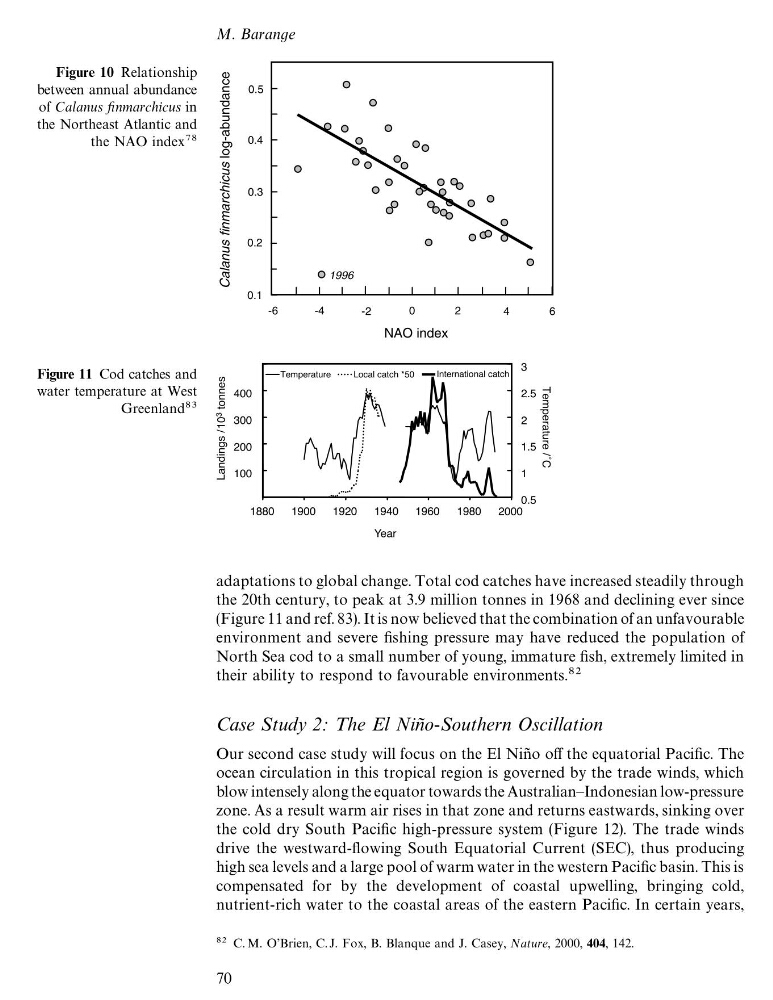
Figure 10 Relationship
between annual abundance
of Calanus finmarchicus in
the Northeast Atlantic and
the NAO index
Figure 11 Cod catches and
water temperature at West
Greenland
adaptations to global change. Total cod catches have increased steadily through
the 20th century, to peak at 3.9 million tonnes in 1968 and declining ever since
(Figure 11 and ref. 83). It is now believed that the combination of an unfavourable
environment and severe fishing pressure may have reduced the population of
North Sea cod to a small number of young, immature fish, extremely limited in
their ability to respond to favourable environments.
Case Study 2: The El Nin ˜o-Southern Oscillation
Our second case study will focus on the El Nin o off the equatorial Pacific. The
ocean circulation in this tropical region is governed by the trade winds, which
blow intensely along the equator towards the Australian—Indonesian low-pressure
zone. As a result warm air rises in that zone and returns eastwards, sinking over
the cold dry South Pacific high-pressure system (Figure 12). The trade winds
drive the westward-flowing South Equatorial Current (SEC), thus producing
high sea levels and a large pool of warm water in the western Pacific basin. This is
compensated for by the development of coastal upwelling, bringing cold,
nutrient-rich water to the coastal areas of the eastern Pacific. In certain years,
C. M. O’Brien, C. J. Fox, B. Blanque and J. Casey, Nature, 2000, 404, 142.
M. Barange
70
0.4
0.3
0.2
0.1
6
4
2
0
-2
-4
-6
1996
Calanus finmarchicus log-abundance
NAO index
Figure 10 Relationship
between annual abundance
of Calanus finmarchicus in
the Northeast Atlantic and
the NAO index
Figure 11 Cod catches and
water temperature at West
Greenland
adaptations to global change. Total cod catches have increased steadily through
the 20th century, to peak at 3.9 million tonnes in 1968 and declining ever since
(Figure 11 and ref. 83). It is now believed that the combination of an unfavourable
environment and severe fishing pressure may have reduced the population of
North Sea cod to a small number of young, immature fish, extremely limited in
their ability to respond to favourable environments.
Case Study 2: The El Nin ˜o-Southern Oscillation
Our second case study will focus on the El Nin o off the equatorial Pacific. The
ocean circulation in this tropical region is governed by the trade winds, which
blow intensely along the equator towards the Australian—Indonesian low-pressure
zone. As a result warm air rises in that zone and returns eastwards, sinking over
the cold dry South Pacific high-pressure system (Figure 12). The trade winds
drive the westward-flowing South Equatorial Current (SEC), thus producing
high sea levels and a large pool of warm water in the western Pacific basin. This is
compensated for by the development of coastal upwelling, bringing cold,
nutrient-rich water to the coastal areas of the eastern Pacific. In certain years,
C. M. O’Brien, C. J. Fox, B. Blanque and J. Casey, Nature, 2000, 404, 142.
M. Barange
70