

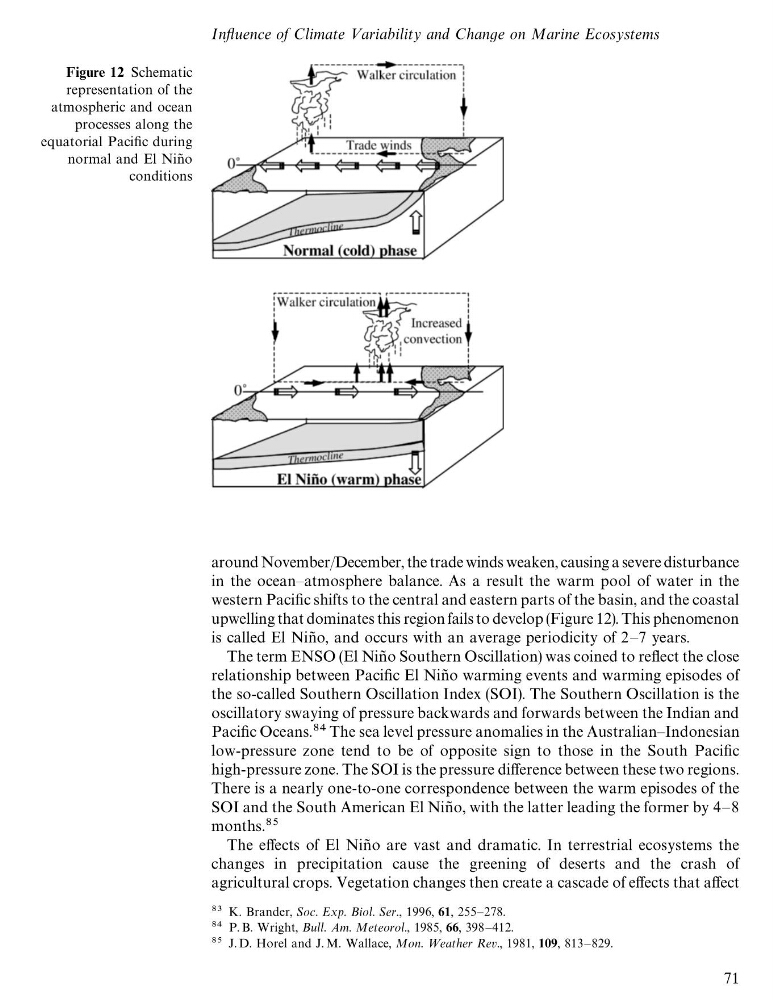
Figure 12 Schematic
representation of the
atmospheric and ocean
processes along the
equatorial Pacific during
normal and El Nin o
conditions
around November/December, the trade winds weaken, causing a severe disturbance
in the ocean—atmosphere balance. As a result the warm pool of water in the
western Pacific shifts to the central and eastern parts of the basin, and the coastal
upwelling that dominates this region fails to develop (Figure 12). This phenomenon
is called El Nin o, and occurs with an average periodicity of 2—7 years.
The term ENSO (El Nin o Southern Oscillation) was coined to reflect the close
relationship between Pacific El Nin o warming events and warming episodes of
the so-called Southern Oscillation Index (SOI). The Southern Oscillation is the
oscillatory swaying of pressure backwards and forwards between the Indian and
Pacific Oceans. The sea level pressure anomalies in the Australian—Indonesian
low-pressure zone tend to be of opposite sign to those in the South Pacific
high-pressure zone. The SOI is the pressure difference between these two regions.
There is a nearly one-to-one correspondence between the warm episodes of the
SOI and the South American El Nin o, with the latter leading the former by 4—8
months.
The effects of El Nin o are vast and dramatic. In terrestrial ecosystems the
changes in precipitation cause the greening of deserts and the crash of
agricultural crops. Vegetation changes then create a cascade of effects that affect
K. Brander, Soc. Exp. Biol. Ser., 1996, 61, 255—278.
P. B. Wright, Bull. Am. Meteorol., 1985, 66, 398—412.
J. D. Horel and J. M. Wallace, Mon. Weather Rev., 1981, 109, 813—829.
Influence of Climate Variability and Change on Marine Ecosystems
71
representation of the
atmospheric and ocean
processes along the
equatorial Pacific during
normal and El Nin o
conditions
around November/December, the trade winds weaken, causing a severe disturbance
in the ocean—atmosphere balance. As a result the warm pool of water in the
western Pacific shifts to the central and eastern parts of the basin, and the coastal
upwelling that dominates this region fails to develop (Figure 12). This phenomenon
is called El Nin o, and occurs with an average periodicity of 2—7 years.
The term ENSO (El Nin o Southern Oscillation) was coined to reflect the close
relationship between Pacific El Nin o warming events and warming episodes of
the so-called Southern Oscillation Index (SOI). The Southern Oscillation is the
oscillatory swaying of pressure backwards and forwards between the Indian and
Pacific Oceans. The sea level pressure anomalies in the Australian—Indonesian
low-pressure zone tend to be of opposite sign to those in the South Pacific
high-pressure zone. The SOI is the pressure difference between these two regions.
There is a nearly one-to-one correspondence between the warm episodes of the
SOI and the South American El Nin o, with the latter leading the former by 4—8
months.
The effects of El Nin o are vast and dramatic. In terrestrial ecosystems the
changes in precipitation cause the greening of deserts and the crash of
agricultural crops. Vegetation changes then create a cascade of effects that affect
K. Brander, Soc. Exp. Biol. Ser., 1996, 61, 255—278.
P. B. Wright, Bull. Am. Meteorol., 1985, 66, 398—412.
J. D. Horel and J. M. Wallace, Mon. Weather Rev., 1981, 109, 813—829.
Influence of Climate Variability and Change on Marine Ecosystems
71