

Phytoplankton
standardised Index
2.5
1.5
0.5
400
300
200
100
-6
-4
-2
0
2
4
6
1950
1960
1970
Year
1980
1990
2000
NAO Index
3
2
1
0
-1
Zooplankton
abundance
H. mackerel catch
(x 10 3 tonnes)
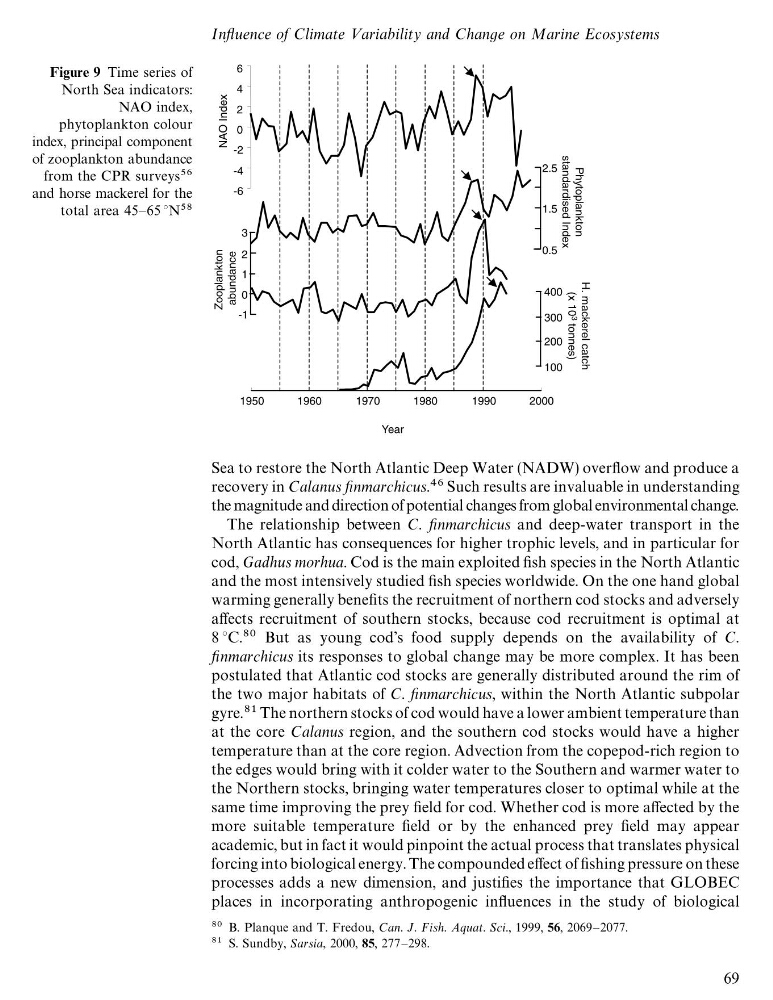
Figure 9 Time series of
North Sea indicators:
NAO index,
phytoplankton colour
index, principal component
of zooplankton abundance
from the CPR surveys
and horse mackerel for the
total area 45—65 °N
Sea to restore the North Atlantic Deep Water (NADW) overflow and produce a
recovery in Calanus finmarchicus. Such results are invaluable in understanding
the magnitude and direction of potential changes from global environmental change.
The relationship between C. finmarchicus and deep-water transport in the
North Atlantic has consequences for higher trophic levels, and in particular for
cod, Gadhus morhua. Cod is the main exploited fish species in the North Atlantic
and the most intensively studied fish species worldwide. On the one hand global
warming generally benefits the recruitment of northern cod stocks and adversely
affects recruitment of southern stocks, because cod recruitment is optimal at
8 °C. But as young cod’s food supply depends on the availability of C.
finmarchicus its responses to global change may be more complex. It has been
postulated that Atlantic cod stocks are generally distributed around the rim of
the two major habitats of C. finmarchicus, within the North Atlantic subpolar
gyre. The northern stocks of cod would have a lower ambient temperature than
at the core Calanus region, and the southern cod stocks would have a higher
temperature than at the core region. Advection from the copepod-rich region to
the edges would bring with it colder water to the Southern and warmer water to
the Northern stocks, bringing water temperatures closer to optimal while at the
same time improving the prey field for cod. Whether cod is more affected by the
more suitable temperature field or by the enhanced prey field may appear
academic, but in fact it would pinpoint the actual process that translates physical
forcing into biological energy. The compounded effect of fishing pressure on these
processes adds a new dimension, and justifies the importance that GLOBEC
places in incorporating anthropogenic influences in the study of biological
B. Planque and T. Fredou, Can. J. Fish. Aquat. Sci., 1999, 56, 2069—2077.
S. Sundby, Sarsia, 2000, 85, 277—298.
Influence of Climate Variability and Change on Marine Ecosystems
69
standardised Index
2.5
1.5
0.5
400
300
200
100
-6
-4
-2
0
2
4
6
1950
1960
1970
Year
1980
1990
2000
NAO Index
3
2
1
0
-1
Zooplankton
abundance
H. mackerel catch
(x 10 3 tonnes)
Figure 9 Time series of
North Sea indicators:
NAO index,
phytoplankton colour
index, principal component
of zooplankton abundance
from the CPR surveys
and horse mackerel for the
total area 45—65 °N
Sea to restore the North Atlantic Deep Water (NADW) overflow and produce a
recovery in Calanus finmarchicus. Such results are invaluable in understanding
the magnitude and direction of potential changes from global environmental change.
The relationship between C. finmarchicus and deep-water transport in the
North Atlantic has consequences for higher trophic levels, and in particular for
cod, Gadhus morhua. Cod is the main exploited fish species in the North Atlantic
and the most intensively studied fish species worldwide. On the one hand global
warming generally benefits the recruitment of northern cod stocks and adversely
affects recruitment of southern stocks, because cod recruitment is optimal at
8 °C. But as young cod’s food supply depends on the availability of C.
finmarchicus its responses to global change may be more complex. It has been
postulated that Atlantic cod stocks are generally distributed around the rim of
the two major habitats of C. finmarchicus, within the North Atlantic subpolar
gyre. The northern stocks of cod would have a lower ambient temperature than
at the core Calanus region, and the southern cod stocks would have a higher
temperature than at the core region. Advection from the copepod-rich region to
the edges would bring with it colder water to the Southern and warmer water to
the Northern stocks, bringing water temperatures closer to optimal while at the
same time improving the prey field for cod. Whether cod is more affected by the
more suitable temperature field or by the enhanced prey field may appear
academic, but in fact it would pinpoint the actual process that translates physical
forcing into biological energy. The compounded effect of fishing pressure on these
processes adds a new dimension, and justifies the importance that GLOBEC
places in incorporating anthropogenic influences in the study of biological
B. Planque and T. Fredou, Can. J. Fish. Aquat. Sci., 1999, 56, 2069—2077.
S. Sundby, Sarsia, 2000, 85, 277—298.
Influence of Climate Variability and Change on Marine Ecosystems
69