

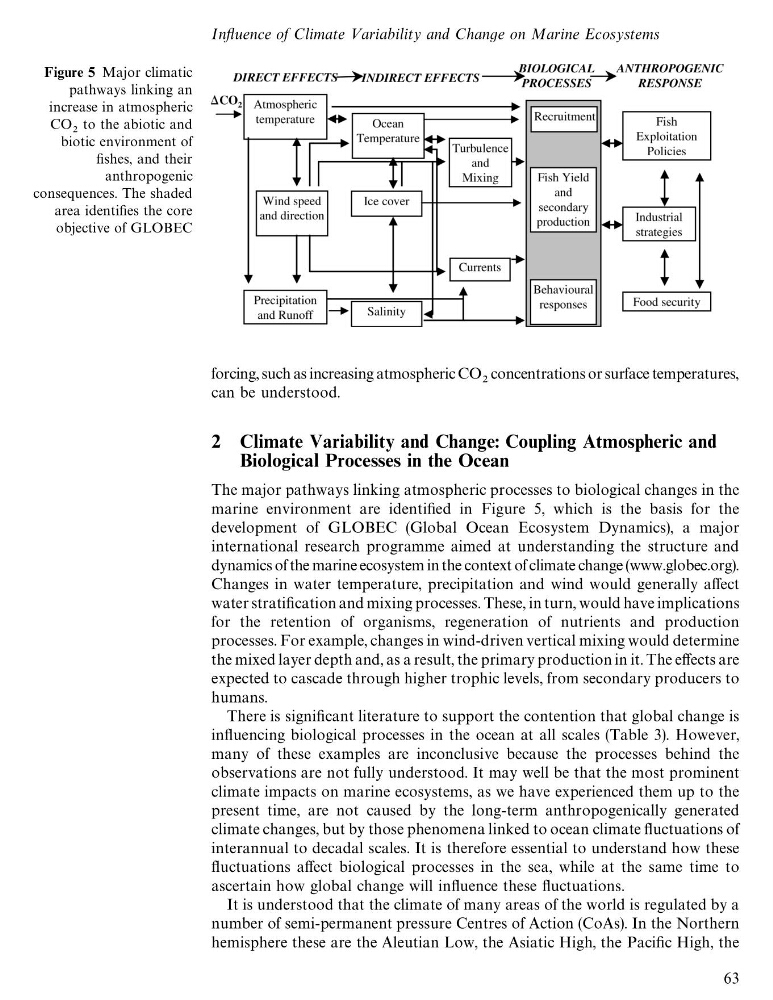
Figure 5 Major climatic
pathways linking an
increase in atmospheric
CO
to the abiotic and
biotic environment of
fishes, and their
anthropogenic
consequences. The shaded
area identifies the core
objective of GLOBEC
forcing, such as increasing atmospheric CO
concentrations or surface temperatures,
can be understood.
2 Climate Variability and Change: Coupling Atmospheric and
Biological Processes in the Ocean
The major pathways linking atmospheric processes to biological changes in the
marine environment are identified in Figure 5, which is the basis for the
development of GLOBEC (Global Ocean Ecosystem Dynamics), a major
international research programme aimed at understanding the structure and
dynamics of the marine ecosystem in the context of climate change (www.globec.org).
Changes in water temperature, precipitation and wind would generally affect
water stratification and mixing processes. These, in turn, would have implications
for the retention of organisms, regeneration of nutrients and production
processes. For example, changes in wind-driven vertical mixing would determine
the mixed layer depth and, as a result, the primary production in it. The effects are
expected to cascade through higher trophic levels, from secondary producers to
humans.
There is significant literature to support the contention that global change is
influencing biological processes in the ocean at all scales (Table 3). However,
many of these examples are inconclusive because the processes behind the
observations are not fully understood. It may well be that the most prominent
climate impacts on marine ecosystems, as we have experienced them up to the
present time, are not caused by the long-term anthropogenically generated
climate changes, but by those phenomena linked to ocean climate fluctuations of
interannual to decadal scales. It is therefore essential to understand how these
fluctuations affect biological processes in the sea, while at the same time to
ascertain how global change will influence these fluctuations.
It is understood that the climate of many areas of the world is regulated by a
number of semi-permanent pressure Centres of Action (CoAs). In the Northern
hemisphere these are the Aleutian Low, the Asiatic High, the Pacific High, the
Influence of Climate Variability and Change on Marine Ecosystems
63
pathways linking an
increase in atmospheric
CO
to the abiotic and
biotic environment of
fishes, and their
anthropogenic
consequences. The shaded
area identifies the core
objective of GLOBEC
forcing, such as increasing atmospheric CO
concentrations or surface temperatures,
can be understood.
2 Climate Variability and Change: Coupling Atmospheric and
Biological Processes in the Ocean
The major pathways linking atmospheric processes to biological changes in the
marine environment are identified in Figure 5, which is the basis for the
development of GLOBEC (Global Ocean Ecosystem Dynamics), a major
international research programme aimed at understanding the structure and
dynamics of the marine ecosystem in the context of climate change (www.globec.org).
Changes in water temperature, precipitation and wind would generally affect
water stratification and mixing processes. These, in turn, would have implications
for the retention of organisms, regeneration of nutrients and production
processes. For example, changes in wind-driven vertical mixing would determine
the mixed layer depth and, as a result, the primary production in it. The effects are
expected to cascade through higher trophic levels, from secondary producers to
humans.
There is significant literature to support the contention that global change is
influencing biological processes in the ocean at all scales (Table 3). However,
many of these examples are inconclusive because the processes behind the
observations are not fully understood. It may well be that the most prominent
climate impacts on marine ecosystems, as we have experienced them up to the
present time, are not caused by the long-term anthropogenically generated
climate changes, but by those phenomena linked to ocean climate fluctuations of
interannual to decadal scales. It is therefore essential to understand how these
fluctuations affect biological processes in the sea, while at the same time to
ascertain how global change will influence these fluctuations.
It is understood that the climate of many areas of the world is regulated by a
number of semi-permanent pressure Centres of Action (CoAs). In the Northern
hemisphere these are the Aleutian Low, the Asiatic High, the Pacific High, the
Influence of Climate Variability and Change on Marine Ecosystems
63