

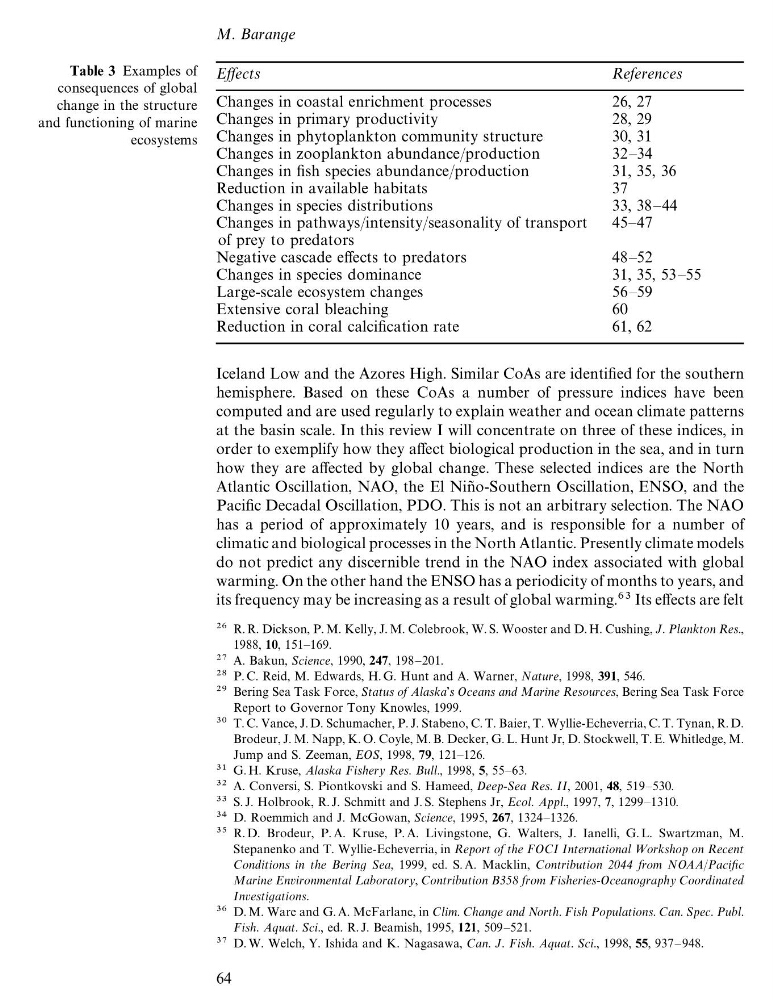
Table 3 Examples of
consequences of global
change in the structure
and functioning of marine
ecosystems
Effects
References
Changes in coastal enrichment processes
26, 27
Changes in primary productivity
28, 29
Changes in phytoplankton community structure
30, 31
Changes in zooplankton abundance/production
32—34
Changes in fish species abundance/production
31, 35, 36
Reduction in available habitats
37
Changes in species distributions
33, 38—44
Changes in pathways/intensity/seasonality of transport
of prey to predators
45—47
Negative cascade effects to predators
48—52
Changes in species dominance
31, 35, 53—55
Large-scale ecosystem changes
56—59
Extensive coral bleaching
60
Reduction in coral calcification rate
61, 62
Iceland Low and the Azores High. Similar CoAs are identified for the southern
hemisphere. Based on these CoAs a number of pressure indices have been
computed and are used regularly to explain weather and ocean climate patterns
at the basin scale. In this review I will concentrate on three of these indices, in
order to exemplify how they affect biological production in the sea, and in turn
how they are affected by global change. These selected indices are the North
Atlantic Oscillation, NAO, the El Nin o-Southern Oscillation, ENSO, and the
Pacific Decadal Oscillation, PDO. This is not an arbitrary selection. The NAO
has a period of approximately 10 years, and is responsible for a number of
climatic and biological processes in the North Atlantic. Presently climate models
do not predict any discernible trend in the NAO index associated with global
warming. On the other hand the ENSO has a periodicity of months to years, and
its frequency may be increasing as a result of global warming. Its effects are felt
R. R. Dickson, P. M. Kelly, J. M. Colebrook, W. S. Wooster and D. H. Cushing, J. Plankton Res.,
1988, 10, 151—169.
A. Bakun, Science, 1990, 247, 198—201.
P. C. Reid, M. Edwards, H. G. Hunt and A. Warner, Nature, 1998, 391, 546.
Bering Sea Task Force, Status of Alaska’s Oceans and Marine Resources, Bering Sea Task Force
Report to Governor Tony Knowles, 1999.
T. C. Vance, J. D. Schumacher, P. J. Stabeno, C. T. Baier, T. Wyllie-Echeverria, C. T. Tynan, R. D.
Brodeur, J. M. Napp, K. O. Coyle, M. B. Decker, G. L. Hunt Jr, D. Stockwell, T. E. Whitledge, M.
Jump and S. Zeeman, EOS, 1998, 79, 121—126.
G. H. Kruse, Alaska Fishery Res. Bull., 1998, 5, 55—63.
A. Conversi, S. Piontkovski and S. Hameed, Deep-Sea Res. II, 2001, 48, 519—530.
S. J. Holbrook, R. J. Schmitt and J. S. Stephens Jr, Ecol. Appl., 1997, 7, 1299—1310.
D. Roemmich and J. McGowan, Science, 1995, 267, 1324—1326.
R. D. Brodeur, P. A. Kruse, P. A. Livingstone, G. Walters, J. Ianelli, G. L. Swartzman, M.
Stepanenko and T. Wyllie-Echeverria, in Report of the FOCI International Workshop on Recent
Conditions in the Bering Sea, 1999, ed. S. A. Macklin, Contribution 2044 from NOAA/Pacific
Marine Environmental Laboratory, Contribution B358 from Fisheries-Oceanography Coordinated
Investigations.
D. M. Ware and G. A. McFarlane, in Clim. Change and North. Fish Populations. Can. Spec. Publ.
Fish. Aquat. Sci., ed. R. J. Beamish, 1995, 121, 509—521.
D. W. Welch, Y. Ishida and K. Nagasawa, Can. J. Fish. Aquat. Sci., 1998, 55, 937—948.
M. Barange
64
consequences of global
change in the structure
and functioning of marine
ecosystems
Effects
References
Changes in coastal enrichment processes
26, 27
Changes in primary productivity
28, 29
Changes in phytoplankton community structure
30, 31
Changes in zooplankton abundance/production
32—34
Changes in fish species abundance/production
31, 35, 36
Reduction in available habitats
37
Changes in species distributions
33, 38—44
Changes in pathways/intensity/seasonality of transport
of prey to predators
45—47
Negative cascade effects to predators
48—52
Changes in species dominance
31, 35, 53—55
Large-scale ecosystem changes
56—59
Extensive coral bleaching
60
Reduction in coral calcification rate
61, 62
Iceland Low and the Azores High. Similar CoAs are identified for the southern
hemisphere. Based on these CoAs a number of pressure indices have been
computed and are used regularly to explain weather and ocean climate patterns
at the basin scale. In this review I will concentrate on three of these indices, in
order to exemplify how they affect biological production in the sea, and in turn
how they are affected by global change. These selected indices are the North
Atlantic Oscillation, NAO, the El Nin o-Southern Oscillation, ENSO, and the
Pacific Decadal Oscillation, PDO. This is not an arbitrary selection. The NAO
has a period of approximately 10 years, and is responsible for a number of
climatic and biological processes in the North Atlantic. Presently climate models
do not predict any discernible trend in the NAO index associated with global
warming. On the other hand the ENSO has a periodicity of months to years, and
its frequency may be increasing as a result of global warming. Its effects are felt
R. R. Dickson, P. M. Kelly, J. M. Colebrook, W. S. Wooster and D. H. Cushing, J. Plankton Res.,
1988, 10, 151—169.
A. Bakun, Science, 1990, 247, 198—201.
P. C. Reid, M. Edwards, H. G. Hunt and A. Warner, Nature, 1998, 391, 546.
Bering Sea Task Force, Status of Alaska’s Oceans and Marine Resources, Bering Sea Task Force
Report to Governor Tony Knowles, 1999.
T. C. Vance, J. D. Schumacher, P. J. Stabeno, C. T. Baier, T. Wyllie-Echeverria, C. T. Tynan, R. D.
Brodeur, J. M. Napp, K. O. Coyle, M. B. Decker, G. L. Hunt Jr, D. Stockwell, T. E. Whitledge, M.
Jump and S. Zeeman, EOS, 1998, 79, 121—126.
G. H. Kruse, Alaska Fishery Res. Bull., 1998, 5, 55—63.
A. Conversi, S. Piontkovski and S. Hameed, Deep-Sea Res. II, 2001, 48, 519—530.
S. J. Holbrook, R. J. Schmitt and J. S. Stephens Jr, Ecol. Appl., 1997, 7, 1299—1310.
D. Roemmich and J. McGowan, Science, 1995, 267, 1324—1326.
R. D. Brodeur, P. A. Kruse, P. A. Livingstone, G. Walters, J. Ianelli, G. L. Swartzman, M.
Stepanenko and T. Wyllie-Echeverria, in Report of the FOCI International Workshop on Recent
Conditions in the Bering Sea, 1999, ed. S. A. Macklin, Contribution 2044 from NOAA/Pacific
Marine Environmental Laboratory, Contribution B358 from Fisheries-Oceanography Coordinated
Investigations.
D. M. Ware and G. A. McFarlane, in Clim. Change and North. Fish Populations. Can. Spec. Publ.
Fish. Aquat. Sci., ed. R. J. Beamish, 1995, 121, 509—521.
D. W. Welch, Y. Ishida and K. Nagasawa, Can. J. Fish. Aquat. Sci., 1998, 55, 937—948.
M. Barange
64