

1000
1200
1400
1600
1800
2000
1900
1700
1500
1300
1100
2100
-1.0
-0.5
0.0
0.5
1.0
1.5
2.0
2.5
3.0
3.5
4.0
4.5
5.0
5.5
6.0
6.5
Observations, Northern Hemisphere, proxy data
A1B
Scenarios
A1T
A1FI
A2
B1
B2
IS92a
Bars show the
range in 2100
produced by
several models
Global
instrumental
observations
Several models
all SRES
envelope
Projections
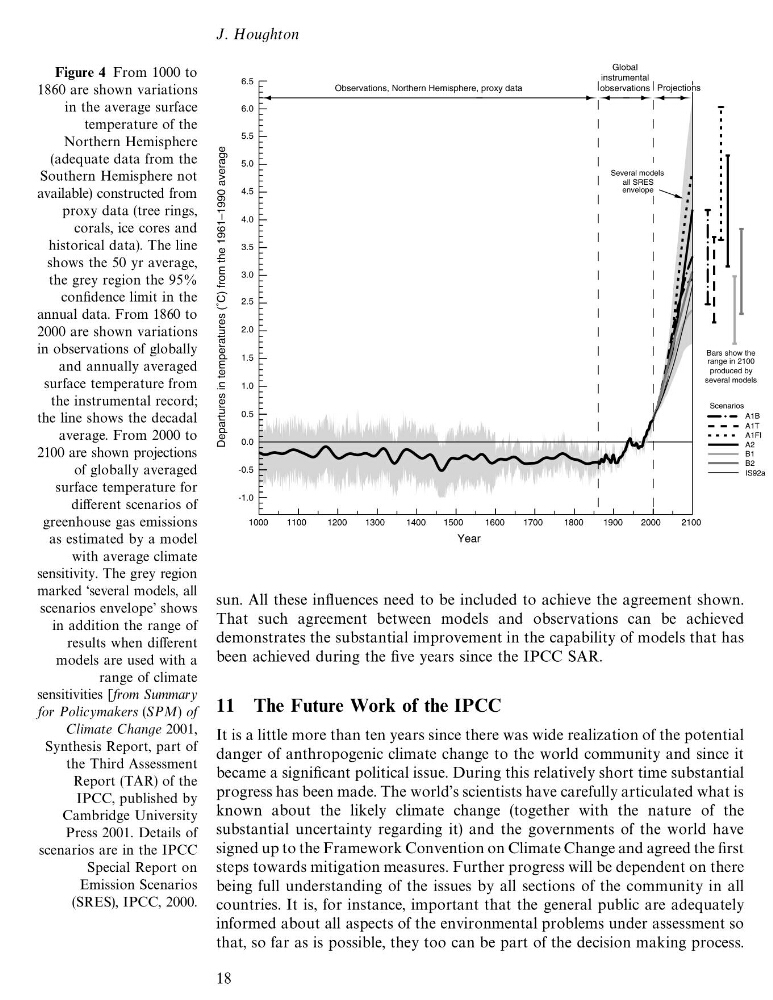
Figure 4 From 1000 to
1860 are shown variations
in the average surface
temperature of the
Northern Hemisphere
(adequate data from the
Southern Hemisphere not
available) constructed from
proxy data (tree rings,
corals, ice cores and
historical data). The line
shows the 50 yr average,
the grey region the 95%
confidence limit in the
annual data. From 1860 to
2000 are shown variations
in observations of globally
and annually averaged
surface temperature from
the instrumental record;
the line shows the decadal
average. From 2000 to
2100 are shown projections
of globally averaged
surface temperature for
different scenarios of
greenhouse gas emissions
as estimated by a model
with average climate
sensitivity. The grey region
marked ‘several models, all
scenarios envelope’ shows
in addition the range of
results when different
models are used with a
range of climate
sensitivities [from Summary
for Policymakers (SPM) of
Climate Change 2001,
Synthesis Report, part of
the Third Assessment
Report (TAR) of the
IPCC, published by
Cambridge University
Press 2001. Details of
scenarios are in the IPCC
Special Report on
Emission Scenarios
(SRES), IPCC, 2000.
sun. All these influences need to be included to achieve the agreement shown.
That such agreement between models and observations can be achieved
demonstrates the substantial improvement in the capability of models that has
been achieved during the five years since the IPCC SAR.
11 The Future Work of the IPCC
It is a little more than ten years since there was wide realization of the potential
danger of anthropogenic climate change to the world community and since it
became a significant political issue. During this relatively short time substantial
progress has been made. The world’s scientists have carefully articulated what is
known about the likely climate change (together with the nature of the
substantial uncertainty regarding it) and the governments of the world have
signed up to the Framework Convention on Climate Change and agreed the first
steps towards mitigation measures. Further progress will be dependent on there
being full understanding of the issues by all sections of the community in all
countries. It is, for instance, important that the general public are adequately
informed about all aspects of the environmental problems under assessment so
that, so far as is possible, they too can be part of the decision making process.
J. Houghton
18
1200
1400
1600
1800
2000
1900
1700
1500
1300
1100
2100
-1.0
-0.5
0.0
0.5
1.0
1.5
2.0
2.5
3.0
3.5
4.0
4.5
5.0
5.5
6.0
6.5
Observations, Northern Hemisphere, proxy data
A1B
Scenarios
A1T
A1FI
A2
B1
B2
IS92a
Bars show the
range in 2100
produced by
several models
Global
instrumental
observations
Several models
all SRES
envelope
Projections
Figure 4 From 1000 to
1860 are shown variations
in the average surface
temperature of the
Northern Hemisphere
(adequate data from the
Southern Hemisphere not
available) constructed from
proxy data (tree rings,
corals, ice cores and
historical data). The line
shows the 50 yr average,
the grey region the 95%
confidence limit in the
annual data. From 1860 to
2000 are shown variations
in observations of globally
and annually averaged
surface temperature from
the instrumental record;
the line shows the decadal
average. From 2000 to
2100 are shown projections
of globally averaged
surface temperature for
different scenarios of
greenhouse gas emissions
as estimated by a model
with average climate
sensitivity. The grey region
marked ‘several models, all
scenarios envelope’ shows
in addition the range of
results when different
models are used with a
range of climate
sensitivities [from Summary
for Policymakers (SPM) of
Climate Change 2001,
Synthesis Report, part of
the Third Assessment
Report (TAR) of the
IPCC, published by
Cambridge University
Press 2001. Details of
scenarios are in the IPCC
Special Report on
Emission Scenarios
(SRES), IPCC, 2000.
sun. All these influences need to be included to achieve the agreement shown.
That such agreement between models and observations can be achieved
demonstrates the substantial improvement in the capability of models that has
been achieved during the five years since the IPCC SAR.
11 The Future Work of the IPCC
It is a little more than ten years since there was wide realization of the potential
danger of anthropogenic climate change to the world community and since it
became a significant political issue. During this relatively short time substantial
progress has been made. The world’s scientists have carefully articulated what is
known about the likely climate change (together with the nature of the
substantial uncertainty regarding it) and the governments of the world have
signed up to the Framework Convention on Climate Change and agreed the first
steps towards mitigation measures. Further progress will be dependent on there
being full understanding of the issues by all sections of the community in all
countries. It is, for instance, important that the general public are adequately
informed about all aspects of the environmental problems under assessment so
that, so far as is possible, they too can be part of the decision making process.
J. Houghton
18