

1850
1900
1950
2000
Year
−1.0
−0.5
0.0
0.5
1.0
Temperature anomalies /ßC
model
observations
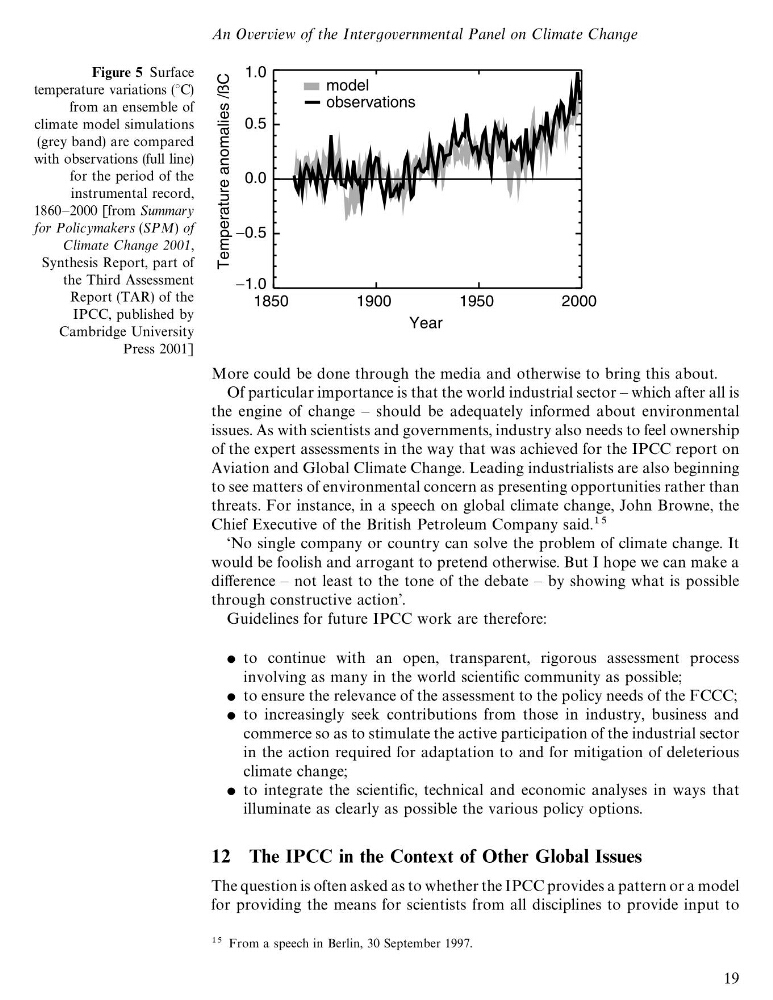
Figure 5 Surface
temperature variations (°C)
from an ensemble of
climate model simulations
(grey band) are compared
with observations (full line)
for the period of the
instrumental record,
1860—2000 [from Summary
for Policymakers (SPM) of
Climate Change 2001,
Synthesis Report, part of
the Third Assessment
Report (TAR) of the
IPCC, published by
Cambridge University
Press 2001]
More could be done through the media and otherwise to bring this about.
Of particular importance is that the world industrial sector — which after all is
the engine of change — should be adequately informed about environmental
issues. As with scientists and governments, industry also needs to feel ownership
of the expert assessments in the way that was achieved for the IPCC report on
Aviation and Global Climate Change. Leading industrialists are also beginning
to see matters of environmental concern as presenting opportunities rather than
threats. For instance, in a speech on global climate change, John Browne, the
Chief Executive of the British Petroleum Company said.
‘No single company or country can solve the problem of climate change. It
would be foolish and arrogant to pretend otherwise. But I hope we can make a
difference — not least to the tone of the debate — by showing what is possible
through constructive action’.
Guidelines for future IPCC work are therefore:
E to continue with an open, transparent, rigorous assessment process
involving as many in the world scientific community as possible;
E to ensure the relevance of the assessment to the policy needs of the FCCC;
E to increasingly seek contributions from those in industry, business and
commerce so as to stimulate the active participation of the industrial sector
in the action required for adaptation to and for mitigation of deleterious
climate change;
E to integrate the scientific, technical and economic analyses in ways that
illuminate as clearly as possible the various policy options.
12 The IPCC in the Context of Other Global Issues
The question is often asked as to whether the IPCC provides a pattern or a model
for providing the means for scientists from all disciplines to provide input to
From a speech in Berlin, 30 September 1997.
An Overview of the Intergovernmental Panel on Climate Change
19
1900
1950
2000
Year
−1.0
−0.5
0.0
0.5
1.0
Temperature anomalies /ßC
model
observations
Figure 5 Surface
temperature variations (°C)
from an ensemble of
climate model simulations
(grey band) are compared
with observations (full line)
for the period of the
instrumental record,
1860—2000 [from Summary
for Policymakers (SPM) of
Climate Change 2001,
Synthesis Report, part of
the Third Assessment
Report (TAR) of the
IPCC, published by
Cambridge University
Press 2001]
More could be done through the media and otherwise to bring this about.
Of particular importance is that the world industrial sector — which after all is
the engine of change — should be adequately informed about environmental
issues. As with scientists and governments, industry also needs to feel ownership
of the expert assessments in the way that was achieved for the IPCC report on
Aviation and Global Climate Change. Leading industrialists are also beginning
to see matters of environmental concern as presenting opportunities rather than
threats. For instance, in a speech on global climate change, John Browne, the
Chief Executive of the British Petroleum Company said.
‘No single company or country can solve the problem of climate change. It
would be foolish and arrogant to pretend otherwise. But I hope we can make a
difference — not least to the tone of the debate — by showing what is possible
through constructive action’.
Guidelines for future IPCC work are therefore:
E to continue with an open, transparent, rigorous assessment process
involving as many in the world scientific community as possible;
E to ensure the relevance of the assessment to the policy needs of the FCCC;
E to increasingly seek contributions from those in industry, business and
commerce so as to stimulate the active participation of the industrial sector
in the action required for adaptation to and for mitigation of deleterious
climate change;
E to integrate the scientific, technical and economic analyses in ways that
illuminate as clearly as possible the various policy options.
12 The IPCC in the Context of Other Global Issues
The question is often asked as to whether the IPCC provides a pattern or a model
for providing the means for scientists from all disciplines to provide input to
From a speech in Berlin, 30 September 1997.
An Overview of the Intergovernmental Panel on Climate Change
19