

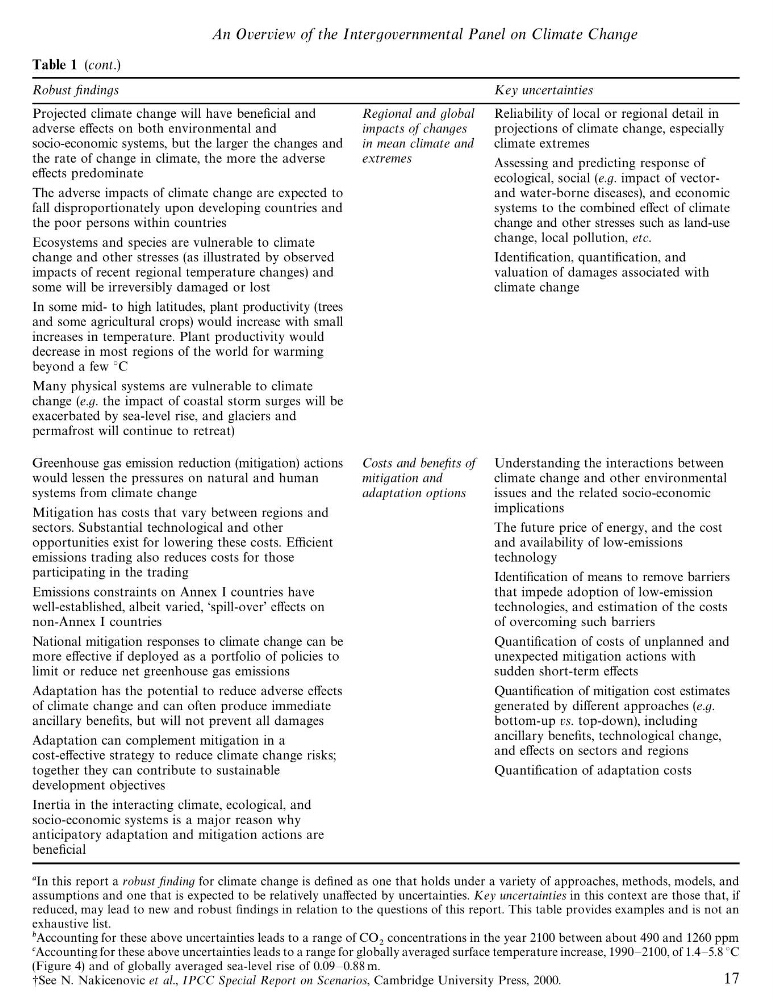
Table 1 (cont.)
Robust findings
Key uncertainties
Projected climate change will have beneficial and
adverse effects on both environmental and
socio-economic systems, but the larger the changes and
the rate of change in climate, the more the adverse
effects predominate
The adverse impacts of climate change are expected to
fall disproportionately upon developing countries and
the poor persons within countries
Ecosystems and species are vulnerable to climate
change and other stresses (as illustrated by observed
impacts of recent regional temperature changes) and
some will be irreversibly damaged or lost
In some mid- to high latitudes, plant productivity (trees
and some agricultural crops) would increase with small
increases in temperature. Plant productivity would
decrease in most regions of the world for warming
beyond a few °C
Many physical systems are vulnerable to climate
change (e.g. the impact of coastal storm surges will be
exacerbated by sea-level rise, and glaciers and
permafrost will continue to retreat)
Regional and global
impacts of changes
in mean climate and
extremes
Reliability of local or regional detail in
projections of climate change, especially
climate extremes
Assessing and predicting response of
ecological, social (e.g. impact of vectorand water-borne diseases), and economic
systems to the combined effect of climate
change and other stresses such as land-use
change, local pollution, etc.
Identification, quantification, and
valuation of damages associated with
climate change
Greenhouse gas emission reduction (mitigation) actions
would lessen the pressures on natural and human
systems from climate change
Mitigation has costs that vary between regions and
sectors. Substantial technological and other
opportunities exist for lowering these costs. Efficient
emissions trading also reduces costs for those
participating in the trading
Emissions constraints on Annex I countries have
well-established, albeit varied, ‘spill-over’ effects on
non-Annex I countries
National mitigation responses to climate change can be
more effective if deployed as a portfolio of policies to
limit or reduce net greenhouse gas emissions
Adaptation has the potential to reduce adverse effects
of climate change and can often produce immediate
ancillary benefits, but will not prevent all damages
Adaptation can complement mitigation in a
cost-effective strategy to reduce climate change risks;
together they can contribute to sustainable
development objectives
Inertia in the interacting climate, ecological, and
socio-economic systems is a major reason why
anticipatory adaptation and mitigation actions are
beneficial
Costs and benefits of
mitigation and
adaptation options
Understanding the interactions between
climate change and other environmental
issues and the related socio-economic
implications
The future price of energy, and the cost
and availability of low-emissions
technology
Identification of means to remove barriers
that impede adoption of low-emission
technologies, and estimation of the costs
of overcoming such barriers
Quantification of costs of unplanned and
unexpected mitigation actions with
sudden short-term effects
Quantification of mitigation cost estimates
generated by different approaches (e.g.
bottom-up vs. top-down), including
ancillary benefits, technological change,
and effects on sectors and regions
Quantification of adaptation costs
?In this report a robust finding for climate change is defined as one that holds under a variety of approaches, methods, models, and
assumptions and one that is expected to be relatively unaffected by uncertainties. Key uncertainties in this context are those that, if
reduced, may lead to new and robust findings in relation to the questions of this report. This table provides examples and is not an
exhaustive list.
@Accounting for these above uncertainties leads to a range of CO
concentrations in the year 2100 between about 490 and 1260 ppm
AAccounting for these above uncertainties leads to a range for globally averaged surface temperature increase, 1990—2100, of 1.4—5.8 °C
(Figure 4) and of globally averaged sea-level rise of 0.09—0.88 m.
†See N. Nakicenovic et al., IPCC Special Report on Scenarios, Cambridge University Press, 2000.
An Overview of the Intergovernmental Panel on Climate Change
17
Robust findings
Key uncertainties
Projected climate change will have beneficial and
adverse effects on both environmental and
socio-economic systems, but the larger the changes and
the rate of change in climate, the more the adverse
effects predominate
The adverse impacts of climate change are expected to
fall disproportionately upon developing countries and
the poor persons within countries
Ecosystems and species are vulnerable to climate
change and other stresses (as illustrated by observed
impacts of recent regional temperature changes) and
some will be irreversibly damaged or lost
In some mid- to high latitudes, plant productivity (trees
and some agricultural crops) would increase with small
increases in temperature. Plant productivity would
decrease in most regions of the world for warming
beyond a few °C
Many physical systems are vulnerable to climate
change (e.g. the impact of coastal storm surges will be
exacerbated by sea-level rise, and glaciers and
permafrost will continue to retreat)
Regional and global
impacts of changes
in mean climate and
extremes
Reliability of local or regional detail in
projections of climate change, especially
climate extremes
Assessing and predicting response of
ecological, social (e.g. impact of vectorand water-borne diseases), and economic
systems to the combined effect of climate
change and other stresses such as land-use
change, local pollution, etc.
Identification, quantification, and
valuation of damages associated with
climate change
Greenhouse gas emission reduction (mitigation) actions
would lessen the pressures on natural and human
systems from climate change
Mitigation has costs that vary between regions and
sectors. Substantial technological and other
opportunities exist for lowering these costs. Efficient
emissions trading also reduces costs for those
participating in the trading
Emissions constraints on Annex I countries have
well-established, albeit varied, ‘spill-over’ effects on
non-Annex I countries
National mitigation responses to climate change can be
more effective if deployed as a portfolio of policies to
limit or reduce net greenhouse gas emissions
Adaptation has the potential to reduce adverse effects
of climate change and can often produce immediate
ancillary benefits, but will not prevent all damages
Adaptation can complement mitigation in a
cost-effective strategy to reduce climate change risks;
together they can contribute to sustainable
development objectives
Inertia in the interacting climate, ecological, and
socio-economic systems is a major reason why
anticipatory adaptation and mitigation actions are
beneficial
Costs and benefits of
mitigation and
adaptation options
Understanding the interactions between
climate change and other environmental
issues and the related socio-economic
implications
The future price of energy, and the cost
and availability of low-emissions
technology
Identification of means to remove barriers
that impede adoption of low-emission
technologies, and estimation of the costs
of overcoming such barriers
Quantification of costs of unplanned and
unexpected mitigation actions with
sudden short-term effects
Quantification of mitigation cost estimates
generated by different approaches (e.g.
bottom-up vs. top-down), including
ancillary benefits, technological change,
and effects on sectors and regions
Quantification of adaptation costs
?In this report a robust finding for climate change is defined as one that holds under a variety of approaches, methods, models, and
assumptions and one that is expected to be relatively unaffected by uncertainties. Key uncertainties in this context are those that, if
reduced, may lead to new and robust findings in relation to the questions of this report. This table provides examples and is not an
exhaustive list.
@Accounting for these above uncertainties leads to a range of CO
concentrations in the year 2100 between about 490 and 1260 ppm
AAccounting for these above uncertainties leads to a range for globally averaged surface temperature increase, 1990—2100, of 1.4—5.8 °C
(Figure 4) and of globally averaged sea-level rise of 0.09—0.88 m.
†See N. Nakicenovic et al., IPCC Special Report on Scenarios, Cambridge University Press, 2000.
An Overview of the Intergovernmental Panel on Climate Change
17