

D I D Y O U K N O W ?
Enormous crystals have been found in a
type of igneous rock called pegmatite.
For example, single crystals of the
mineral feldspar the size of a house
have been unearthed in North Carolina
and Norway, while huge muscovite
(mica) plates weighing 85 tons have
been mined in India. In addition, crystals
as large as telephone poles (over 40
feet in length) of the lithium-bearing
mineral spodumene have been found in
the Black Hills of South Dakota.
chlorine, and fluorine, make up an
unusually high percentage of the melt.
Because ion migration is enhanced in these
fluid-rich environments, the crystals that
form are abnormally large. Thus, the large
crystals in pegmatites are not the result of
inordinately long cooling histories; rather,
they are the consequence of a fluid-rich
environment that enhances crystallization.
The composition of most pegmatites is
similar to that of granite. Thus, pegmatites
contain large crystals of quartz, feldspar,
and muscovite. However, some contain
significant quantities of relatively rare and
Naming Igneous
Rocks
Igneous Rocks
Naming Igneous Rocks
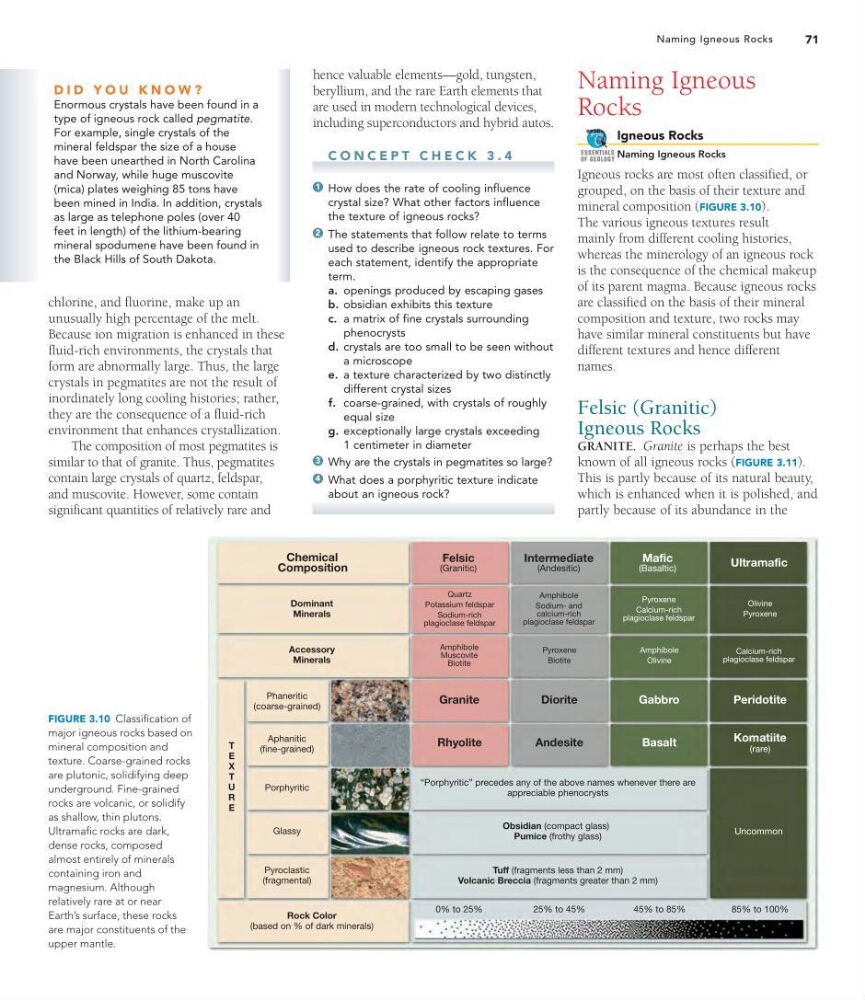
Igneous rocks are most often classified, or
grouped, on the basis of their texture and
mineral composition (FIGURE 3.10).
The various igneous textures result
mainly from different cooling histories,
whereas the minerology of an igneous rock
is the consequence of the chemical makeup
of its parent magma. Because igneous rocks
are classified on the basis of their mineral
composition and texture, two rocks may
have similar mineral constituents but have
different textures and hence different
names.
Felsic (Granitic)
Igneous Rocks
GRANITE. Granite is perhaps the best
known of all igneous rocks (FIGURE 3.11).
This is partly because of its natural beauty,
which is enhanced when it is polished, and
partly because of its abundance in the
GEODe
ESSENTIALS
OF GEOLOGY
hence valuable elements—gold, tungsten,
beryllium, and the rare Earth elements that
are used in modern technological devices,
including superconductors and hybrid autos.
C O N C E P T C H E C K 3 . 4
How does the rate of cooling influence
crystal size? What other factors influence
the texture of igneous rocks?
The statements that follow relate to terms
used to describe igneous rock textures. For
each statement, identify the appropriate
term.
a. openings produced by escaping gases
b. obsidian exhibits this texture
c. a matrix of fine crystals surrounding
phenocrysts
d. crystals are too small to be seen without
a microscope
e. a texture characterized by two distinctly
different crystal sizes
f. coarse-grained, with crystals of roughly
equal size
g. exceptionally large crystals exceeding
1 centimeter in diameter
Why are the crystals in pegmatites so large?
What does a porphyritic texture indicate
about an igneous rock?
4
3
2
1
0% to 25%
25% to 45%
45% to 85%
Rock Color
(based on % of dark minerals)
Phaneritic
(coarse-grained)
Aphanitic
(fine-grained)
Porphyritic
Glassy
T
E
X
T
U
R
E
“Porphyritic” precedes any of the above names whenever there are
appreciable phenocrysts
Obsidian (compact glass)
Pumice (frothy glass)
Peridotite
Uncommon
Diorite
Andesite
Granite
Rhyolite
Quartz
Potassium feldspar
Sodium-rich
plagioclase feldspar
Gabbro
Basalt
Chemical
Composition
Dominant
Minerals
85% to 100%
Ultramafic
Amphibole
Sodium- and
calcium-rich
plagioclase feldspar
Pyroxene
Calcium-rich
plagioclase feldspar
Olivine
Pyroxene
Komatiite
(rare)
Accessory
Minerals
Calcium-rich
plagioclase feldspar
Pyroxene
Biotite
Amphibole
Olivine
Amphibole
Muscovite
Biotite
Pyroclastic
(fragmental)
Tuff (fragments less than 2 mm)
Volcanic Breccia (fragments greater than 2 mm)
Felsic
(Granitic)
Intermediate
(Andesitic)
Mafic
(Basaltic)
FIGURE 3.10 Classification of
major igneous rocks based on
mineral composition and
texture. Coarse-grained rocks
are plutonic, solidifying deep
underground. Fine-grained
rocks are volcanic, or solidify
as shallow, thin plutons.
Ultramafic rocks are dark,
dense rocks, composed
almost entirely of minerals
containing iron and
magnesium. Although
relatively rare at or near
Earth’s surface, these rocks
are major constituents of the
upper mantle.
71
Naming Igneous Rocks
Enormous crystals have been found in a
type of igneous rock called pegmatite.
For example, single crystals of the
mineral feldspar the size of a house
have been unearthed in North Carolina
and Norway, while huge muscovite
(mica) plates weighing 85 tons have
been mined in India. In addition, crystals
as large as telephone poles (over 40
feet in length) of the lithium-bearing
mineral spodumene have been found in
the Black Hills of South Dakota.
chlorine, and fluorine, make up an
unusually high percentage of the melt.
Because ion migration is enhanced in these
fluid-rich environments, the crystals that
form are abnormally large. Thus, the large
crystals in pegmatites are not the result of
inordinately long cooling histories; rather,
they are the consequence of a fluid-rich
environment that enhances crystallization.
The composition of most pegmatites is
similar to that of granite. Thus, pegmatites
contain large crystals of quartz, feldspar,
and muscovite. However, some contain
significant quantities of relatively rare and
Naming Igneous
Rocks
Igneous Rocks
Naming Igneous Rocks
Igneous rocks are most often classified, or
grouped, on the basis of their texture and
mineral composition (FIGURE 3.10).
The various igneous textures result
mainly from different cooling histories,
whereas the minerology of an igneous rock
is the consequence of the chemical makeup
of its parent magma. Because igneous rocks
are classified on the basis of their mineral
composition and texture, two rocks may
have similar mineral constituents but have
different textures and hence different
names.
Felsic (Granitic)
Igneous Rocks
GRANITE. Granite is perhaps the best
known of all igneous rocks (FIGURE 3.11).
This is partly because of its natural beauty,
which is enhanced when it is polished, and
partly because of its abundance in the
GEODe
ESSENTIALS
OF GEOLOGY
hence valuable elements—gold, tungsten,
beryllium, and the rare Earth elements that
are used in modern technological devices,
including superconductors and hybrid autos.
C O N C E P T C H E C K 3 . 4
How does the rate of cooling influence
crystal size? What other factors influence
the texture of igneous rocks?
The statements that follow relate to terms
used to describe igneous rock textures. For
each statement, identify the appropriate
term.
a. openings produced by escaping gases
b. obsidian exhibits this texture
c. a matrix of fine crystals surrounding
phenocrysts
d. crystals are too small to be seen without
a microscope
e. a texture characterized by two distinctly
different crystal sizes
f. coarse-grained, with crystals of roughly
equal size
g. exceptionally large crystals exceeding
1 centimeter in diameter
Why are the crystals in pegmatites so large?
What does a porphyritic texture indicate
about an igneous rock?
4
3
2
1
0% to 25%
25% to 45%
45% to 85%
Rock Color
(based on % of dark minerals)
Phaneritic
(coarse-grained)
Aphanitic
(fine-grained)
Porphyritic
Glassy
T
E
X
T
U
R
E
“Porphyritic” precedes any of the above names whenever there are
appreciable phenocrysts
Obsidian (compact glass)
Pumice (frothy glass)
Peridotite
Uncommon
Diorite
Andesite
Granite
Rhyolite
Quartz
Potassium feldspar
Sodium-rich
plagioclase feldspar
Gabbro
Basalt
Chemical
Composition
Dominant
Minerals
85% to 100%
Ultramafic
Amphibole
Sodium- and
calcium-rich
plagioclase feldspar
Pyroxene
Calcium-rich
plagioclase feldspar
Olivine
Pyroxene
Komatiite
(rare)
Accessory
Minerals
Calcium-rich
plagioclase feldspar
Pyroxene
Biotite
Amphibole
Olivine
Amphibole
Muscovite
Biotite
Pyroclastic
(fragmental)
Tuff (fragments less than 2 mm)
Volcanic Breccia (fragments greater than 2 mm)
Felsic
(Granitic)
Intermediate
(Andesitic)
Mafic
(Basaltic)
FIGURE 3.10 Classification of
major igneous rocks based on
mineral composition and
texture. Coarse-grained rocks
are plutonic, solidifying deep
underground. Fine-grained
rocks are volcanic, or solidify
as shallow, thin plutons.
Ultramafic rocks are dark,
dense rocks, composed
almost entirely of minerals
containing iron and
magnesium. Although
relatively rare at or near
Earth’s surface, these rocks
are major constituents of the
upper mantle.
71
Naming Igneous Rocks