

CHAPTER 3 Igneous Rocks and Intrusive Activity
72
Phaneritic
(course-grained)
Diorite
Andesite
Granite
Rhyolite
Gabbro
Basalt
Andesite porphyry
Granite porphyry
Basalt porphyry
Felsic
(Granitic)
Intermediate
(Andesitic)
Mafic
(Basaltic)
Aphanitic
(fine-grained)
Porphyritic
Texture
Composition
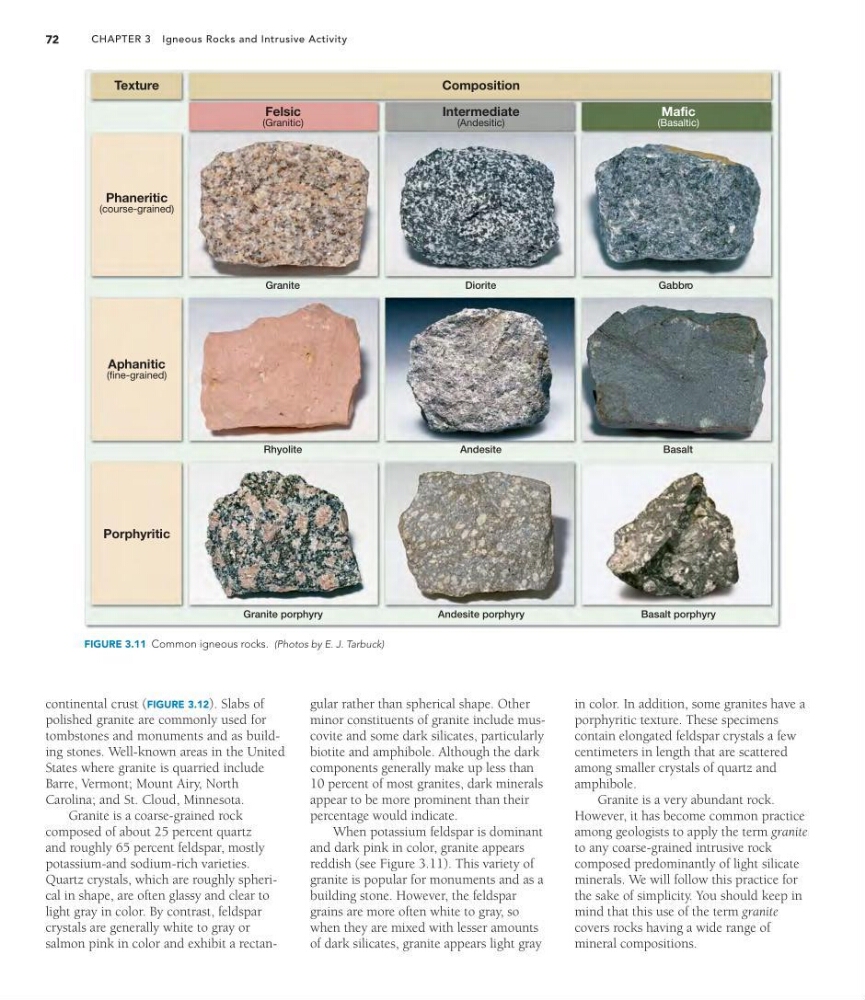
FIGURE 3.11 Common igneous rocks. (Photos by E. J. Tarbuck)
continental crust (FIGURE 3.12). Slabs of
polished granite are commonly used for
tombstones and monuments and as building stones. Well-known areas in the United
States where granite is quarried include
Barre, Vermont; Mount Airy, North
Carolina; and St. Cloud, Minnesota.
Granite is a coarse-grained rock
composed of about 25 percent quartz
and roughly 65 percent feldspar, mostly
potassium-and sodium-rich varieties.
Quartz crystals, which are roughly spherical in shape, are often glassy and clear to
light gray in color. By contrast, feldspar
crystals are generally white to gray or
salmon pink in color and exhibit a rectangular rather than spherical shape. Other
minor constituents of granite include muscovite and some dark silicates, particularly
biotite and amphibole. Although the dark
components generally make up less than
10 percent of most granites, dark minerals
appear to be more prominent than their
percentage would indicate.
When potassium feldspar is dominant
and dark pink in color, granite appears
reddish (see Figure 3.11). This variety of
granite is popular for monuments and as a
building stone. However, the feldspar
grains are more often white to gray, so
when they are mixed with lesser amounts
of dark silicates, granite appears light gray
in color. In addition, some granites have a
porphyritic texture. These specimens
contain elongated feldspar crystals a few
centimeters in length that are scattered
among smaller crystals of quartz and
amphibole.
Granite is a very abundant rock.
However, it has become common practice
among geologists to apply the term granite
to any coarse-grained intrusive rock
composed predominantly of light silicate
minerals. We will follow this practice for
the sake of simplicity. You should keep in
mind that this use of the term granite
covers rocks having a wide range of
mineral compositions.
72
Phaneritic
(course-grained)
Diorite
Andesite
Granite
Rhyolite
Gabbro
Basalt
Andesite porphyry
Granite porphyry
Basalt porphyry
Felsic
(Granitic)
Intermediate
(Andesitic)
Mafic
(Basaltic)
Aphanitic
(fine-grained)
Porphyritic
Texture
Composition
FIGURE 3.11 Common igneous rocks. (Photos by E. J. Tarbuck)
continental crust (FIGURE 3.12). Slabs of
polished granite are commonly used for
tombstones and monuments and as building stones. Well-known areas in the United
States where granite is quarried include
Barre, Vermont; Mount Airy, North
Carolina; and St. Cloud, Minnesota.
Granite is a coarse-grained rock
composed of about 25 percent quartz
and roughly 65 percent feldspar, mostly
potassium-and sodium-rich varieties.
Quartz crystals, which are roughly spherical in shape, are often glassy and clear to
light gray in color. By contrast, feldspar
crystals are generally white to gray or
salmon pink in color and exhibit a rectangular rather than spherical shape. Other
minor constituents of granite include muscovite and some dark silicates, particularly
biotite and amphibole. Although the dark
components generally make up less than
10 percent of most granites, dark minerals
appear to be more prominent than their
percentage would indicate.
When potassium feldspar is dominant
and dark pink in color, granite appears
reddish (see Figure 3.11). This variety of
granite is popular for monuments and as a
building stone. However, the feldspar
grains are more often white to gray, so
when they are mixed with lesser amounts
of dark silicates, granite appears light gray
in color. In addition, some granites have a
porphyritic texture. These specimens
contain elongated feldspar crystals a few
centimeters in length that are scattered
among smaller crystals of quartz and
amphibole.
Granite is a very abundant rock.
However, it has become common practice
among geologists to apply the term granite
to any coarse-grained intrusive rock
composed predominantly of light silicate
minerals. We will follow this practice for
the sake of simplicity. You should keep in
mind that this use of the term granite
covers rocks having a wide range of
mineral compositions.