

70
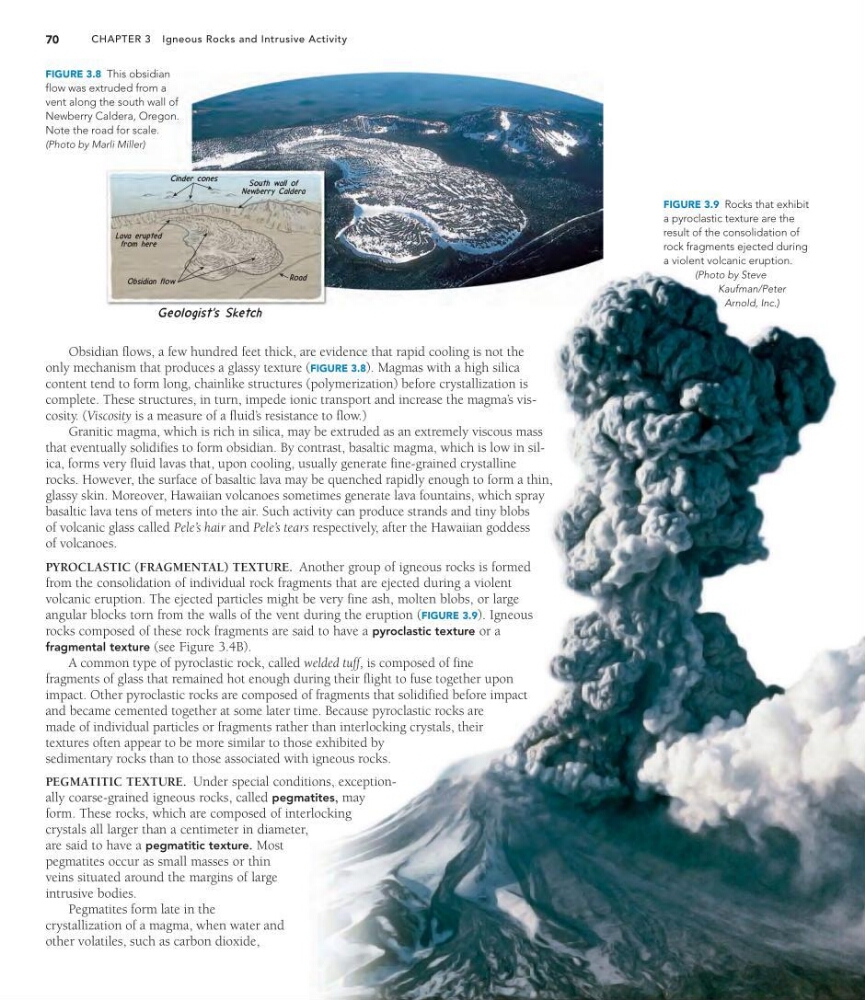
Obsidian flows, a few hundred feet thick, are evidence that rapid cooling is not the
only mechanism that produces a glassy texture (FIGURE 3.8). Magmas with a high silica
content tend to form long, chainlike structures (polymerization) before crystallization is
complete. These structures, in turn, impede ionic transport and increase the magma’ s viscosity. (Viscosity is a measure of a fluid’ s resistance to flow.)
Granitic magma, which is rich in silica, may be extruded as an extremely viscous mass
that eventually solidifies to form obsidian. By contrast, basaltic magma, which is low in silica, forms very fluid lavas that, upon cooling, usually generate fine-grained crystalline
rocks. However, the surface of basaltic lava may be quenched rapidly enough to form a thin,
glassy skin. Moreover, Hawaiian volcanoes sometimes generate lava fountains, which spray
basaltic lava tens of meters into the air. Such activity can produce strands and tiny blobs
of volcanic glass called Pele’s hair and Pele’s tears respectively, after the Hawaiian goddess
of volcanoes.
PYROCLASTIC (FRAGMENTAL) TEXTURE. Another group of igneous rocks is formed
from the consolidation of individual rock fragments that are ejected during a violent
volcanic eruption. The ejected particles might be very fine ash, molten blobs, or large
angular blocks torn from the walls of the vent during the eruption (FIGURE 3.9). Igneous
rocks composed of these rock fragments are said to have a pyroclastic texture or a
fragmental texture (see Figure 3.4B).
A common type of pyroclastic rock, called welded tuff, is composed of fine
fragments of glass that remained hot enough during their flight to fuse together upon
impact. Other pyroclastic rocks are composed of fragments that solidified before impact
and became cemented together at some later time. Because pyroclastic rocks are
made of individual particles or fragments rather than interlocking crystals, their
textures often appear to be more similar to those exhibited by
sedimentary rocks than to those associated with igneous rocks.
PEGMATITIC TEXTURE. Under special conditions, exceptionally coarse-grained igneous rocks, called pegmatites, may
form. These rocks, which are composed of interlocking
crystals all larger than a centimeter in diameter,
are said to have a pegmatitic texture. Most
pegmatites occur as small masses or thin
veins situated around the margins of large
intrusive bodies.
Pegmatites form late in the
crystallization of a magma, when water and
other volatiles, such as carbon dioxide,
FIGURE 3.8 This obsidian
flow was extruded from a
vent along the south wall of
Newberry Caldera, Oregon.
Note the road for scale.
(Photo by Marli Miller)
CHAPTER 3 Igneous Rocks and Intrusive Activity
FIGURE 3.9 Rocks that exhibit
a pyroclastic texture are the
result of the consolidation of
rock fragments ejected during
a violent volcanic eruption.
(Photo by Steve
Kaufman/Peter
Arnold, Inc.)
Obsidian flows, a few hundred feet thick, are evidence that rapid cooling is not the
only mechanism that produces a glassy texture (FIGURE 3.8). Magmas with a high silica
content tend to form long, chainlike structures (polymerization) before crystallization is
complete. These structures, in turn, impede ionic transport and increase the magma’ s viscosity. (Viscosity is a measure of a fluid’ s resistance to flow.)
Granitic magma, which is rich in silica, may be extruded as an extremely viscous mass
that eventually solidifies to form obsidian. By contrast, basaltic magma, which is low in silica, forms very fluid lavas that, upon cooling, usually generate fine-grained crystalline
rocks. However, the surface of basaltic lava may be quenched rapidly enough to form a thin,
glassy skin. Moreover, Hawaiian volcanoes sometimes generate lava fountains, which spray
basaltic lava tens of meters into the air. Such activity can produce strands and tiny blobs
of volcanic glass called Pele’s hair and Pele’s tears respectively, after the Hawaiian goddess
of volcanoes.
PYROCLASTIC (FRAGMENTAL) TEXTURE. Another group of igneous rocks is formed
from the consolidation of individual rock fragments that are ejected during a violent
volcanic eruption. The ejected particles might be very fine ash, molten blobs, or large
angular blocks torn from the walls of the vent during the eruption (FIGURE 3.9). Igneous
rocks composed of these rock fragments are said to have a pyroclastic texture or a
fragmental texture (see Figure 3.4B).
A common type of pyroclastic rock, called welded tuff, is composed of fine
fragments of glass that remained hot enough during their flight to fuse together upon
impact. Other pyroclastic rocks are composed of fragments that solidified before impact
and became cemented together at some later time. Because pyroclastic rocks are
made of individual particles or fragments rather than interlocking crystals, their
textures often appear to be more similar to those exhibited by
sedimentary rocks than to those associated with igneous rocks.
PEGMATITIC TEXTURE. Under special conditions, exceptionally coarse-grained igneous rocks, called pegmatites, may
form. These rocks, which are composed of interlocking
crystals all larger than a centimeter in diameter,
are said to have a pegmatitic texture. Most
pegmatites occur as small masses or thin
veins situated around the margins of large
intrusive bodies.
Pegmatites form late in the
crystallization of a magma, when water and
other volatiles, such as carbon dioxide,
FIGURE 3.8 This obsidian
flow was extruded from a
vent along the south wall of
Newberry Caldera, Oregon.
Note the road for scale.
(Photo by Marli Miller)
CHAPTER 3 Igneous Rocks and Intrusive Activity
FIGURE 3.9 Rocks that exhibit
a pyroclastic texture are the
result of the consolidation of
rock fragments ejected during
a violent volcanic eruption.
(Photo by Steve
Kaufman/Peter
Arnold, Inc.)