

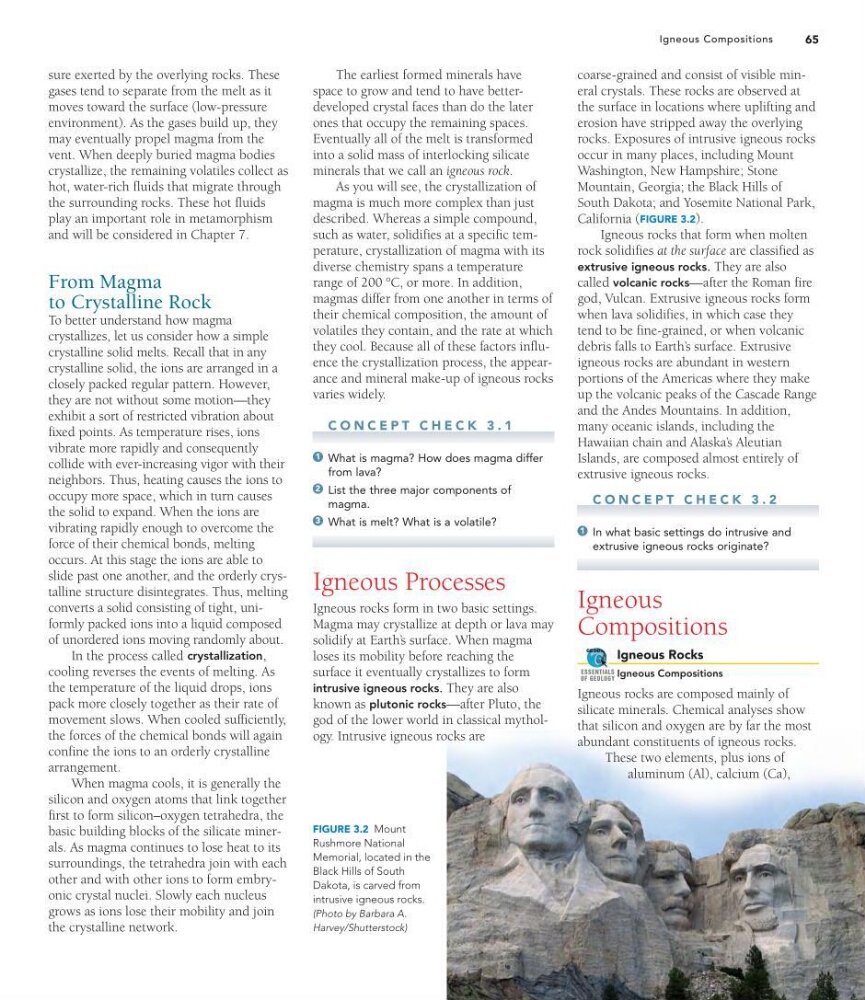
FIGURE 3.2 Mount
Rushmore National
Memorial, located in the
Black Hills of South
Dakota, is carved from
intrusive igneous rocks.
(Photo by Barbara A.
Harvey/Shutterstock)
The earliest formed minerals have
space to grow and tend to have betterdeveloped crystal faces than do the later
ones that occupy the remaining spaces.
Eventually all of the melt is transformed
into a solid mass of interlocking silicate
minerals that we call an igneous rock.
As you will see, the crystallization of
magma is much more complex than just
described. Whereas a simple compound,
such as water, solidifies at a specific temperature, crystallization of magma with its
diverse chemistry spans a temperature
range of 200 °C, or more. In addition,
magmas differ from one another in terms of
their chemical composition, the amount of
volatiles they contain, and the rate at which
they cool. Because all of these factors influence the crystallization process, the appearance and mineral make-up of igneous rocks
varies widely.
C O N C E P T C H E C K 3 . 1
What is magma? How does magma differ
from lava?
List the three major components of
magma.
What is melt? What is a volatile?
Igneous Processes
Igneous rocks form in two basic settings.
Magma may crystallize at depth or lava may
solidify at Earth’ s surface. When magma
loses its mobility before reaching the
surface it eventually crystallizes to form
intrusive igneous rocks. They are also
known as plutonic rocks—after Pluto, the
god of the lower world in classical mythology. Intrusive igneous rocks are
3
2
1
65
Igneous Compositions
sure exerted by the overlying rocks. These
gases tend to separate from the melt as it
moves toward the surface (low-pressure
environment). As the gases build up, they
may eventually propel magma from the
vent. When deeply buried magma bodies
crystallize, the remaining volatiles collect as
hot, water-rich fluids that migrate through
the surrounding rocks. These hot fluids
play an important role in metamorphism
and will be considered in Chapter 7.
From Magma
to Crystalline Rock
To better understand how magma
crystallizes, let us consider how a simple
crystalline solid melts. Recall that in any
crystalline solid, the ions are arranged in a
closely packed regular pattern. However,
they are not without some motion—they
exhibit a sort of restricted vibration about
fixed points. As temperature rises, ions
vibrate more rapidly and consequently
collide with ever-increasing vigor with their
neighbors. Thus, heating causes the ions to
occupy more space, which in turn causes
the solid to expand. When the ions are
vibrating rapidly enough to overcome the
force of their chemical bonds, melting
occurs. At this stage the ions are able to
slide past one another, and the orderly crystalline structure disintegrates. Thus, melting
converts a solid consisting of tight, uniformly packed ions into a liquid composed
of unordered ions moving randomly about.
In the process called crystallization,
cooling reverses the events of melting. As
the temperature of the liquid drops, ions
pack more closely together as their rate of
movement slows. When cooled sufficiently,
the forces of the chemical bonds will again
confine the ions to an orderly crystalline
arrangement.
When magma cools, it is generally the
silicon and oxygen atoms that link together
first to form silicon–oxygen tetrahedra, the
basic building blocks of the silicate minerals. As magma continues to lose heat to its
surroundings, the tetrahedra join with each
other and with other ions to form embryonic crystal nuclei. Slowly each nucleus
grows as ions lose their mobility and join
the crystalline network.
coarse-grained and consist of visible mineral crystals. These rocks are observed at
the surface in locations where uplifting and
erosion have stripped away the overlying
rocks. Exposures of intrusive igneous rocks
occur in many places, including Mount
Washington, New Hampshire; Stone
Mountain, Georgia; the Black Hills of
South Dakota; and Yosemite National Park,
California (FIGURE 3.2).
Igneous rocks that form when molten
rock solidifies at the surface are classified as
extrusive igneous rocks. They are also
called volcanic rocks—after the Roman fire
god, Vulcan. Extrusive igneous rocks form
when lava solidifies, in which case they
tend to be fine-grained, or when volcanic
debris falls to Earth’ s surface. Extrusive
igneous rocks are abundant in western
portions of the Americas where they make
up the volcanic peaks of the Cascade Range
and the Andes Mountains. In addition,
many oceanic islands, including the
Hawaiian chain and Alaska’ s Aleutian
Islands, are composed almost entirely of
extrusive igneous rocks.
C O N C E P T C H E C K 3 . 2
In what basic settings do intrusive and
extrusive igneous rocks originate?
Igneous
Compositions
Igneous Rocks
Igneous Compositions
Igneous rocks are composed mainly of
silicate minerals. Chemical analyses show
that silicon and oxygen are by far the most
abundant constituents of igneous rocks.
These two elements, plus ions of
aluminum (Al), calcium (Ca),
GEODe
ESSENTIALS
OF GEOLOGY
1
Rushmore National
Memorial, located in the
Black Hills of South
Dakota, is carved from
intrusive igneous rocks.
(Photo by Barbara A.
Harvey/Shutterstock)
The earliest formed minerals have
space to grow and tend to have betterdeveloped crystal faces than do the later
ones that occupy the remaining spaces.
Eventually all of the melt is transformed
into a solid mass of interlocking silicate
minerals that we call an igneous rock.
As you will see, the crystallization of
magma is much more complex than just
described. Whereas a simple compound,
such as water, solidifies at a specific temperature, crystallization of magma with its
diverse chemistry spans a temperature
range of 200 °C, or more. In addition,
magmas differ from one another in terms of
their chemical composition, the amount of
volatiles they contain, and the rate at which
they cool. Because all of these factors influence the crystallization process, the appearance and mineral make-up of igneous rocks
varies widely.
C O N C E P T C H E C K 3 . 1
What is magma? How does magma differ
from lava?
List the three major components of
magma.
What is melt? What is a volatile?
Igneous Processes
Igneous rocks form in two basic settings.
Magma may crystallize at depth or lava may
solidify at Earth’ s surface. When magma
loses its mobility before reaching the
surface it eventually crystallizes to form
intrusive igneous rocks. They are also
known as plutonic rocks—after Pluto, the
god of the lower world in classical mythology. Intrusive igneous rocks are
3
2
1
65
Igneous Compositions
sure exerted by the overlying rocks. These
gases tend to separate from the melt as it
moves toward the surface (low-pressure
environment). As the gases build up, they
may eventually propel magma from the
vent. When deeply buried magma bodies
crystallize, the remaining volatiles collect as
hot, water-rich fluids that migrate through
the surrounding rocks. These hot fluids
play an important role in metamorphism
and will be considered in Chapter 7.
From Magma
to Crystalline Rock
To better understand how magma
crystallizes, let us consider how a simple
crystalline solid melts. Recall that in any
crystalline solid, the ions are arranged in a
closely packed regular pattern. However,
they are not without some motion—they
exhibit a sort of restricted vibration about
fixed points. As temperature rises, ions
vibrate more rapidly and consequently
collide with ever-increasing vigor with their
neighbors. Thus, heating causes the ions to
occupy more space, which in turn causes
the solid to expand. When the ions are
vibrating rapidly enough to overcome the
force of their chemical bonds, melting
occurs. At this stage the ions are able to
slide past one another, and the orderly crystalline structure disintegrates. Thus, melting
converts a solid consisting of tight, uniformly packed ions into a liquid composed
of unordered ions moving randomly about.
In the process called crystallization,
cooling reverses the events of melting. As
the temperature of the liquid drops, ions
pack more closely together as their rate of
movement slows. When cooled sufficiently,
the forces of the chemical bonds will again
confine the ions to an orderly crystalline
arrangement.
When magma cools, it is generally the
silicon and oxygen atoms that link together
first to form silicon–oxygen tetrahedra, the
basic building blocks of the silicate minerals. As magma continues to lose heat to its
surroundings, the tetrahedra join with each
other and with other ions to form embryonic crystal nuclei. Slowly each nucleus
grows as ions lose their mobility and join
the crystalline network.
coarse-grained and consist of visible mineral crystals. These rocks are observed at
the surface in locations where uplifting and
erosion have stripped away the overlying
rocks. Exposures of intrusive igneous rocks
occur in many places, including Mount
Washington, New Hampshire; Stone
Mountain, Georgia; the Black Hills of
South Dakota; and Yosemite National Park,
California (FIGURE 3.2).
Igneous rocks that form when molten
rock solidifies at the surface are classified as
extrusive igneous rocks. They are also
called volcanic rocks—after the Roman fire
god, Vulcan. Extrusive igneous rocks form
when lava solidifies, in which case they
tend to be fine-grained, or when volcanic
debris falls to Earth’ s surface. Extrusive
igneous rocks are abundant in western
portions of the Americas where they make
up the volcanic peaks of the Cascade Range
and the Andes Mountains. In addition,
many oceanic islands, including the
Hawaiian chain and Alaska’ s Aleutian
Islands, are composed almost entirely of
extrusive igneous rocks.
C O N C E P T C H E C K 3 . 2
In what basic settings do intrusive and
extrusive igneous rocks originate?
Igneous
Compositions
Igneous Rocks
Igneous Compositions
Igneous rocks are composed mainly of
silicate minerals. Chemical analyses show
that silicon and oxygen are by far the most
abundant constituents of igneous rocks.
These two elements, plus ions of
aluminum (Al), calcium (Ca),
GEODe
ESSENTIALS
OF GEOLOGY
1