

CHAPTER 3 Igneous Rocks and Intrusive Activity
64
D I D Y O U K N O W ?
During the catastrophic eruption of
Vesuvius in AD 79, the entire city of
Pompeii (near Naples, Italy) was
completely buried by several meters
of pumice and volcanic ash. Centuries
passed, and new towns sprang up
around Vesuvius. It was not until 1595,
during a construction project, that the
remains of Pompeii came to light.
Today, thousands of tourists stroll
amongst the excavated remains of
Pompeii’s shops, taverns, and villas.
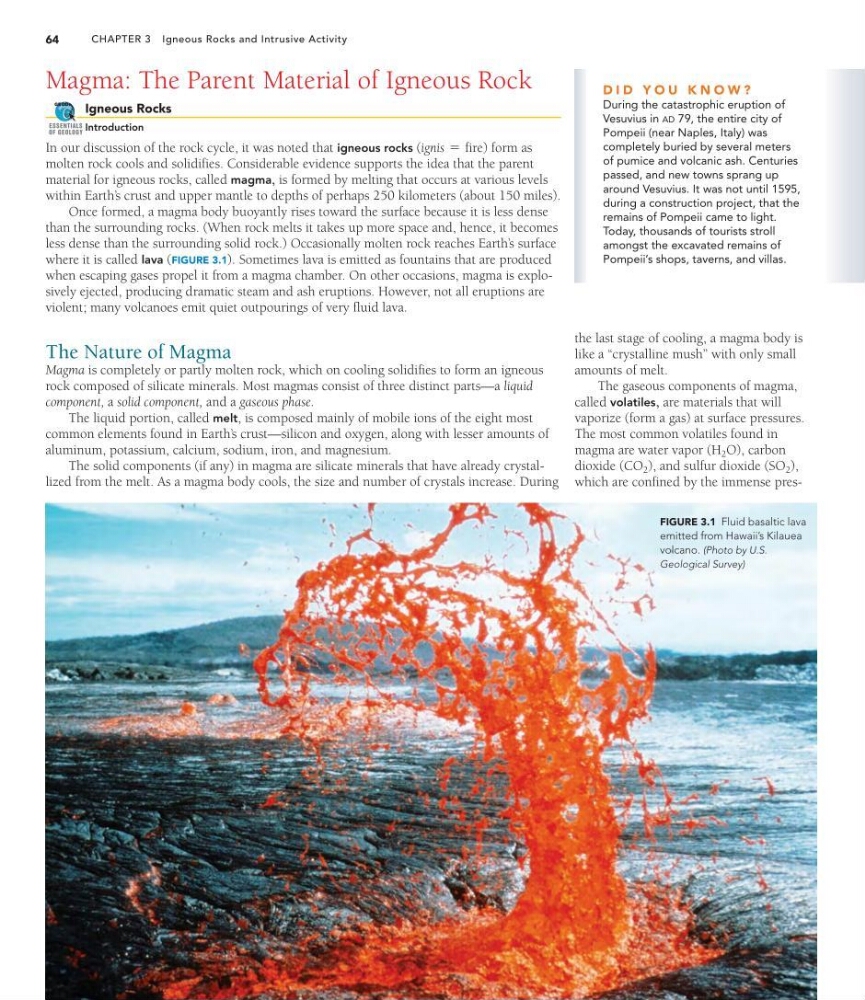
FIGURE 3.1 Fluid basaltic lava
emitted from Hawaii’s Kilauea
volcano. (Photo by U.S.
Geological Survey)
Magma: The Parent Material of Igneous Rock
Igneous Rocks
Introduction
In our discussion of the rock cycle, it was noted that igneous rocks (
) form as
molten rock cools and solidifies. Considerable evidence supports the idea that the parent
material for igneous rocks, called magma, is formed by melting that occurs at various levels
within Earth’ s crust and upper mantle to depths of perhaps 250 kilometers (about 150 miles).
Once formed, a magma body buoyantly rises toward the surface because it is less dense
than the surrounding rocks. (When rock melts it takes up more space and, hence, it becomes
less dense than the surrounding solid rock.) Occasionally molten rock reaches Earth’ s surface
where it is called lava (FIGURE 3.1). Sometimes lava is emitted as fountains that are produced
when escaping gases propel it from a magma chamber. On other occasions, magma is explosively ejected, producing dramatic steam and ash eruptions. However, not all eruptions are
violent; many volcanoes emit quiet outpourings of very fluid lava.
ignis = fire
GEODe
ESSENTIALS
OF GEOLOGY
The Nature of Magma
Magma is completely or partly molten rock, which on cooling solidifies to form an igneous
rock composed of silicate minerals. Most magmas consist of three distinct parts—a liquid
component, a solid component, and a gaseous phase.
The liquid portion, called melt, is composed mainly of mobile ions of the eight most
common elements found in Earth’ s crust—silicon and oxygen, along with lesser amounts of
aluminum, potassium, calcium, sodium, iron, and magnesium.
The solid components (if any) in magma are silicate minerals that have already crystallized from the melt. As a magma body cools, the size and number of crystals increase. During
the last stage of cooling, a magma body is
like a “crystalline mush” with only small
amounts of melt.
The gaseous components of magma,
called volatiles, are materials that will
vaporize (form a gas) at surface pressures.
The most common volatiles found in
magma are water vapor (H 2 O), carbon
dioxide (CO 2 ), and sulfur dioxide (SO 2 ),
which are confined by the immense pres-
64
D I D Y O U K N O W ?
During the catastrophic eruption of
Vesuvius in AD 79, the entire city of
Pompeii (near Naples, Italy) was
completely buried by several meters
of pumice and volcanic ash. Centuries
passed, and new towns sprang up
around Vesuvius. It was not until 1595,
during a construction project, that the
remains of Pompeii came to light.
Today, thousands of tourists stroll
amongst the excavated remains of
Pompeii’s shops, taverns, and villas.
FIGURE 3.1 Fluid basaltic lava
emitted from Hawaii’s Kilauea
volcano. (Photo by U.S.
Geological Survey)
Magma: The Parent Material of Igneous Rock
Igneous Rocks
Introduction
In our discussion of the rock cycle, it was noted that igneous rocks (
) form as
molten rock cools and solidifies. Considerable evidence supports the idea that the parent
material for igneous rocks, called magma, is formed by melting that occurs at various levels
within Earth’ s crust and upper mantle to depths of perhaps 250 kilometers (about 150 miles).
Once formed, a magma body buoyantly rises toward the surface because it is less dense
than the surrounding rocks. (When rock melts it takes up more space and, hence, it becomes
less dense than the surrounding solid rock.) Occasionally molten rock reaches Earth’ s surface
where it is called lava (FIGURE 3.1). Sometimes lava is emitted as fountains that are produced
when escaping gases propel it from a magma chamber. On other occasions, magma is explosively ejected, producing dramatic steam and ash eruptions. However, not all eruptions are
violent; many volcanoes emit quiet outpourings of very fluid lava.
ignis = fire
GEODe
ESSENTIALS
OF GEOLOGY
The Nature of Magma
Magma is completely or partly molten rock, which on cooling solidifies to form an igneous
rock composed of silicate minerals. Most magmas consist of three distinct parts—a liquid
component, a solid component, and a gaseous phase.
The liquid portion, called melt, is composed mainly of mobile ions of the eight most
common elements found in Earth’ s crust—silicon and oxygen, along with lesser amounts of
aluminum, potassium, calcium, sodium, iron, and magnesium.
The solid components (if any) in magma are silicate minerals that have already crystallized from the melt. As a magma body cools, the size and number of crystals increase. During
the last stage of cooling, a magma body is
like a “crystalline mush” with only small
amounts of melt.
The gaseous components of magma,
called volatiles, are materials that will
vaporize (form a gas) at surface pressures.
The most common volatiles found in
magma are water vapor (H 2 O), carbon
dioxide (CO 2 ), and sulfur dioxide (SO 2 ),
which are confined by the immense pres-