

I
GNEOUS ROCKS AND
METAMORPHIC ROCKS
DERIVED FROM IGNEOUS
“parents” make up about 95 percent
of Earth’ s crust. Furthermore, the
mantle, which accounts for more
than 82 percent of Earth’ s volume,
is composed entirely of igneous
rock. Thus, Earth can be described
as a huge mass of igneous rock
covered with a thin veneer of
sedimentary rock and having a
relatively small iron-rich core.
Consequently, a basic knowledge
of igneous rocks is essential to our
understanding of the structure,
composition, and internal
workings of our planet.
F O C U S O N C O N C E P T S
To assist you in learning
the important concepts in this
chapter, focus on the following
questions:
How are igneous rocks formed?
How does magma differ from
lava?
What two criteria are used to
classify igneous rocks?
How does the rate of cooling of
magma influence the crystal size
of minerals in igneous rocks?
How is the mineral makeup of an
igneous rock related to Bowen’s
reaction series?
In what ways are granitic rocks
different from basaltic rocks?
What criteria are used to classify
intrusive igneous bodies?
How are economic deposits of
gold, silver, and many other
metals formed?
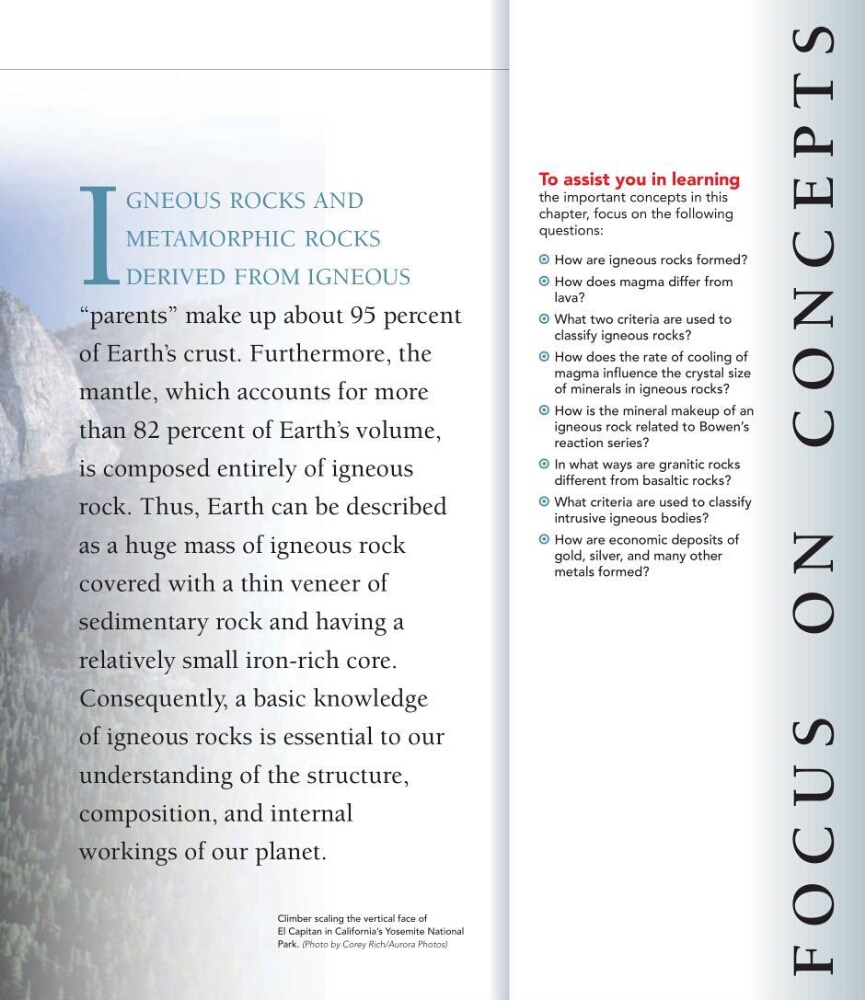
Climber scaling the vertical face of
El Capitan in California’s Yosemite National
Park. (Photo by Corey Rich/Aurora Photos)
GNEOUS ROCKS AND
METAMORPHIC ROCKS
DERIVED FROM IGNEOUS
“parents” make up about 95 percent
of Earth’ s crust. Furthermore, the
mantle, which accounts for more
than 82 percent of Earth’ s volume,
is composed entirely of igneous
rock. Thus, Earth can be described
as a huge mass of igneous rock
covered with a thin veneer of
sedimentary rock and having a
relatively small iron-rich core.
Consequently, a basic knowledge
of igneous rocks is essential to our
understanding of the structure,
composition, and internal
workings of our planet.
F O C U S O N C O N C E P T S
To assist you in learning
the important concepts in this
chapter, focus on the following
questions:
How are igneous rocks formed?
How does magma differ from
lava?
What two criteria are used to
classify igneous rocks?
How does the rate of cooling of
magma influence the crystal size
of minerals in igneous rocks?
How is the mineral makeup of an
igneous rock related to Bowen’s
reaction series?
In what ways are granitic rocks
different from basaltic rocks?
What criteria are used to classify
intrusive igneous bodies?
How are economic deposits of
gold, silver, and many other
metals formed?
Climber scaling the vertical face of
El Capitan in California’s Yosemite National
Park. (Photo by Corey Rich/Aurora Photos)