

CHAPTER 2 Matter and Minerals
50
located at the center of the tetrahedron. The
remaining charge on each oxygen is
available to bond with another positive
ion or with the silicon ion in an adjacent
tetrahedron.
MINERALS WITH INDEPENDENT
TETRAHEDRA. One of the simplest
silicate structures consists of independent
tetrahedra that have their four oxygen ions
bonded to positive ions, such as
,
and
. The mineral olivine, with
the formula MgFe 2 SiO 4 is a good example.
In olivine, magnesium (
) and/or iron
(
) ions pack between comparatively
large independent SiO 4 tetrahedra, forming
a dense three-dimensional structure.
Garnet, another common silicate, is also
composed of independent tetrahedra
ionically bonded by positive ions. Both
olivine and garnet form dense, hard,
equidimensional crystals that
lack cleavage.
MINERALS WITH CHAIN OR SHEET
STRUCTURES. One reason for the great
variety of silicate minerals is the ability of
SiO 4 tetrahedra to link to one another in a
variety of configurations. This important
phenomenon, called polymerization, is
achieved by the sharing of one, two, three,
or all four of the oxygen atoms with adjacent tetrahedra. Vast numbers of tetrahedra
Fe
2+
Mg
2+
Ca
2+
Fe
2+ ,
Mg
2+
1
-
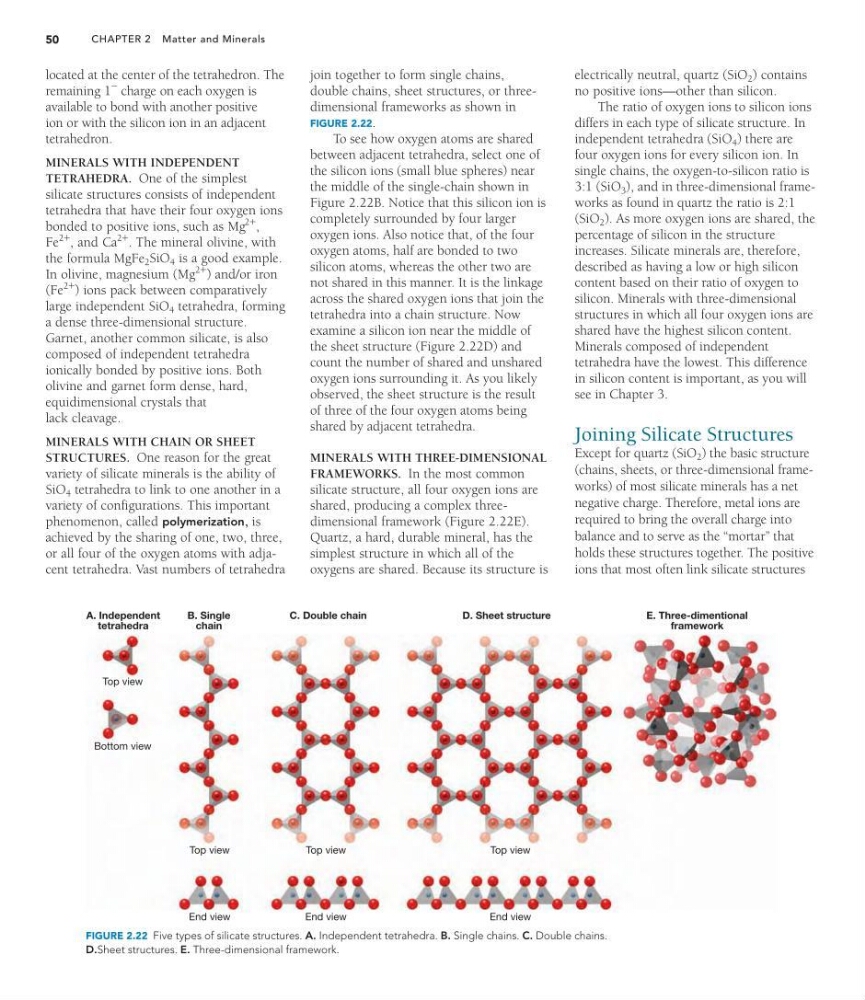
join together to form single chains,
double chains, sheet structures, or threedimensional frameworks as shown in
FIGURE 2.22.
To see how oxygen atoms are shared
between adjacent tetrahedra, select one of
the silicon ions (small blue spheres) near
the middle of the single-chain shown in
Figure 2.22B. Notice that this silicon ion is
completely surrounded by four larger
oxygen ions. Also notice that, of the four
oxygen atoms, half are bonded to two
silicon atoms, whereas the other two are
not shared in this manner. It is the linkage
across the shared oxygen ions that join the
tetrahedra into a chain structure. Now
examine a silicon ion near the middle of
the sheet structure (Figure 2.22D) and
count the number of shared and unshared
oxygen ions surrounding it. As you likely
observed, the sheet structure is the result
of three of the four oxygen atoms being
shared by adjacent tetrahedra.
MINERALS WITH THREE-DIMENSIONAL
FRAMEWORKS. In the most common
silicate structure, all four oxygen ions are
shared, producing a complex threedimensional framework (Figure 2.22E).
Quartz, a hard, durable mineral, has the
simplest structure in which all of the
oxygens are shared. Because its structure is
electrically neutral, quartz (SiO 2 ) contains
no positive ions—other than silicon.
The ratio of oxygen ions to silicon ions
differs in each type of silicate structure. In
independent tetrahedra (SiO 4 ) there are
four oxygen ions for every silicon ion. In
single chains, the oxygen-to-silicon ratio is
3:1 (SiO 3 ), and in three-dimensional frameworks as found in quartz the ratio is 2:1
(SiO 2 ). As more oxygen ions are shared, the
percentage of silicon in the structure
increases. Silicate minerals are, therefore,
described as having a low or high silicon
content based on their ratio of oxygen to
silicon. Minerals with three-dimensional
structures in which all four oxygen ions are
shared have the highest silicon content.
Minerals composed of independent
tetrahedra have the lowest. This difference
in silicon content is important, as you will
see in Chapter 3.
Joining Silicate Structures
Except for quartz (SiO 2 ) the basic structure
(chains, sheets, or three-dimensional frameworks) of most silicate minerals has a net
negative charge. Therefore, metal ions are
required to bring the overall charge into
balance and to serve as the “mortar” that
holds these structures together. The positive
ions that most often link silicate structures
A. Independent
tetrahedra
E. Three-dimentional
framework
B. Single
chain
C. Double chain
D. Sheet structure
End view
Top view
Bottom view
Top view
End view
Top view
End view
Top view
FIGURE 2.22 Five types of silicate structures. A. Independent tetrahedra. B. Single chains. C. Double chains.
D.Sheet structures. E. Three-dimensional framework.
50
located at the center of the tetrahedron. The
remaining charge on each oxygen is
available to bond with another positive
ion or with the silicon ion in an adjacent
tetrahedron.
MINERALS WITH INDEPENDENT
TETRAHEDRA. One of the simplest
silicate structures consists of independent
tetrahedra that have their four oxygen ions
bonded to positive ions, such as
,
and
. The mineral olivine, with
the formula MgFe 2 SiO 4 is a good example.
In olivine, magnesium (
) and/or iron
(
) ions pack between comparatively
large independent SiO 4 tetrahedra, forming
a dense three-dimensional structure.
Garnet, another common silicate, is also
composed of independent tetrahedra
ionically bonded by positive ions. Both
olivine and garnet form dense, hard,
equidimensional crystals that
lack cleavage.
MINERALS WITH CHAIN OR SHEET
STRUCTURES. One reason for the great
variety of silicate minerals is the ability of
SiO 4 tetrahedra to link to one another in a
variety of configurations. This important
phenomenon, called polymerization, is
achieved by the sharing of one, two, three,
or all four of the oxygen atoms with adjacent tetrahedra. Vast numbers of tetrahedra
Fe
2+
Mg
2+
Ca
2+
Fe
2+ ,
Mg
2+
1
-
join together to form single chains,
double chains, sheet structures, or threedimensional frameworks as shown in
FIGURE 2.22.
To see how oxygen atoms are shared
between adjacent tetrahedra, select one of
the silicon ions (small blue spheres) near
the middle of the single-chain shown in
Figure 2.22B. Notice that this silicon ion is
completely surrounded by four larger
oxygen ions. Also notice that, of the four
oxygen atoms, half are bonded to two
silicon atoms, whereas the other two are
not shared in this manner. It is the linkage
across the shared oxygen ions that join the
tetrahedra into a chain structure. Now
examine a silicon ion near the middle of
the sheet structure (Figure 2.22D) and
count the number of shared and unshared
oxygen ions surrounding it. As you likely
observed, the sheet structure is the result
of three of the four oxygen atoms being
shared by adjacent tetrahedra.
MINERALS WITH THREE-DIMENSIONAL
FRAMEWORKS. In the most common
silicate structure, all four oxygen ions are
shared, producing a complex threedimensional framework (Figure 2.22E).
Quartz, a hard, durable mineral, has the
simplest structure in which all of the
oxygens are shared. Because its structure is
electrically neutral, quartz (SiO 2 ) contains
no positive ions—other than silicon.
The ratio of oxygen ions to silicon ions
differs in each type of silicate structure. In
independent tetrahedra (SiO 4 ) there are
four oxygen ions for every silicon ion. In
single chains, the oxygen-to-silicon ratio is
3:1 (SiO 3 ), and in three-dimensional frameworks as found in quartz the ratio is 2:1
(SiO 2 ). As more oxygen ions are shared, the
percentage of silicon in the structure
increases. Silicate minerals are, therefore,
described as having a low or high silicon
content based on their ratio of oxygen to
silicon. Minerals with three-dimensional
structures in which all four oxygen ions are
shared have the highest silicon content.
Minerals composed of independent
tetrahedra have the lowest. This difference
in silicon content is important, as you will
see in Chapter 3.
Joining Silicate Structures
Except for quartz (SiO 2 ) the basic structure
(chains, sheets, or three-dimensional frameworks) of most silicate minerals has a net
negative charge. Therefore, metal ions are
required to bring the overall charge into
balance and to serve as the “mortar” that
holds these structures together. The positive
ions that most often link silicate structures
A. Independent
tetrahedra
E. Three-dimentional
framework
B. Single
chain
C. Double chain
D. Sheet structure
End view
Top view
Bottom view
Top view
End view
Top view
End view
Top view
FIGURE 2.22 Five types of silicate structures. A. Independent tetrahedra. B. Single chains. C. Double chains.
D.Sheet structures. E. Three-dimensional framework.