

51
Common Silicate Minerals
Negative Ions
Positive Ions
O
2–
Mg
2+
Ca
2+
Mn
2+
Fe
2+
Fe
3+
Al
3+
Si
4+
Ti
4+
F –
S
2–
Cl –
Na +
K +
Angstroms
0 1 2 3
Ionic charge
–2
–1
0
+ 1
+2
+3
+4
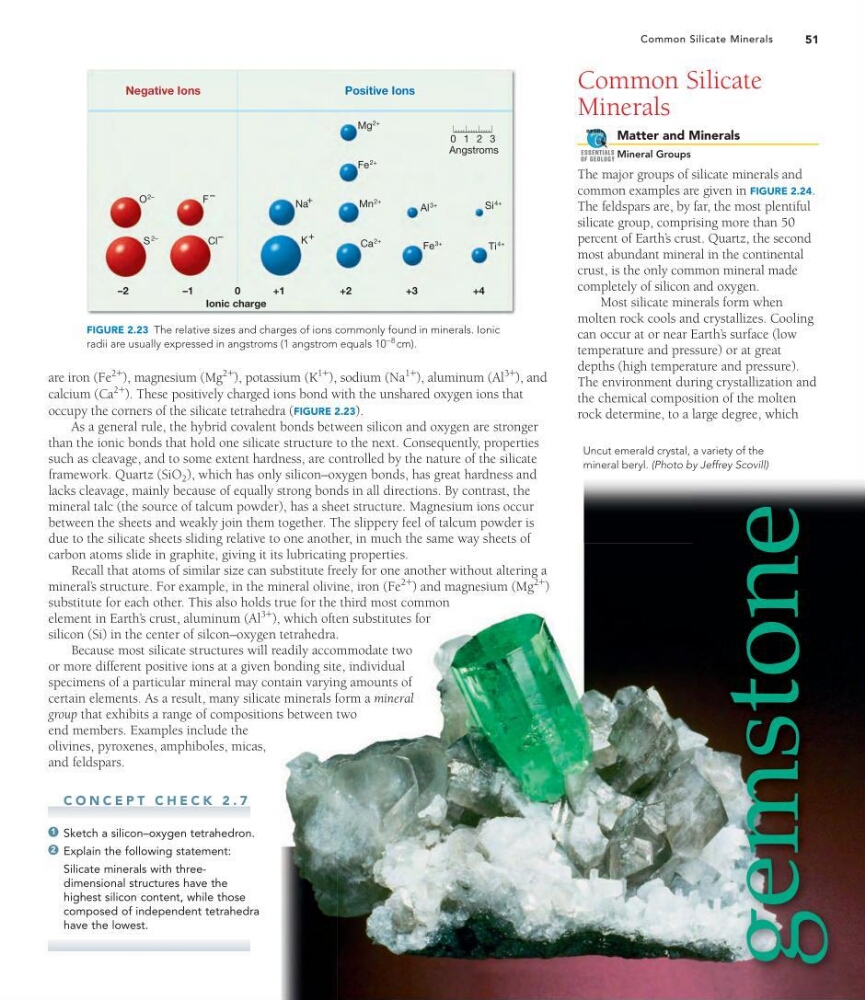
FIGURE 2.23 The relative sizes and charges of ions commonly found in minerals. Ionic
radii are usually expressed in angstroms (1 angstrom equals
).
10
-8 cm
gemstone
Common Silicate
Minerals
Matter and Minerals
Mineral Groups
The major groups of silicate minerals and
common examples are given in FIGURE 2.24.
The feldspars are, by far, the most plentiful
silicate group, comprising more than 50
percent of Earth’ s crust. Quartz, the second
most abundant mineral in the continental
crust, is the only common mineral made
completely of silicon and oxygen.
Most silicate minerals form when
molten rock cools and crystallizes. Cooling
can occur at or near Earth’ s surface (low
temperature and pressure) or at great
depths (high temperature and pressure).
The environment during crystallization and
the chemical composition of the molten
rock determine, to a large degree, which
GEODe
ESSENTIALS
OF GEOLOGY
are iron (
), magnesium (
), potassium ( ), sodium (
), aluminum (
), and
calcium (
). These positively charged ions bond with the unshared oxygen ions that
occupy the corners of the silicate tetrahedra (FIGURE 2.23).
As a general rule, the hybrid covalent bonds between silicon and oxygen are stronger
than the ionic bonds that hold one silicate structure to the next. Consequently, properties
such as cleavage, and to some extent hardness, are controlled by the nature of the silicate
framework. Quartz (SiO 2 ), which has only silicon–oxygen bonds, has great hardness and
lacks cleavage, mainly because of equally strong bonds in all directions. By contrast, the
mineral talc (the source of talcum powder), has a sheet structure. Magnesium ions occur
between the sheets and weakly join them together. The slippery feel of talcum powder is
due to the silicate sheets sliding relative to one another, in much the same way sheets of
carbon atoms slide in graphite, giving it its lubricating properties.
Recall that atoms of similar size can substitute freely for one another without altering a
mineral’ s structure. For example, in the mineral olivine, iron (
) and magnesium (
)
substitute for each other. This also holds true for the third most common
element in Earth’ s crust, aluminum (
), which often substitutes for
silicon (Si) in the center of silcon–oxygen tetrahedra.
Because most silicate structures will readily accommodate two
or more different positive ions at a given bonding site, individual
specimens of a particular mineral may contain varying amounts of
certain elements. As a result, many silicate minerals form a mineral
group that exhibits a range of compositions between two
end members. Examples include the
olivines, pyroxenes, amphiboles, micas,
and feldspars.
C O N C E P T C H E C K 2 . 7
Sketch a silicon–oxygen tetrahedron.
Explain the following statement:
Silicate minerals with threedimensional structures have the
highest silicon content, while those
composed of independent tetrahedra
have the lowest.
2
1
Al
3+
Mg
2+
Fe
2+
Ca
2+
Al
3+
Na
1+
K
1+
Mg
2+
Fe
2+
Uncut emerald crystal, a variety of the
mineral beryl. (Photo by Jeffrey Scovill)
Common Silicate Minerals
Negative Ions
Positive Ions
O
2–
Mg
2+
Ca
2+
Mn
2+
Fe
2+
Fe
3+
Al
3+
Si
4+
Ti
4+
F –
S
2–
Cl –
Na +
K +
Angstroms
0 1 2 3
Ionic charge
–2
–1
0
+ 1
+2
+3
+4
FIGURE 2.23 The relative sizes and charges of ions commonly found in minerals. Ionic
radii are usually expressed in angstroms (1 angstrom equals
).
10
-8 cm
gemstone
Common Silicate
Minerals
Matter and Minerals
Mineral Groups
The major groups of silicate minerals and
common examples are given in FIGURE 2.24.
The feldspars are, by far, the most plentiful
silicate group, comprising more than 50
percent of Earth’ s crust. Quartz, the second
most abundant mineral in the continental
crust, is the only common mineral made
completely of silicon and oxygen.
Most silicate minerals form when
molten rock cools and crystallizes. Cooling
can occur at or near Earth’ s surface (low
temperature and pressure) or at great
depths (high temperature and pressure).
The environment during crystallization and
the chemical composition of the molten
rock determine, to a large degree, which
GEODe
ESSENTIALS
OF GEOLOGY
are iron (
), magnesium (
), potassium ( ), sodium (
), aluminum (
), and
calcium (
). These positively charged ions bond with the unshared oxygen ions that
occupy the corners of the silicate tetrahedra (FIGURE 2.23).
As a general rule, the hybrid covalent bonds between silicon and oxygen are stronger
than the ionic bonds that hold one silicate structure to the next. Consequently, properties
such as cleavage, and to some extent hardness, are controlled by the nature of the silicate
framework. Quartz (SiO 2 ), which has only silicon–oxygen bonds, has great hardness and
lacks cleavage, mainly because of equally strong bonds in all directions. By contrast, the
mineral talc (the source of talcum powder), has a sheet structure. Magnesium ions occur
between the sheets and weakly join them together. The slippery feel of talcum powder is
due to the silicate sheets sliding relative to one another, in much the same way sheets of
carbon atoms slide in graphite, giving it its lubricating properties.
Recall that atoms of similar size can substitute freely for one another without altering a
mineral’ s structure. For example, in the mineral olivine, iron (
) and magnesium (
)
substitute for each other. This also holds true for the third most common
element in Earth’ s crust, aluminum (
), which often substitutes for
silicon (Si) in the center of silcon–oxygen tetrahedra.
Because most silicate structures will readily accommodate two
or more different positive ions at a given bonding site, individual
specimens of a particular mineral may contain varying amounts of
certain elements. As a result, many silicate minerals form a mineral
group that exhibits a range of compositions between two
end members. Examples include the
olivines, pyroxenes, amphiboles, micas,
and feldspars.
C O N C E P T C H E C K 2 . 7
Sketch a silicon–oxygen tetrahedron.
Explain the following statement:
Silicate minerals with threedimensional structures have the
highest silicon content, while those
composed of independent tetrahedra
have the lowest.
2
1
Al
3+
Mg
2+
Fe
2+
Ca
2+
Al
3+
Na
1+
K
1+
Mg
2+
Fe
2+
Uncut emerald crystal, a variety of the
mineral beryl. (Photo by Jeffrey Scovill)