

O
2–
O
2–
O
2–
O
2–
Si
4+
SiO 4
4–
B.
A.
O
2–
O
2–
O
2–
O
2–
Si
4+
Oxygen (O)
46.6%
Silicon (Si)
27.7%
Aluminum (Al)
8.1%
Iron (Fe)
5.0%
Calcium (Ca)
3.6%
Sodium (Na)
2.8%
Other
elements
1.5%
Potassium (K)
2.6%
Magnesium (Mg)
2.1%
More than 800 silicate minerals are
known, and they account for more
than 90 percent of Earth’ s crust.
Because other mineral
groups are far less abundant in
Earth’ s crust than the silicates,
they are often grouped together
under the heading nonsilicates.
Although not as common as silicates, some nonsilicate minerals
are very important economically. They provide us with
iron and aluminum to build
our automobiles, gypsum
for plaster and drywall for
home construction, and
copper wire that carries
electricity and connects us
to the Internet. Some common nonsilicate
mineral groups include the carbonates,
sulfates, and halides. In addition to their
economic importance, these mineral
groups include members that are major
constituents in sediments and sedimentary
rocks.
We first discuss the most common
mineral group, the silicates, and then
consider some of the prominent nonsilicate
mineral groups.
C O N C E P T C H E C K 2 . 6
List the eight most common elements in
Earth’s crust in order of abundance (most
to least).
Explain the difference between the terms
silicon and silicate.
The Silicates
Every silicate mineral contains
the two most abundant elements of Earth’ s crust, oxygen and silicon. Further,
most contain one or more
of the other common elements. Together, these elements give rise to hundreds
of silicate minerals with a wide variety of
properties, including hard quartz, soft talc,
sheet-like mica, fibrous asbestos, green
olivine, and blood-red garnet.
2
1
49
The Silicates
useful in identifying the common carbonate
mineral calcite.
C O N C E P T C H E C K 2 . 5
Why is color not always a useful property in
mineral identification? Give an example of
a mineral that supports your answer.
What is meant when we refer to a mineral’s
tenacity? List four terms that describe
tenacity.
Why does quartz lack cleavage?
Mineral Groups
Matter and Minerals
Minerals
Over 4000 minerals have been named, and
several new ones are identified each year.
Fortunately, for students who are beginning
to study minerals, no more than a few
dozen are abundant! Collectively, these few
make up most of the rocks of Earth’ s crust
and, as such, are often referred to as the
rock-forming minerals.
Although less abundant, many other
minerals are used extensively in the manufacture of products and are called economic
minerals. However, rock-forming minerals
and economic minerals are not mutually
exclusive groups. When found in large
deposits, some rock-forming minerals are
economically significant. One example is
the mineral calcite, which is the primary
component of the sedimentary rock limestone and has many uses including being
used in the production of cement.
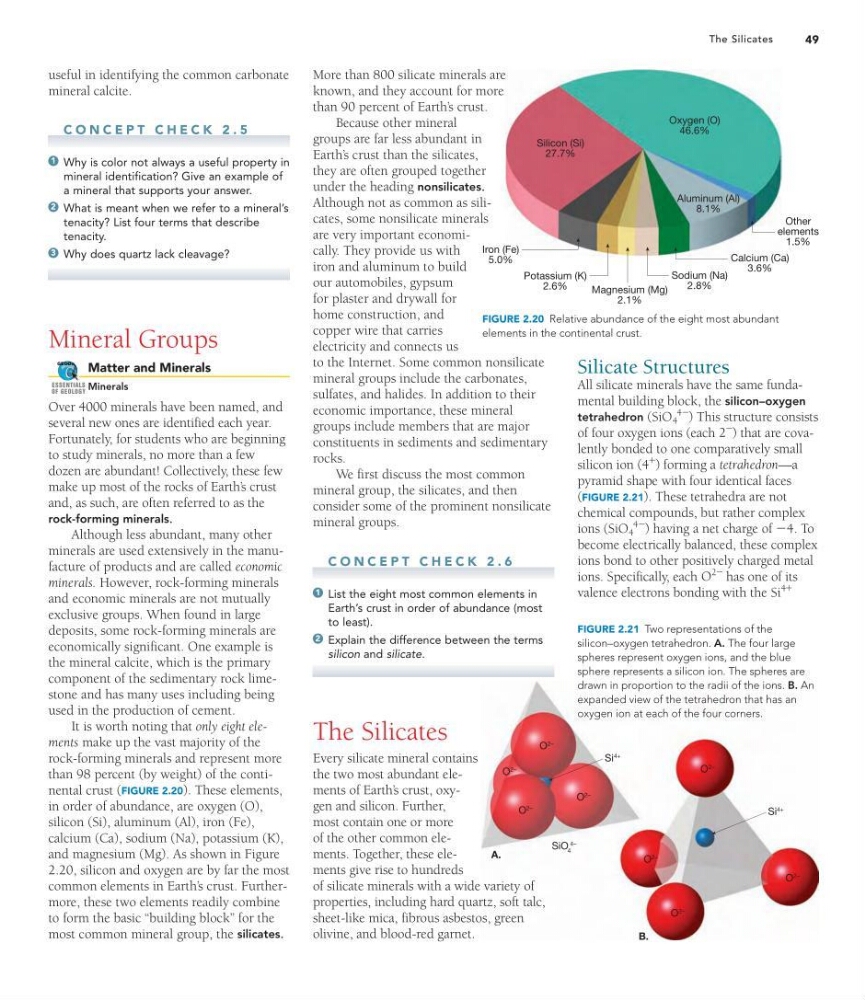
It is worth noting that only eight elements make up the vast majority of the
rock-forming minerals and represent more
than 98 percent (by weight) of the continental crust (FIGURE 2.20). These elements,
in order of abundance, are oxygen (O),
silicon (Si), aluminum (Al), iron (Fe),
calcium (Ca), sodium (Na), potassium (K),
and magnesium (Mg). As shown in Figure
2.20, silicon and oxygen are by far the most
common elements in Earth’ s crust. Furthermore, these two elements readily combine
to form the basic “building block” for the
most common mineral group, the silicates.
GEODe
ESSENTIALS
OF GEOLOGY
3
2
1
FIGURE 2.21 Two representations of the
silicon–oxygen tetrahedron. A. The four large
spheres represent oxygen ions, and the blue
sphere represents a silicon ion. The spheres are
drawn in proportion to the radii of the ions. B. An
expanded view of the tetrahedron that has an
oxygen ion at each of the four corners.
FIGURE 2.20 Relative abundance of the eight most abundant
elements in the continental crust.
Silicate Structures
All silicate minerals have the same fundamental building block, the silicon–oxygen
tetrahedron (
) This structure consists
of four oxygen ions (each ) that are covalently bonded to one comparatively small
silicon ion ( ) forming a tetrahedron—a
pyramid shape with four identical faces
(FIGURE 2.21). These tetrahedra are not
chemical compounds, but rather complex
ions (
) having a net charge of
. To
become electrically balanced, these complex
ions bond to other positively charged metal
ions. Specifically, each
has one of its
valence electrons bonding with the Si
4+
O
2- 4
SiO 4
44
+
2
-
SiO 4
4-
2–
O
2–
O
2–
O
2–
Si
4+
SiO 4
4–
B.
A.
O
2–
O
2–
O
2–
O
2–
Si
4+
Oxygen (O)
46.6%
Silicon (Si)
27.7%
Aluminum (Al)
8.1%
Iron (Fe)
5.0%
Calcium (Ca)
3.6%
Sodium (Na)
2.8%
Other
elements
1.5%
Potassium (K)
2.6%
Magnesium (Mg)
2.1%
More than 800 silicate minerals are
known, and they account for more
than 90 percent of Earth’ s crust.
Because other mineral
groups are far less abundant in
Earth’ s crust than the silicates,
they are often grouped together
under the heading nonsilicates.
Although not as common as silicates, some nonsilicate minerals
are very important economically. They provide us with
iron and aluminum to build
our automobiles, gypsum
for plaster and drywall for
home construction, and
copper wire that carries
electricity and connects us
to the Internet. Some common nonsilicate
mineral groups include the carbonates,
sulfates, and halides. In addition to their
economic importance, these mineral
groups include members that are major
constituents in sediments and sedimentary
rocks.
We first discuss the most common
mineral group, the silicates, and then
consider some of the prominent nonsilicate
mineral groups.
C O N C E P T C H E C K 2 . 6
List the eight most common elements in
Earth’s crust in order of abundance (most
to least).
Explain the difference between the terms
silicon and silicate.
The Silicates
Every silicate mineral contains
the two most abundant elements of Earth’ s crust, oxygen and silicon. Further,
most contain one or more
of the other common elements. Together, these elements give rise to hundreds
of silicate minerals with a wide variety of
properties, including hard quartz, soft talc,
sheet-like mica, fibrous asbestos, green
olivine, and blood-red garnet.
2
1
49
The Silicates
useful in identifying the common carbonate
mineral calcite.
C O N C E P T C H E C K 2 . 5
Why is color not always a useful property in
mineral identification? Give an example of
a mineral that supports your answer.
What is meant when we refer to a mineral’s
tenacity? List four terms that describe
tenacity.
Why does quartz lack cleavage?
Mineral Groups
Matter and Minerals
Minerals
Over 4000 minerals have been named, and
several new ones are identified each year.
Fortunately, for students who are beginning
to study minerals, no more than a few
dozen are abundant! Collectively, these few
make up most of the rocks of Earth’ s crust
and, as such, are often referred to as the
rock-forming minerals.
Although less abundant, many other
minerals are used extensively in the manufacture of products and are called economic
minerals. However, rock-forming minerals
and economic minerals are not mutually
exclusive groups. When found in large
deposits, some rock-forming minerals are
economically significant. One example is
the mineral calcite, which is the primary
component of the sedimentary rock limestone and has many uses including being
used in the production of cement.
It is worth noting that only eight elements make up the vast majority of the
rock-forming minerals and represent more
than 98 percent (by weight) of the continental crust (FIGURE 2.20). These elements,
in order of abundance, are oxygen (O),
silicon (Si), aluminum (Al), iron (Fe),
calcium (Ca), sodium (Na), potassium (K),
and magnesium (Mg). As shown in Figure
2.20, silicon and oxygen are by far the most
common elements in Earth’ s crust. Furthermore, these two elements readily combine
to form the basic “building block” for the
most common mineral group, the silicates.
GEODe
ESSENTIALS
OF GEOLOGY
3
2
1
FIGURE 2.21 Two representations of the
silicon–oxygen tetrahedron. A. The four large
spheres represent oxygen ions, and the blue
sphere represents a silicon ion. The spheres are
drawn in proportion to the radii of the ions. B. An
expanded view of the tetrahedron that has an
oxygen ion at each of the four corners.
FIGURE 2.20 Relative abundance of the eight most abundant
elements in the continental crust.
Silicate Structures
All silicate minerals have the same fundamental building block, the silicon–oxygen
tetrahedron (
) This structure consists
of four oxygen ions (each ) that are covalently bonded to one comparatively small
silicon ion ( ) forming a tetrahedron—a
pyramid shape with four identical faces
(FIGURE 2.21). These tetrahedra are not
chemical compounds, but rather complex
ions (
) having a net charge of
. To
become electrically balanced, these complex
ions bond to other positively charged metal
ions. Specifically, each
has one of its
valence electrons bonding with the Si
4+
O
2- 4
SiO 4
44
+
2
-
SiO 4
4-