

CHAPTER 2 Matter and Minerals
48
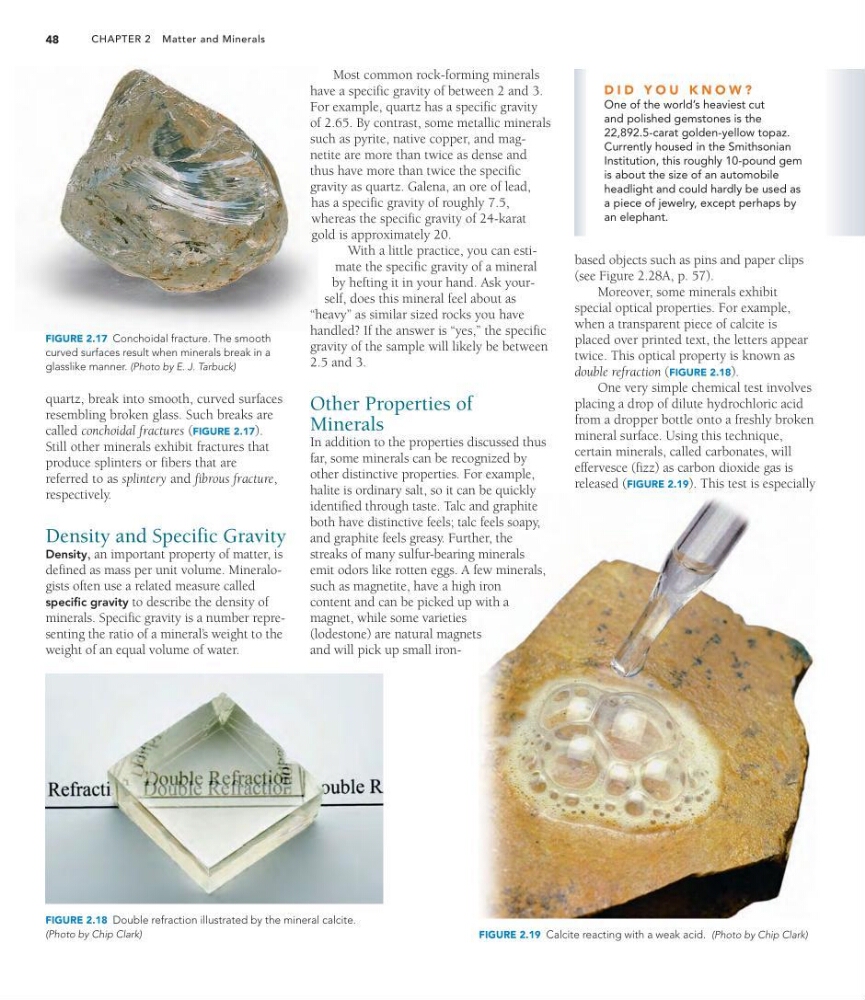
quartz, break into smooth, curved surfaces
resembling broken glass. Such breaks are
called conchoidal fractures (FIGURE 2.17).
Still other minerals exhibit fractures that
produce splinters or fibers that are
referred to as splintery and fibrous fracture,
respectively.
Density and Specific Gravity
Density, an important property of matter, is
defined as mass per unit volume. Mineralogists often use a related measure called
specific gravity to describe the density of
minerals. Specific gravity is a number representing the ratio of a mineral’ s weight to the
weight of an equal volume of water.
D I D Y O U K N O W ?
One of the world’s heaviest cut
and polished gemstones is the
22,892.5-carat golden-yellow topaz.
Currently housed in the Smithsonian
Institution, this roughly 10-pound gem
is about the size of an automobile
headlight and could hardly be used as
a piece of jewelry, except perhaps by
an elephant.
FIGURE 2.17 Conchoidal fracture. The smooth
curved surfaces result when minerals break in a
glasslike manner. (Photo by E. J. Tarbuck)
FIGURE 2.18 Double refraction illustrated by the mineral calcite.
(Photo by Chip Clark)
Most common rock-forming minerals
have a specific gravity of between 2 and 3.
For example, quartz has a specific gravity
of 2.65. By contrast, some metallic minerals
such as pyrite, native copper, and magnetite are more than twice as dense and
thus have more than twice the specific
gravity as quartz. Galena, an ore of lead,
has a specific gravity of roughly 7.5,
whereas the specific gravity of 24-karat
gold is approximately 20.
With a little practice, you can estimate the specific gravity of a mineral
by hefting it in your hand. Ask yourself, does this mineral feel about as
“heavy” as similar sized rocks you have
handled? If the answer is “yes,” the specific
gravity of the sample will likely be between
2.5 and 3.
Other Properties of
Minerals
In addition to the properties discussed thus
far, some minerals can be recognized by
other distinctive properties. For example,
halite is ordinary salt, so it can be quickly
identified through taste. Talc and graphite
both have distinctive feels; talc feels soapy,
and graphite feels greasy. Further, the
streaks of many sulfur-bearing minerals
emit odors like rotten eggs. A few minerals,
such as magnetite, have a high iron
content and can be picked up with a
magnet, while some varieties
(lodestone) are natural magnets
and will pick up small ironFIGURE 2.19 Calcite reacting with a weak acid. (Photo by Chip Clark)
based objects such as pins and paper clips
(see Figure 2.28A, p. 57).
Moreover, some minerals exhibit
special optical properties. For example,
when a transparent piece of calcite is
placed over printed text, the letters appear
twice. This optical property is known as
double refraction (FIGURE 2.18).
One very simple chemical test involves
placing a drop of dilute hydrochloric acid
from a dropper bottle onto a freshly broken
mineral surface. Using this technique,
certain minerals, called carbonates, will
effervesce (fizz) as carbon dioxide gas is
released (FIGURE 2.19). This test is especially
48
quartz, break into smooth, curved surfaces
resembling broken glass. Such breaks are
called conchoidal fractures (FIGURE 2.17).
Still other minerals exhibit fractures that
produce splinters or fibers that are
referred to as splintery and fibrous fracture,
respectively.
Density and Specific Gravity
Density, an important property of matter, is
defined as mass per unit volume. Mineralogists often use a related measure called
specific gravity to describe the density of
minerals. Specific gravity is a number representing the ratio of a mineral’ s weight to the
weight of an equal volume of water.
D I D Y O U K N O W ?
One of the world’s heaviest cut
and polished gemstones is the
22,892.5-carat golden-yellow topaz.
Currently housed in the Smithsonian
Institution, this roughly 10-pound gem
is about the size of an automobile
headlight and could hardly be used as
a piece of jewelry, except perhaps by
an elephant.
FIGURE 2.17 Conchoidal fracture. The smooth
curved surfaces result when minerals break in a
glasslike manner. (Photo by E. J. Tarbuck)
FIGURE 2.18 Double refraction illustrated by the mineral calcite.
(Photo by Chip Clark)
Most common rock-forming minerals
have a specific gravity of between 2 and 3.
For example, quartz has a specific gravity
of 2.65. By contrast, some metallic minerals
such as pyrite, native copper, and magnetite are more than twice as dense and
thus have more than twice the specific
gravity as quartz. Galena, an ore of lead,
has a specific gravity of roughly 7.5,
whereas the specific gravity of 24-karat
gold is approximately 20.
With a little practice, you can estimate the specific gravity of a mineral
by hefting it in your hand. Ask yourself, does this mineral feel about as
“heavy” as similar sized rocks you have
handled? If the answer is “yes,” the specific
gravity of the sample will likely be between
2.5 and 3.
Other Properties of
Minerals
In addition to the properties discussed thus
far, some minerals can be recognized by
other distinctive properties. For example,
halite is ordinary salt, so it can be quickly
identified through taste. Talc and graphite
both have distinctive feels; talc feels soapy,
and graphite feels greasy. Further, the
streaks of many sulfur-bearing minerals
emit odors like rotten eggs. A few minerals,
such as magnetite, have a high iron
content and can be picked up with a
magnet, while some varieties
(lodestone) are natural magnets
and will pick up small ironFIGURE 2.19 Calcite reacting with a weak acid. (Photo by Chip Clark)
based objects such as pins and paper clips
(see Figure 2.28A, p. 57).
Moreover, some minerals exhibit
special optical properties. For example,
when a transparent piece of calcite is
placed over printed text, the letters appear
twice. This optical property is known as
double refraction (FIGURE 2.18).
One very simple chemical test involves
placing a drop of dilute hydrochloric acid
from a dropper bottle onto a freshly broken
mineral surface. Using this technique,
certain minerals, called carbonates, will
effervesce (fizz) as carbon dioxide gas is
released (FIGURE 2.19). This test is especially