

elements including carbon, nitrogen,
and oxygen. All carbon atoms have six
protons, whereas all nitrogen atoms have
seven protons, and all oxygen atoms
have eight.
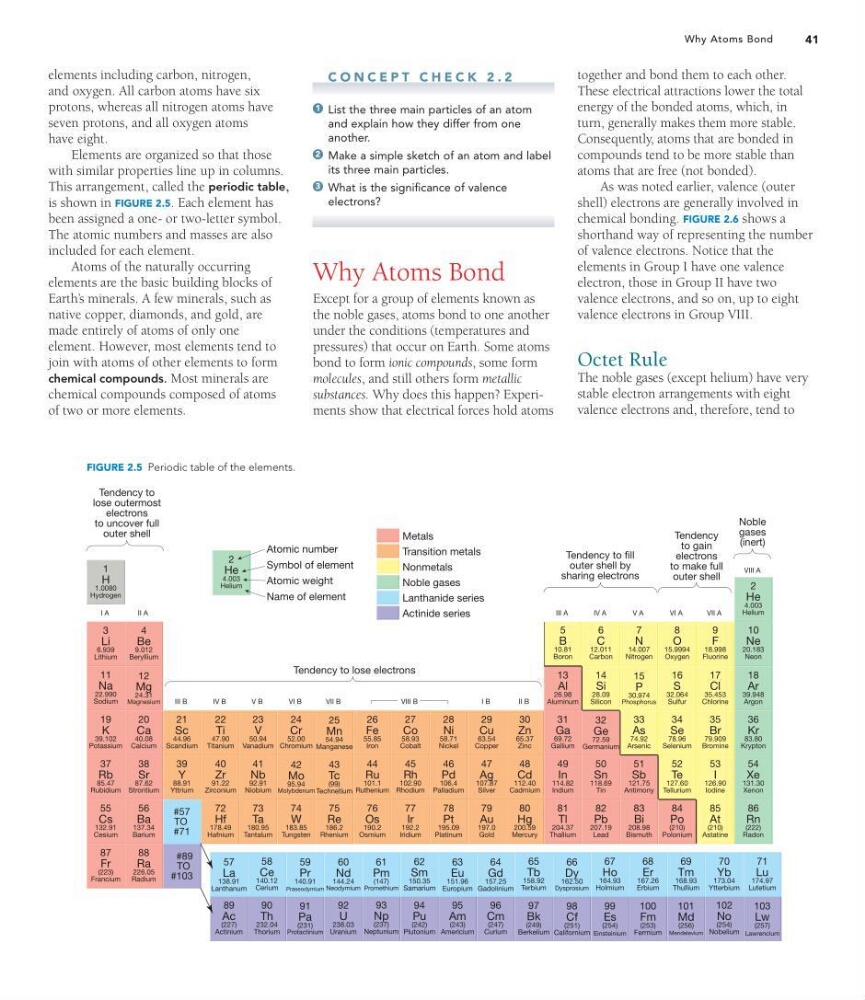
Elements are organized so that those
with similar properties line up in columns.
This arrangement, called the periodic table,
is shown in FIGURE 2.5. Each element has
been assigned a one- or two-letter symbol.
The atomic numbers and masses are also
included for each element.
Atoms of the naturally occurring
elements are the basic building blocks of
Earth’ s minerals. A few minerals, such as
native copper, diamonds, and gold, are
made entirely of atoms of only one
element. However, most elements tend to
join with atoms of other elements to form
chemical compounds. Most minerals are
chemical compounds composed of atoms
of two or more elements.
C O N C E P T C H E C K 2 . 2
List the three main particles of an atom
and explain how they differ from one
another.
Make a simple sketch of an atom and label
its three main particles.
What is the significance of valence
electrons?
Why Atoms Bond
Except for a group of elements known as
the noble gases, atoms bond to one another
under the conditions (temperatures and
pressures) that occur on Earth. Some atoms
bond to form ionic compounds, some form
molecules, and still others form metallic
substances. Why does this happen? Experiments show that electrical forces hold atoms
3
2
1
together and bond them to each other.
These electrical attractions lower the total
energy of the bonded atoms, which, in
turn, generally makes them more stable.
Consequently, atoms that are bonded in
compounds tend to be more stable than
atoms that are free (not bonded).
As was noted earlier, valence (outer
shell) electrons are generally involved in
chemical bonding. FIGURE 2.6 shows a
shorthand way of representing the number
of valence electrons. Notice that the
elements in Group I have one valence
electron, those in Group II have two
valence electrons, and so on, up to eight
valence electrons in Group VIII.
Octet Rule
The noble gases (except helium) have very
stable electron arrangements with eight
valence electrons and, therefore, tend to
41
Why Atoms Bond
2
He
4.003
Helium
Nonmetals
Metals
Transition metals
Noble gases
Lanthanide series
Actinide series
I A
II A
III A
IV A
V A
VI A
VII A
VIII A
III B
IV B
V B
VI B
VII B
I B
II B
Atomic number
Symbol of element
Atomic weight
Name of element
2
He
4.003
Helium
1
H
1.0080
Hydrogen
87
Fr
(223)
Francium
88
Ra
226.05
Radium
#89
TO
#103
55
Cs
132.91
Cesium
56
Ba
137.34
Barium
#57
TO
#71
72
Hf
178.49
Hafnium
73
Ta
180.95
Tantalum
74
W
183.85
Tungsten
75
Re
186.2
Rhenium
76
Os
190.2
Osmium
77
Ir
192.2
Iridium
78
Pt
195.09
Platinum
79
Au
197.0
Gold
80
Hg
200.59
Mercury
81
Tl
204.37
Thallium
82
Pb
207.19
Lead
83
Bi
208.98
Bismuth
84
Po
(210)
Polonium
85
At
(210)
Astatine
86
Rn
(222)
Radon
37
Rb
85.47
Rubidium
38
Sr
87.62
Strontium
39
Y
88.91
Yttrium
40
Zr
91.22
Zirconium
41
Nb
92.91
Niobium
42
Mo
95.94
Molybdenum
43
Tc
(99)
Technetium
44
Ru
101.1
Ruthenium
45
Rh
102.90
Rhodium
46
Pd
106.4
Palladium
47
Ag
107.87
Silver
48
Cd
112.40
Cadmium
49
In
114.82
Indium
50
Sn
118.69
Tin
51
Sb
121.75
Antimony
52
Te
127.60
Tellurium
53
I
126.90
Iodine
54
Xe
131.30
Xenon
19
K
39.102
Potassium
20
Ca
40.08
Calcium
21
Sc
44.96
Scandium
22
Ti
47.90
Titanium
23
V
50.94
Vanadium
24
Cr
52.00
Chromium
25
Mn
54.94
Manganese
26
Fe
55.85
Iron
27
Co
58.93
Cobalt
28
Ni
58.71
Nickel
29
Cu
63.54
Copper
30
Zn
65.37
Zinc
31
Ga
69.72
Gallium
32
Ge
72.59
Germanium
33
As
74.92
Arsenic
34
Se
78.96
Selenium
35
Br
79.909
Bromine
36
Kr
83.80
Krypton
11
Na
22.990
Sodium
12
Mg
24.31
Magnesium
13
Al
26.98
Aluminum
14
Si
28.09
Silicon
15
P
30.974
Phosphorus
16
S
32.064
Sulfur
17
Cl
35.453
Chlorine
18
Ar
39.948
Argon
3
Li
6.939
Lithium
4
Be
9.012
Beryllium
5
B
10.81
Boron
6
C
12.011
Carbon
7
N
14.007
Nitrogen
8
O
15.9994
Oxygen
9
F
18.998
Fluorine
10
Ne
20.183
Neon
57
La
138.91
Lanthanum
58
Ce
140.12
Cerium
59
Pr
140.91
Praseodymium
60
Nd
144.24
Neodymium
61
Pm
(147)
Promethium
62
Sm
150.35
Samarium
63
Eu
151.96
Europium
64
Gd
157.25
Gadolinium
65
Tb
158.92
Terbium
66
Dy
162.50
Dysprosium
67
Ho
164.93
Holmium
68
Er
167.26
Erbium
69
Tm
168.93
Thullium
70
Yb
173.04
Ytterbium
71
Lu
174.97
Lutetium
89
Ac
(227)
Actinium
90
Th
232.04
Thorium
91
Pa
(231)
Protactinium
92
U
238.03
Uranium
93
Np
(237)
Neptunium
94
Pu
(242)
Plutonium
95
Am
(243)
Americium
96
Cm
(247)
Curium
97
Bk
(249)
Berkelium
98
Cf
(251)
Californium
99
Es
(254)
Einsteinium
100
Fm
(253)
Fermium
101
Md
(256)
Mendelevium
102
No
(254)
Nobelium
103
Lw
(257)
Lawrencium
VIII B
Tendency to
lose outermost
electrons
to uncover full
outer shell
Tendency to lose electrons
Tendency to fill
outer shell by
sharing electrons
Tendency
to gain
electrons
to make full
outer shell
Noble
gases
(inert)
FIGURE 2.5 Periodic table of the elements.
and oxygen. All carbon atoms have six
protons, whereas all nitrogen atoms have
seven protons, and all oxygen atoms
have eight.
Elements are organized so that those
with similar properties line up in columns.
This arrangement, called the periodic table,
is shown in FIGURE 2.5. Each element has
been assigned a one- or two-letter symbol.
The atomic numbers and masses are also
included for each element.
Atoms of the naturally occurring
elements are the basic building blocks of
Earth’ s minerals. A few minerals, such as
native copper, diamonds, and gold, are
made entirely of atoms of only one
element. However, most elements tend to
join with atoms of other elements to form
chemical compounds. Most minerals are
chemical compounds composed of atoms
of two or more elements.
C O N C E P T C H E C K 2 . 2
List the three main particles of an atom
and explain how they differ from one
another.
Make a simple sketch of an atom and label
its three main particles.
What is the significance of valence
electrons?
Why Atoms Bond
Except for a group of elements known as
the noble gases, atoms bond to one another
under the conditions (temperatures and
pressures) that occur on Earth. Some atoms
bond to form ionic compounds, some form
molecules, and still others form metallic
substances. Why does this happen? Experiments show that electrical forces hold atoms
3
2
1
together and bond them to each other.
These electrical attractions lower the total
energy of the bonded atoms, which, in
turn, generally makes them more stable.
Consequently, atoms that are bonded in
compounds tend to be more stable than
atoms that are free (not bonded).
As was noted earlier, valence (outer
shell) electrons are generally involved in
chemical bonding. FIGURE 2.6 shows a
shorthand way of representing the number
of valence electrons. Notice that the
elements in Group I have one valence
electron, those in Group II have two
valence electrons, and so on, up to eight
valence electrons in Group VIII.
Octet Rule
The noble gases (except helium) have very
stable electron arrangements with eight
valence electrons and, therefore, tend to
41
Why Atoms Bond
2
He
4.003
Helium
Nonmetals
Metals
Transition metals
Noble gases
Lanthanide series
Actinide series
I A
II A
III A
IV A
V A
VI A
VII A
VIII A
III B
IV B
V B
VI B
VII B
I B
II B
Atomic number
Symbol of element
Atomic weight
Name of element
2
He
4.003
Helium
1
H
1.0080
Hydrogen
87
Fr
(223)
Francium
88
Ra
226.05
Radium
#89
TO
#103
55
Cs
132.91
Cesium
56
Ba
137.34
Barium
#57
TO
#71
72
Hf
178.49
Hafnium
73
Ta
180.95
Tantalum
74
W
183.85
Tungsten
75
Re
186.2
Rhenium
76
Os
190.2
Osmium
77
Ir
192.2
Iridium
78
Pt
195.09
Platinum
79
Au
197.0
Gold
80
Hg
200.59
Mercury
81
Tl
204.37
Thallium
82
Pb
207.19
Lead
83
Bi
208.98
Bismuth
84
Po
(210)
Polonium
85
At
(210)
Astatine
86
Rn
(222)
Radon
37
Rb
85.47
Rubidium
38
Sr
87.62
Strontium
39
Y
88.91
Yttrium
40
Zr
91.22
Zirconium
41
Nb
92.91
Niobium
42
Mo
95.94
Molybdenum
43
Tc
(99)
Technetium
44
Ru
101.1
Ruthenium
45
Rh
102.90
Rhodium
46
Pd
106.4
Palladium
47
Ag
107.87
Silver
48
Cd
112.40
Cadmium
49
In
114.82
Indium
50
Sn
118.69
Tin
51
Sb
121.75
Antimony
52
Te
127.60
Tellurium
53
I
126.90
Iodine
54
Xe
131.30
Xenon
19
K
39.102
Potassium
20
Ca
40.08
Calcium
21
Sc
44.96
Scandium
22
Ti
47.90
Titanium
23
V
50.94
Vanadium
24
Cr
52.00
Chromium
25
Mn
54.94
Manganese
26
Fe
55.85
Iron
27
Co
58.93
Cobalt
28
Ni
58.71
Nickel
29
Cu
63.54
Copper
30
Zn
65.37
Zinc
31
Ga
69.72
Gallium
32
Ge
72.59
Germanium
33
As
74.92
Arsenic
34
Se
78.96
Selenium
35
Br
79.909
Bromine
36
Kr
83.80
Krypton
11
Na
22.990
Sodium
12
Mg
24.31
Magnesium
13
Al
26.98
Aluminum
14
Si
28.09
Silicon
15
P
30.974
Phosphorus
16
S
32.064
Sulfur
17
Cl
35.453
Chlorine
18
Ar
39.948
Argon
3
Li
6.939
Lithium
4
Be
9.012
Beryllium
5
B
10.81
Boron
6
C
12.011
Carbon
7
N
14.007
Nitrogen
8
O
15.9994
Oxygen
9
F
18.998
Fluorine
10
Ne
20.183
Neon
57
La
138.91
Lanthanum
58
Ce
140.12
Cerium
59
Pr
140.91
Praseodymium
60
Nd
144.24
Neodymium
61
Pm
(147)
Promethium
62
Sm
150.35
Samarium
63
Eu
151.96
Europium
64
Gd
157.25
Gadolinium
65
Tb
158.92
Terbium
66
Dy
162.50
Dysprosium
67
Ho
164.93
Holmium
68
Er
167.26
Erbium
69
Tm
168.93
Thullium
70
Yb
173.04
Ytterbium
71
Lu
174.97
Lutetium
89
Ac
(227)
Actinium
90
Th
232.04
Thorium
91
Pa
(231)
Protactinium
92
U
238.03
Uranium
93
Np
(237)
Neptunium
94
Pu
(242)
Plutonium
95
Am
(243)
Americium
96
Cm
(247)
Curium
97
Bk
(249)
Berkelium
98
Cf
(251)
Californium
99
Es
(254)
Einsteinium
100
Fm
(253)
Fermium
101
Md
(256)
Mendelevium
102
No
(254)
Nobelium
103
Lw
(257)
Lawrencium
VIII B
Tendency to
lose outermost
electrons
to uncover full
outer shell
Tendency to lose electrons
Tendency to fill
outer shell by
sharing electrons
Tendency
to gain
electrons
to make full
outer shell
Noble
gases
(inert)
FIGURE 2.5 Periodic table of the elements.