

Electron Dot Diagrams for Some Representative Elements
VIII
He
Ne
Ar
Kr
VII
F
Cl
Br
VI
O
S
Se
V
N
P
As
IV
C
Si
Ge
III
B
Al
Ga
II
Be
Mg
Ca
I
H
Li
Na
K
FIGURE 2.6 Dot diagrams for
some representative elements.
Each dot represents a valence
electron found in the outermost
principal shell.
lack chemical reactivity. Many other atoms
gain, lose, or share electrons during chemical reactions to end up with electron
arrangements of the noble gases. This observation led to a chemical guideline known as
the octet rule: Atoms tend to gain, lose, or
share electrons until they are surrounded by
eight valence electrons. Although there are
exceptions to the octet rule, it is a useful
rule of thumb for understanding chemical
bonding.
When an atom’ s outer shell does not
contain eight electrons, it is likely to chemically bond to other atoms to fill its shell. A
chemical bond is the transfer or sharing of
electrons that allows each atom to attain a
full valence shell of electrons. Some atoms
do this by transferring all of their valence
electrons to other atoms so that an inner
shell becomes the full valence shell.
When the valence electrons are
transferred between the elements to form
ions, the bond is an ionic bond. When the
electrons are shared between the atoms,
the bond is a covalent bond. When the
valence electrons are shared among all the
atoms in a substance, the bonding is
metallic. In any case, the bonding atoms
get stable electron configurations, which
usually consist of eight electrons in their
outmost shells.
Ionic Bonds:
Electrons Transferred
Perhaps the easiest type of bond to visualize
is the ionic bond, in which one atom gives
up one or more of its valence electrons to
another atom to form ions—positively and
negatively charged atoms. The atom that loses
electrons becomes a positive ion, and the
atom that gains electrons becomes a
negative ion. Oppositely charged ions are
strongly attracted to one another and join to
form ionic compounds.
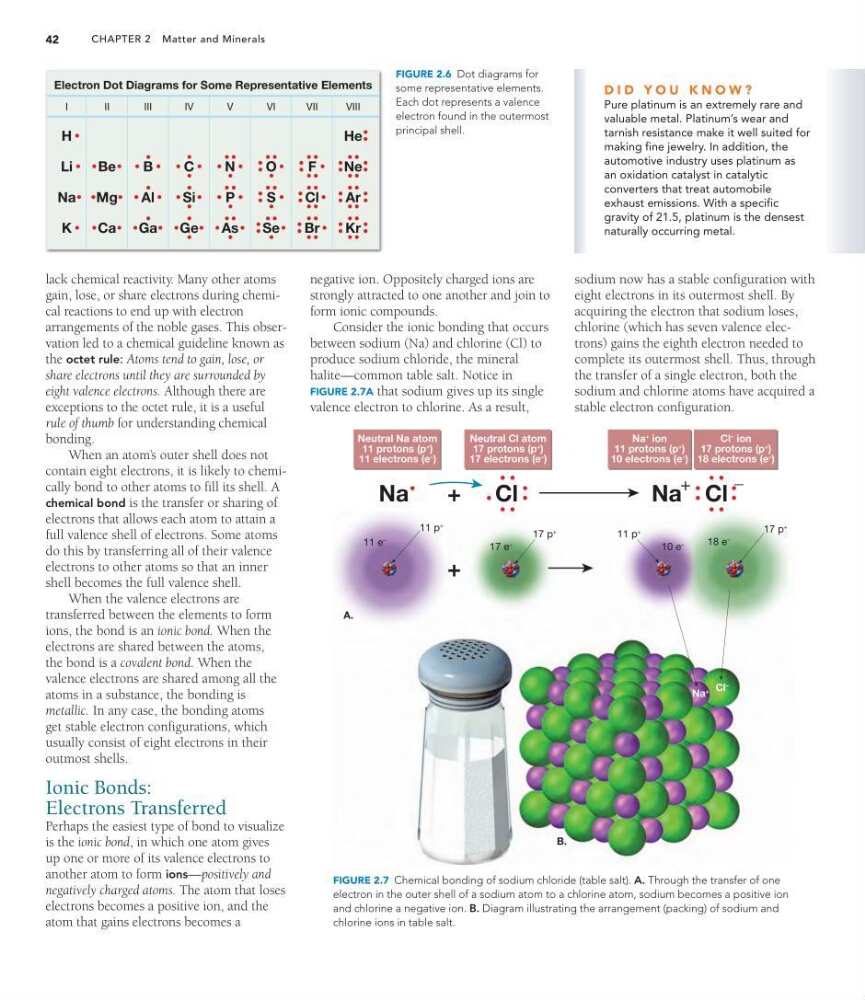
Consider the ionic bonding that occurs
between sodium (Na) and chlorine (Cl) to
produce sodium chloride, the mineral
halite—common table salt. Notice in
FIGURE 2.7A that sodium gives up its single
valence electron to chlorine. As a result,
sodium now has a stable configuration with
eight electrons in its outermost shell. By
acquiring the electron that sodium loses,
chlorine (which has seven valence electrons) gains the eighth electron needed to
complete its outermost shell. Thus, through
the transfer of a single electron, both the
sodium and chlorine atoms have acquired a
stable electron configuration.
CHAPTER 2 Matter and Minerals
42
11 p
+
11 e
–
17 e
–
10 e
–
18 e
–
17 p
+
17 p
+
11 p
+
Neutral Na atom
11 protons (p
+
)
11 electrons (e
– )
Neutral Cl atom
17 protons (p
+
)
17 electrons (e
– )
Na
+ ion
11 protons (p
+ )
10 electrons (e
–
)
Cl
– ion
17 protons (p
+
)
18 electrons (e
– )
+
+
Na
Cl
Cl
–
Na
+
Na
+ Cl
–
A.
B.
FIGURE 2.7 Chemical bonding of sodium chloride (table salt). A. Through the transfer of one
electron in the outer shell of a sodium atom to a chlorine atom, sodium becomes a positive ion
and chlorine a negative ion. B. Diagram illustrating the arrangement (packing) of sodium and
chlorine ions in table salt.
D I D Y O U K N O W ?
Pure platinum is an extremely rare and
valuable metal. Platinum’s wear and
tarnish resistance make it well suited for
making fine jewelry. In addition, the
automotive industry uses platinum as
an oxidation catalyst in catalytic
converters that treat automobile
exhaust emissions. With a specific
gravity of 21.5, platinum is the densest
naturally occurring metal.
VIII
He
Ne
Ar
Kr
VII
F
Cl
Br
VI
O
S
Se
V
N
P
As
IV
C
Si
Ge
III
B
Al
Ga
II
Be
Mg
Ca
I
H
Li
Na
K
FIGURE 2.6 Dot diagrams for
some representative elements.
Each dot represents a valence
electron found in the outermost
principal shell.
lack chemical reactivity. Many other atoms
gain, lose, or share electrons during chemical reactions to end up with electron
arrangements of the noble gases. This observation led to a chemical guideline known as
the octet rule: Atoms tend to gain, lose, or
share electrons until they are surrounded by
eight valence electrons. Although there are
exceptions to the octet rule, it is a useful
rule of thumb for understanding chemical
bonding.
When an atom’ s outer shell does not
contain eight electrons, it is likely to chemically bond to other atoms to fill its shell. A
chemical bond is the transfer or sharing of
electrons that allows each atom to attain a
full valence shell of electrons. Some atoms
do this by transferring all of their valence
electrons to other atoms so that an inner
shell becomes the full valence shell.
When the valence electrons are
transferred between the elements to form
ions, the bond is an ionic bond. When the
electrons are shared between the atoms,
the bond is a covalent bond. When the
valence electrons are shared among all the
atoms in a substance, the bonding is
metallic. In any case, the bonding atoms
get stable electron configurations, which
usually consist of eight electrons in their
outmost shells.
Ionic Bonds:
Electrons Transferred
Perhaps the easiest type of bond to visualize
is the ionic bond, in which one atom gives
up one or more of its valence electrons to
another atom to form ions—positively and
negatively charged atoms. The atom that loses
electrons becomes a positive ion, and the
atom that gains electrons becomes a
negative ion. Oppositely charged ions are
strongly attracted to one another and join to
form ionic compounds.
Consider the ionic bonding that occurs
between sodium (Na) and chlorine (Cl) to
produce sodium chloride, the mineral
halite—common table salt. Notice in
FIGURE 2.7A that sodium gives up its single
valence electron to chlorine. As a result,
sodium now has a stable configuration with
eight electrons in its outermost shell. By
acquiring the electron that sodium loses,
chlorine (which has seven valence electrons) gains the eighth electron needed to
complete its outermost shell. Thus, through
the transfer of a single electron, both the
sodium and chlorine atoms have acquired a
stable electron configuration.
CHAPTER 2 Matter and Minerals
42
11 p
+
11 e
–
17 e
–
10 e
–
18 e
–
17 p
+
17 p
+
11 p
+
Neutral Na atom
11 protons (p
+
)
11 electrons (e
– )
Neutral Cl atom
17 protons (p
+
)
17 electrons (e
– )
Na
+ ion
11 protons (p
+ )
10 electrons (e
–
)
Cl
– ion
17 protons (p
+
)
18 electrons (e
– )
+
+
Na
Cl
Cl
–
Na
+
Na
+ Cl
–
A.
B.
FIGURE 2.7 Chemical bonding of sodium chloride (table salt). A. Through the transfer of one
electron in the outer shell of a sodium atom to a chlorine atom, sodium becomes a positive ion
and chlorine a negative ion. B. Diagram illustrating the arrangement (packing) of sodium and
chlorine ions in table salt.
D I D Y O U K N O W ?
Pure platinum is an extremely rare and
valuable metal. Platinum’s wear and
tarnish resistance make it well suited for
making fine jewelry. In addition, the
automotive industry uses platinum as
an oxidation catalyst in catalytic
converters that treat automobile
exhaust emissions. With a specific
gravity of 21.5, platinum is the densest
naturally occurring metal.