

CHAPTER 20 Global Climate Change
520
Increasing Ocean Acidity
The human-induced increase in the
amount of carbon dioxide in the atmosphere has some serious implications for
ocean chemistry and marine life. Recent
studies show that about one third of the
human-generated carbon dioxide currently
ends up in the oceans. As a result, the
ocean’ s pH becomes lower, making seawater more acidic. The pH scale is briefly
described in FIGURE 20.37.
When atmospheric CO 2 dissolves in
seawater (H 2 O) it forms carbonic acid
(H 2 CO 3 ). This lowers the ocean’ s pH and
changes the balance of certain chemicals
found naturally in seawater. In fact, the
oceans have already absorbed enough carbon dioxide for surface waters to have
experienced a pH decrease of 0.1 pH units
since preindustrial times, with an additional pH decrease likely in the future.
Moreover, if the current trend in carbon
dioxide emissions continues, by the year
2100 the ocean will experience a pH
decrease of at least 0.2 pH units, which
represents a change in ocean chemistry that
has not occurred for millions of years. This
shift toward acidity and the changes in
ocean chemistry that result make it more
difficult for certain marine creatures to
build hard parts out of calcium carbonate.
The decline in pH thus threatens a variety
of calcite-secreting organisms as diverse as
microbes and corals, which concerns
marine scientists because of the potential
consequences for other sea life that depend
on the health and availability of these
organisms.
The Potential
for “Surprises”
In summary, you have seen that climate
in the 21st century, unlike the preceding
thousand years, is not expected to be
stable. Rather, a constant state of change is
very likely. Many of the changes will
probably be gradual environmental shifts,
imperceptible from year to year. Nevertheless, the effects, accumulated over decades,
will have powerful economic, social, and
political consequences.
Despite our best efforts to understand
future climate shifts, there is also the potential for “surprises.” This simply means that,
due to the complexity of Earth’ s climate
system, we might experience relatively
sudden, unexpected changes or see some
aspects of climate shift in an unexpected
manner. The report on Climate Change
Impacts on the United States describes the
situation like this:
Surprises challenge humans’ ability to adapt, because of
how quickly and unexpectedly they occur. For example,
what if the Pacific Ocean warms in such a way that El
Niño events become much more extreme? This could
reduce the frequency, but perhaps not the strength, of
hurricanes along the East Coast, while on the West Coast,
more severe winter storms, extreme precipitation events,
and damaging winds could become common. What if large
quantities of methane, a potent greenhouse gas currently
frozen in icy Arctic tundra and sediments, began to be
released to the atmosphere by warming, potentially
creating an amplifying “feedback loop” that would cause
even more warming? We simply do not know how far the
climate system or other systems it affects can be pushed
before they respond in unexpected ways.
There are many examples of potential surprises, each
of which would have large consequences. Most of these
potential outcomes are rarely reported, in this study or
elsewhere. Even if the chance of any particular surprise
happening is small, the chance that at least one such
surprise will occur is much greater. In other words, while
we can’t know which of these events will occur, it is likely
that one or more will eventually occur.*
The impact on climate of an increase in
atmospheric carbon dioxide and trace gases
is obscured by some uncertainties. Yet,
climate scientists continue to improve our
understanding of the climate system and
the potential impacts and effects of global
climate change. Policy makers are confronted with responding to the risks posed
*National Assessment Synthesis Team, Climate
Change Impacts on the United States: The Potential
Consequences of Climate Variability and Change.
Washington, D.C.: U.S. Global Research Program,
2000, 19.
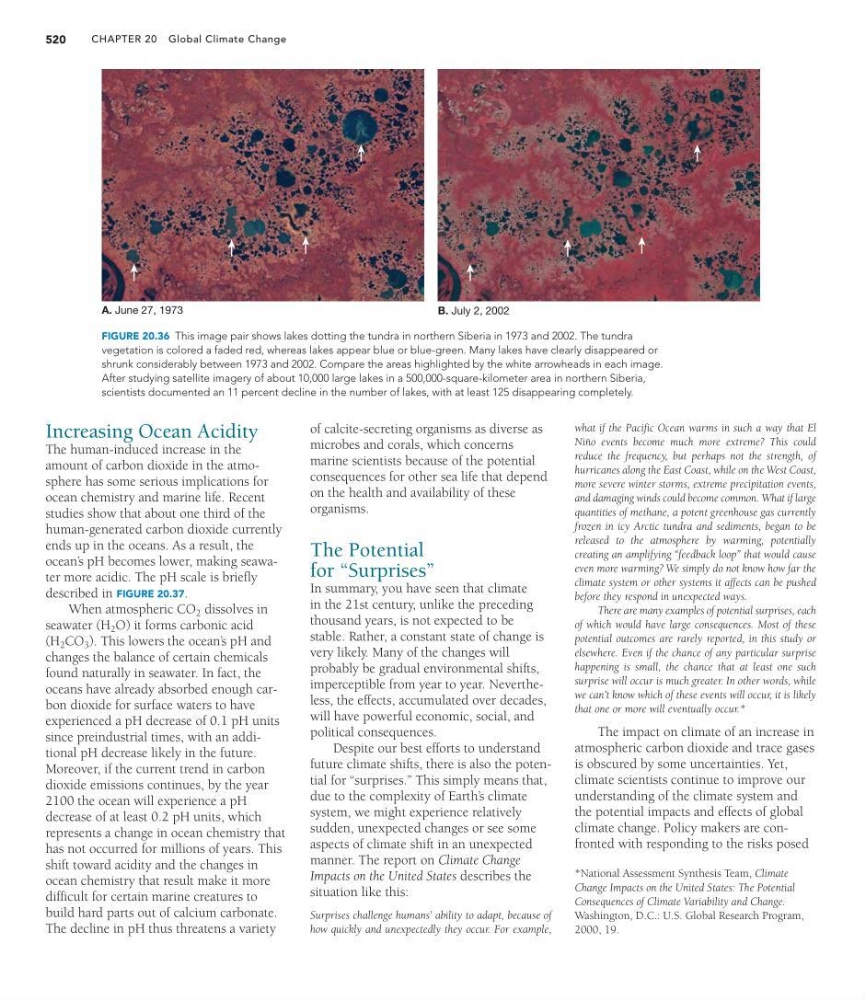
A. June 27, 1973
B. July 2, 2002
FIGURE 20.36 This image pair shows lakes dotting the tundra in northern Siberia in 1973 and 2002. The tundra
vegetation is colored a faded red, whereas lakes appear blue or blue-green. Many lakes have clearly disappeared or
shrunk considerably between 1973 and 2002. Compare the areas highlighted by the white arrowheads in each image.
After studying satellite imagery of about 10,000 large lakes in a 500,000-square-kilometer area in northern Siberia,
scientists documented an 11 percent decline in the number of lakes, with at least 125 disappearing completely.
520
Increasing Ocean Acidity
The human-induced increase in the
amount of carbon dioxide in the atmosphere has some serious implications for
ocean chemistry and marine life. Recent
studies show that about one third of the
human-generated carbon dioxide currently
ends up in the oceans. As a result, the
ocean’ s pH becomes lower, making seawater more acidic. The pH scale is briefly
described in FIGURE 20.37.
When atmospheric CO 2 dissolves in
seawater (H 2 O) it forms carbonic acid
(H 2 CO 3 ). This lowers the ocean’ s pH and
changes the balance of certain chemicals
found naturally in seawater. In fact, the
oceans have already absorbed enough carbon dioxide for surface waters to have
experienced a pH decrease of 0.1 pH units
since preindustrial times, with an additional pH decrease likely in the future.
Moreover, if the current trend in carbon
dioxide emissions continues, by the year
2100 the ocean will experience a pH
decrease of at least 0.2 pH units, which
represents a change in ocean chemistry that
has not occurred for millions of years. This
shift toward acidity and the changes in
ocean chemistry that result make it more
difficult for certain marine creatures to
build hard parts out of calcium carbonate.
The decline in pH thus threatens a variety
of calcite-secreting organisms as diverse as
microbes and corals, which concerns
marine scientists because of the potential
consequences for other sea life that depend
on the health and availability of these
organisms.
The Potential
for “Surprises”
In summary, you have seen that climate
in the 21st century, unlike the preceding
thousand years, is not expected to be
stable. Rather, a constant state of change is
very likely. Many of the changes will
probably be gradual environmental shifts,
imperceptible from year to year. Nevertheless, the effects, accumulated over decades,
will have powerful economic, social, and
political consequences.
Despite our best efforts to understand
future climate shifts, there is also the potential for “surprises.” This simply means that,
due to the complexity of Earth’ s climate
system, we might experience relatively
sudden, unexpected changes or see some
aspects of climate shift in an unexpected
manner. The report on Climate Change
Impacts on the United States describes the
situation like this:
Surprises challenge humans’ ability to adapt, because of
how quickly and unexpectedly they occur. For example,
what if the Pacific Ocean warms in such a way that El
Niño events become much more extreme? This could
reduce the frequency, but perhaps not the strength, of
hurricanes along the East Coast, while on the West Coast,
more severe winter storms, extreme precipitation events,
and damaging winds could become common. What if large
quantities of methane, a potent greenhouse gas currently
frozen in icy Arctic tundra and sediments, began to be
released to the atmosphere by warming, potentially
creating an amplifying “feedback loop” that would cause
even more warming? We simply do not know how far the
climate system or other systems it affects can be pushed
before they respond in unexpected ways.
There are many examples of potential surprises, each
of which would have large consequences. Most of these
potential outcomes are rarely reported, in this study or
elsewhere. Even if the chance of any particular surprise
happening is small, the chance that at least one such
surprise will occur is much greater. In other words, while
we can’t know which of these events will occur, it is likely
that one or more will eventually occur.*
The impact on climate of an increase in
atmospheric carbon dioxide and trace gases
is obscured by some uncertainties. Yet,
climate scientists continue to improve our
understanding of the climate system and
the potential impacts and effects of global
climate change. Policy makers are confronted with responding to the risks posed
*National Assessment Synthesis Team, Climate
Change Impacts on the United States: The Potential
Consequences of Climate Variability and Change.
Washington, D.C.: U.S. Global Research Program,
2000, 19.
A. June 27, 1973
B. July 2, 2002
FIGURE 20.36 This image pair shows lakes dotting the tundra in northern Siberia in 1973 and 2002. The tundra
vegetation is colored a faded red, whereas lakes appear blue or blue-green. Many lakes have clearly disappeared or
shrunk considerably between 1973 and 2002. Compare the areas highlighted by the white arrowheads in each image.
After studying satellite imagery of about 10,000 large lakes in a 500,000-square-kilometer area in northern Siberia,
scientists documented an 11 percent decline in the number of lakes, with at least 125 disappearing completely.