

CHAPTER 20 Global Climate Change
518
from the relatively small sea-level rise that allowed the storm’ s power to cross a much
greater land area.
As mentioned, a warmer climate will cause glaciers to melt. In fact, a portion of the 10to 25-centimeter (4- to 8-inch) rise in sea level over the past century is attributed to the
melting of mountain glaciers. This contribution is projected to continue through the 21st
century. Of course, if the Greenland and Antarctic ice sheets were to experience a significant
increase in melting, it would lead to a much greater rise in sea level and a major encroachment by the sea in coastal zones. Is this possible? In their 2007 report, the IPCC indicates
that such changes may occur over time scales of thousands of years. However, the report
goes on to say that a more rapid rise on century time scales cannot be excluded.*
The Changing Arctic
A recent study of climate change in the Arctic began with the following statement:
For nearly 30 years, Arctic sea ice extent and thickness have been falling dramatically. Permafrost temperatures are
rising and coverage is decreasing. Mountain glaciers and the Greenland ice sheet are shrinking. Evidence suggests we are
witnessing the early stage of an anthropogenically induced global warming superimposed on natural cycles, reinforced by
reductions in Arctic ice.**
ARCTIC SEA ICE. Climate models are in general agreement that one of the strongest signals of global warming should be a loss of sea ice in the Arctic. This is indeed occurring.
The map in FIGURE 20.35A compares the extent of sea ice at the end of the summer melting
period in September 2009 to the long-term average for the period 1979–2000. September
represents the end of the melt period when the area covered by sea ice is at a minimum. In
September 2009, sea ice was 24 percent below the long-term average—third lowest, after
A.
B.
Sho reli ne shif t
Sea level
rise
Original
shoreline
Sho reli ne shif t
Sea level
rise
Original
shoreline
C.
Where the slope is gentle
a small rise in sea level
causes a substantial shift
Where the slope is steep
the same sea level rise
causes a small shift
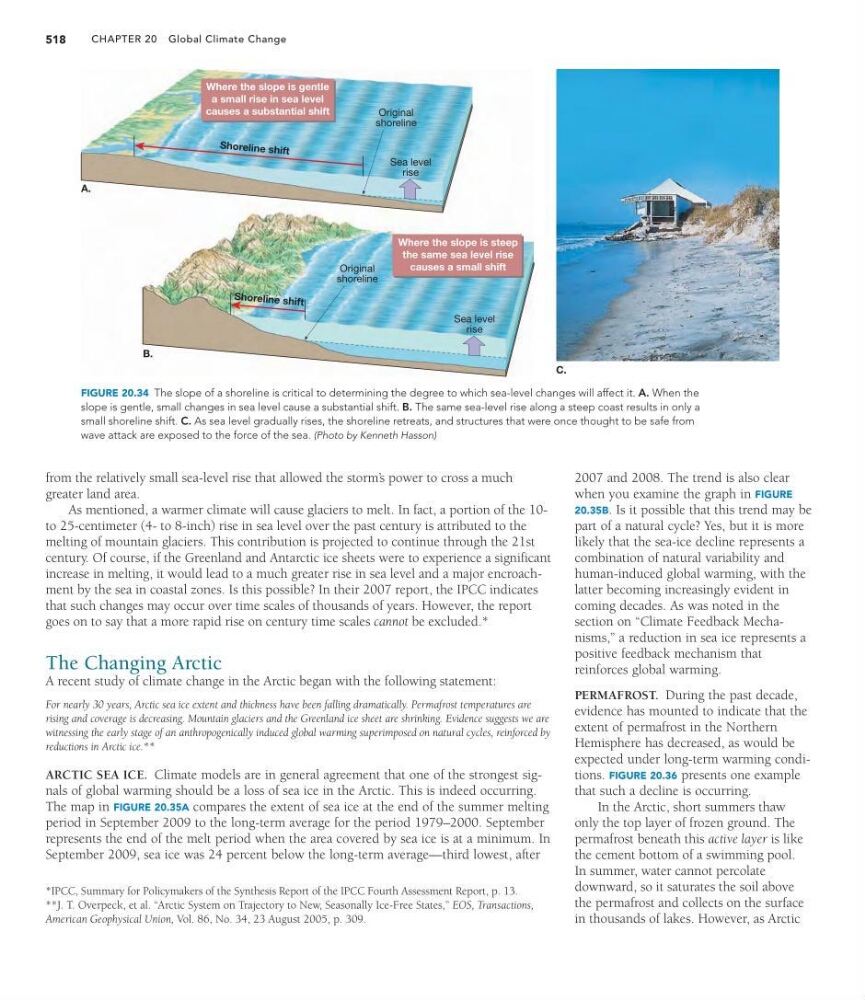
FIGURE 20.34 The slope of a shoreline is critical to determining the degree to which sea-level changes will affect it. A. When the
slope is gentle, small changes in sea level cause a substantial shift. B. The same sea-level rise along a steep coast results in only a
small shoreline shift. C. As sea level gradually rises, the shoreline retreats, and structures that were once thought to be safe from
wave attack are exposed to the force of the sea. (Photo by Kenneth Hasson)
*IPCC, Summary for Policymakers of the Synthesis Report of the IPCC Fourth Assessment Report, p. 13.
**J. T. Overpeck, et al. “Arctic System on Trajectory to New, Seasonally Ice-Free States,” EOS, Transactions,
American Geophysical Union, Vol. 86, No. 34, 23 August 2005, p. 309.
2007 and 2008. The trend is also clear
when you examine the graph in FIGURE
20.35B. Is it possible that this trend may be
part of a natural cycle? Yes, but it is more
likely that the sea-ice decline represents a
combination of natural variability and
human-induced global warming, with the
latter becoming increasingly evident in
coming decades. As was noted in the
section on “Climate Feedback Mechanisms,” a reduction in sea ice represents a
positive feedback mechanism that
reinforces global warming.
PERMAFROST. During the past decade,
evidence has mounted to indicate that the
extent of permafrost in the Northern
Hemisphere has decreased, as would be
expected under long-term warming conditions. FIGURE 20.36 presents one example
that such a decline is occurring.
In the Arctic, short summers thaw
only the top layer of frozen ground. The
permafrost beneath this active layer is like
the cement bottom of a swimming pool.
In summer, water cannot percolate
downward, so it saturates the soil above
the permafrost and collects on the surface
in thousands of lakes. However, as Arctic
518
from the relatively small sea-level rise that allowed the storm’ s power to cross a much
greater land area.
As mentioned, a warmer climate will cause glaciers to melt. In fact, a portion of the 10to 25-centimeter (4- to 8-inch) rise in sea level over the past century is attributed to the
melting of mountain glaciers. This contribution is projected to continue through the 21st
century. Of course, if the Greenland and Antarctic ice sheets were to experience a significant
increase in melting, it would lead to a much greater rise in sea level and a major encroachment by the sea in coastal zones. Is this possible? In their 2007 report, the IPCC indicates
that such changes may occur over time scales of thousands of years. However, the report
goes on to say that a more rapid rise on century time scales cannot be excluded.*
The Changing Arctic
A recent study of climate change in the Arctic began with the following statement:
For nearly 30 years, Arctic sea ice extent and thickness have been falling dramatically. Permafrost temperatures are
rising and coverage is decreasing. Mountain glaciers and the Greenland ice sheet are shrinking. Evidence suggests we are
witnessing the early stage of an anthropogenically induced global warming superimposed on natural cycles, reinforced by
reductions in Arctic ice.**
ARCTIC SEA ICE. Climate models are in general agreement that one of the strongest signals of global warming should be a loss of sea ice in the Arctic. This is indeed occurring.
The map in FIGURE 20.35A compares the extent of sea ice at the end of the summer melting
period in September 2009 to the long-term average for the period 1979–2000. September
represents the end of the melt period when the area covered by sea ice is at a minimum. In
September 2009, sea ice was 24 percent below the long-term average—third lowest, after
A.
B.
Sho reli ne shif t
Sea level
rise
Original
shoreline
Sho reli ne shif t
Sea level
rise
Original
shoreline
C.
Where the slope is gentle
a small rise in sea level
causes a substantial shift
Where the slope is steep
the same sea level rise
causes a small shift
FIGURE 20.34 The slope of a shoreline is critical to determining the degree to which sea-level changes will affect it. A. When the
slope is gentle, small changes in sea level cause a substantial shift. B. The same sea-level rise along a steep coast results in only a
small shoreline shift. C. As sea level gradually rises, the shoreline retreats, and structures that were once thought to be safe from
wave attack are exposed to the force of the sea. (Photo by Kenneth Hasson)
*IPCC, Summary for Policymakers of the Synthesis Report of the IPCC Fourth Assessment Report, p. 13.
**J. T. Overpeck, et al. “Arctic System on Trajectory to New, Seasonally Ice-Free States,” EOS, Transactions,
American Geophysical Union, Vol. 86, No. 34, 23 August 2005, p. 309.
2007 and 2008. The trend is also clear
when you examine the graph in FIGURE
20.35B. Is it possible that this trend may be
part of a natural cycle? Yes, but it is more
likely that the sea-ice decline represents a
combination of natural variability and
human-induced global warming, with the
latter becoming increasingly evident in
coming decades. As was noted in the
section on “Climate Feedback Mechanisms,” a reduction in sea ice represents a
positive feedback mechanism that
reinforces global warming.
PERMAFROST. During the past decade,
evidence has mounted to indicate that the
extent of permafrost in the Northern
Hemisphere has decreased, as would be
expected under long-term warming conditions. FIGURE 20.36 presents one example
that such a decline is occurring.
In the Arctic, short summers thaw
only the top layer of frozen ground. The
permafrost beneath this active layer is like
the cement bottom of a swimming pool.
In summer, water cannot percolate
downward, so it saturates the soil above
the permafrost and collects on the surface
in thousands of lakes. However, as Arctic