

517
Some Possible Consequences of Global Warming
*For more about the behavior of glaciers, see the
sections on “Glaciers in Retreat” and “Greenland’ s
Glacial Budget” in Chapter 11.
**The Rising Sea by Orrin H. Pilkey and Rob
Young (Island Press, 2009) is a highly readable
and up-to-date perspective on the impact of sea
level rise on the coastal environment by two
prominent scientists.
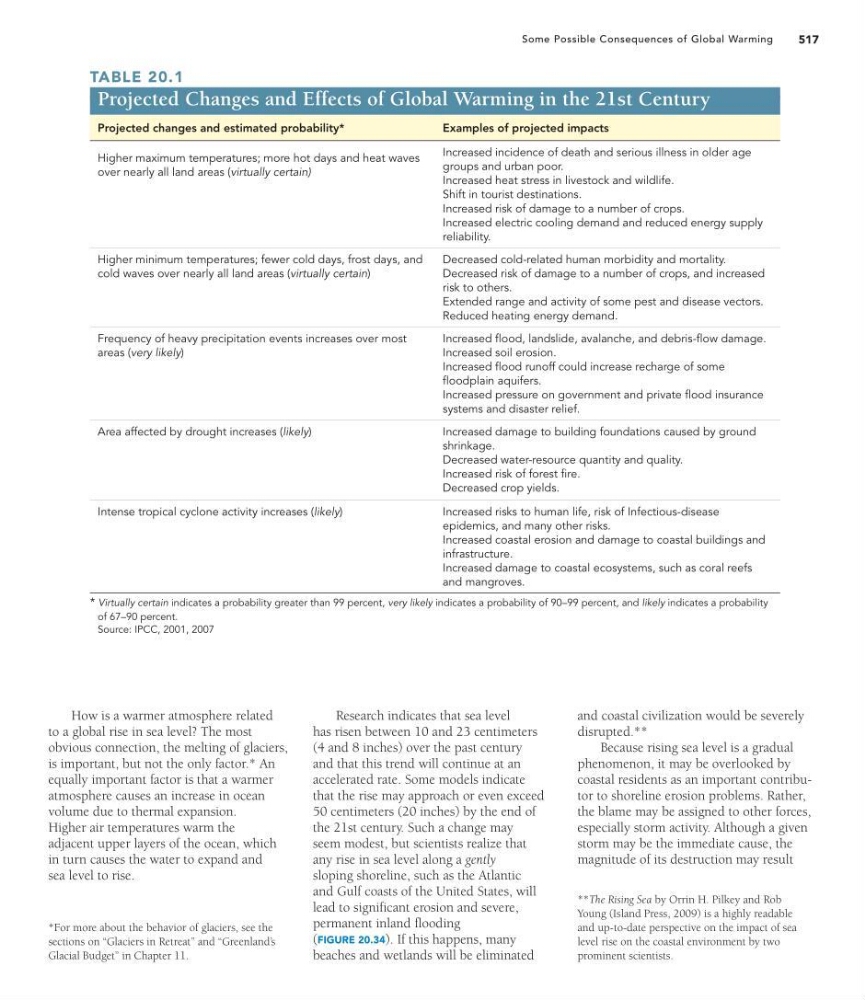
TABLE 20.1
Projected Changes and Effects of Global Warming in the 21st Century
Projected changes and estimated probability*
Examples of projected impacts
Higher maximum temperatures; more hot days and heat waves
over nearly all land areas (virtually certain)
Increased incidence of death and serious illness in older age
groups and urban poor.
Increased heat stress in livestock and wildlife.
Shift in tourist destinations.
Increased risk of damage to a number of crops.
Increased electric cooling demand and reduced energy supply
reliability.
Higher minimum temperatures; fewer cold days, frost days, and
cold waves over nearly all land areas (virtually certain)
Decreased cold-related human morbidity and mortality.
Decreased risk of damage to a number of crops, and increased
risk to others.
Extended range and activity of some pest and disease vectors.
Reduced heating energy demand.
Frequency of heavy precipitation events increases over most
areas (very likely)
Increased flood, landslide, avalanche, and debris-flow damage.
Increased soil erosion.
Increased flood runoff could increase recharge of some
floodplain aquifers.
Increased pressure on government and private flood insurance
systems and disaster relief.
Area affected by drought increases (likely)
Increased damage to building foundations caused by ground
shrinkage.
Decreased water-resource quantity and quality.
Increased risk of forest fire.
Decreased crop yields.
Intense tropical cyclone activity increases (likely)
Increased risks to human life, risk of Infectious-disease
epidemics, and many other risks.
Increased coastal erosion and damage to coastal buildings and
infrastructure.
Increased damage to coastal ecosystems, such as coral reefs
and mangroves.
* Virtually certain indicates a probability greater than 99 percent, very likely indicates a probability of 90–99 percent, and likely indicates a probability
of 67–90 percent.
Source: IPCC, 2001, 2007
How is a warmer atmosphere related
to a global rise in sea level? The most
obvious connection, the melting of glaciers,
is important, but not the only factor.* An
equally important factor is that a warmer
atmosphere causes an increase in ocean
volume due to thermal expansion.
Higher air temperatures warm the
adjacent upper layers of the ocean, which
in turn causes the water to expand and
sea level to rise.
Research indicates that sea level
has risen between 10 and 23 centimeters
(4 and 8 inches) over the past century
and that this trend will continue at an
accelerated rate. Some models indicate
that the rise may approach or even exceed
50 centimeters (20 inches) by the end of
the 21st century. Such a change may
seem modest, but scientists realize that
any rise in sea level along a gently
sloping shoreline, such as the Atlantic
and Gulf coasts of the United States, will
lead to significant erosion and severe,
permanent inland flooding
(FIGURE 20.34). If this happens, many
beaches and wetlands will be eliminated
and coastal civilization would be severely
disrupted.**
Because rising sea level is a gradual
phenomenon, it may be overlooked by
coastal residents as an important contributor to shoreline erosion problems. Rather,
the blame may be assigned to other forces,
especially storm activity. Although a given
storm may be the immediate cause, the
magnitude of its destruction may result
Some Possible Consequences of Global Warming
*For more about the behavior of glaciers, see the
sections on “Glaciers in Retreat” and “Greenland’ s
Glacial Budget” in Chapter 11.
**The Rising Sea by Orrin H. Pilkey and Rob
Young (Island Press, 2009) is a highly readable
and up-to-date perspective on the impact of sea
level rise on the coastal environment by two
prominent scientists.
TABLE 20.1
Projected Changes and Effects of Global Warming in the 21st Century
Projected changes and estimated probability*
Examples of projected impacts
Higher maximum temperatures; more hot days and heat waves
over nearly all land areas (virtually certain)
Increased incidence of death and serious illness in older age
groups and urban poor.
Increased heat stress in livestock and wildlife.
Shift in tourist destinations.
Increased risk of damage to a number of crops.
Increased electric cooling demand and reduced energy supply
reliability.
Higher minimum temperatures; fewer cold days, frost days, and
cold waves over nearly all land areas (virtually certain)
Decreased cold-related human morbidity and mortality.
Decreased risk of damage to a number of crops, and increased
risk to others.
Extended range and activity of some pest and disease vectors.
Reduced heating energy demand.
Frequency of heavy precipitation events increases over most
areas (very likely)
Increased flood, landslide, avalanche, and debris-flow damage.
Increased soil erosion.
Increased flood runoff could increase recharge of some
floodplain aquifers.
Increased pressure on government and private flood insurance
systems and disaster relief.
Area affected by drought increases (likely)
Increased damage to building foundations caused by ground
shrinkage.
Decreased water-resource quantity and quality.
Increased risk of forest fire.
Decreased crop yields.
Intense tropical cyclone activity increases (likely)
Increased risks to human life, risk of Infectious-disease
epidemics, and many other risks.
Increased coastal erosion and damage to coastal buildings and
infrastructure.
Increased damage to coastal ecosystems, such as coral reefs
and mangroves.
* Virtually certain indicates a probability greater than 99 percent, very likely indicates a probability of 90–99 percent, and likely indicates a probability
of 67–90 percent.
Source: IPCC, 2001, 2007
How is a warmer atmosphere related
to a global rise in sea level? The most
obvious connection, the melting of glaciers,
is important, but not the only factor.* An
equally important factor is that a warmer
atmosphere causes an increase in ocean
volume due to thermal expansion.
Higher air temperatures warm the
adjacent upper layers of the ocean, which
in turn causes the water to expand and
sea level to rise.
Research indicates that sea level
has risen between 10 and 23 centimeters
(4 and 8 inches) over the past century
and that this trend will continue at an
accelerated rate. Some models indicate
that the rise may approach or even exceed
50 centimeters (20 inches) by the end of
the 21st century. Such a change may
seem modest, but scientists realize that
any rise in sea level along a gently
sloping shoreline, such as the Atlantic
and Gulf coasts of the United States, will
lead to significant erosion and severe,
permanent inland flooding
(FIGURE 20.34). If this happens, many
beaches and wetlands will be eliminated
and coastal civilization would be severely
disrupted.**
Because rising sea level is a gradual
phenomenon, it may be overlooked by
coastal residents as an important contributor to shoreline erosion problems. Rather,
the blame may be assigned to other forces,
especially storm activity. Although a given
storm may be the immediate cause, the
magnitude of its destruction may result